Back
NEET PG Subject Wise Weightage 2026: Complete Subject-by-Subject Breakdown, Marks Distribution and Topper Strategy
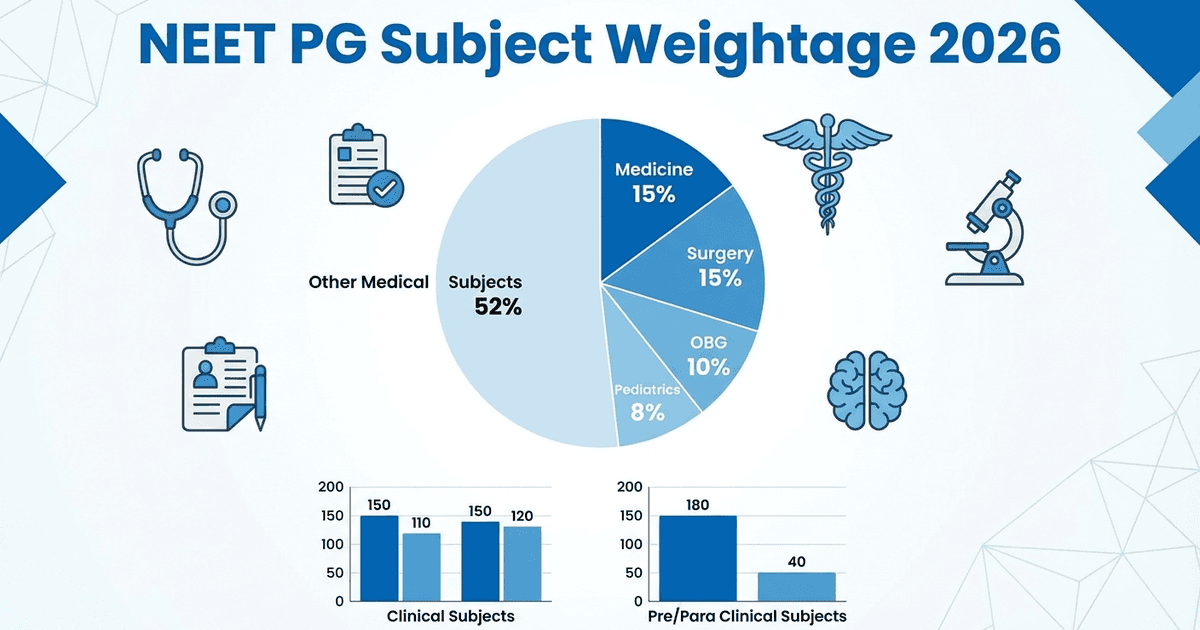
Complete NEET PG 2026 subject weightage breakdown: Medicine 15%, Surgery 15%, OBG 10%. Data-driven analysis showing which subjects deserve 70% of your study time for maximum score optimization.
NEET PG Subject Wise Weightage 2026: Complete Subject-by-Subject Breakdown, Marks Distribution and Topper Strategy
You are probably staring at 19 NEET PG subjects wondering where to start. NEET PG has 200 questions spread across everything from Anatomy to Surgery. You have exactly 3.5 hours. That gives you 63 seconds per question.
Here's what separates toppers from the rest: they dont treat all subjects equally. Medicine and Surgery together make up 30% of your paper. That's 60 questions. Get these right, and you've secured a solid foundation for AIR under 1000.
This breakdown shows you exactly where NEET PG 2026 questions come from, which subjects deserve 70% of your study time, and how to build a personalised prep strategy around actual weightage data.
NEET PG 2026 Exam Pattern Overview
NEET PG 2026 follows the same computer-based format that's tested over 2 lakh candidates annually. Here's what you're walking into:
Total Questions: 200 multiple-choice questions
Total Marks: 800 marks (4 marks per correct answer)
Duration: 3 hours 30 minutes
Negative Marking: -1 mark for incorrect answers
Mode: Computer-based test (CBT)
Parts: Divided into Part A, Part B, and Part C covering all clinical and pre-clinical subjects
The scoring system is straightforward: correct answers fetch 4 marks, wrong answers lose 1 mark, and unattempted questions carry no penalty. With this -0.25 ratio, you can afford to guess intelligently when you've eliminated 2-3 options.
NEET PG Subject Wise Question Distribution 2026
Based on analysis of the last 5 years of NEET PG papers, here's the exact subject-wise breakdown you should expect:
Subject | Questions | Percentage | Marks | Priority Level |
|---|---|---|---|---|
General Medicine (including Dermatology & Psychiatry) | 30-32 | 15.5% | 120-128 | Very High |
General Surgery (including Anaesthesia) | 28-30 | 14.5% | 112-120 | Very High |
Obstetrics & Gynaecology | 20-22 | 10.5% | 80-88 | High |
Pathology | 18-20 | 9.5% | 72-80 | High |
Social & Preventive Medicine | 16-18 | 8.5% | 64-72 | High |
Paediatrics | 15-17 | 8% | 60-68 | Medium |
Pharmacology | 14-16 | 7.5% | 56-64 | Medium |
Microbiology | 14-16 | 7.5% | 56-64 | Medium |
Orthopaedics | 12-14 | 6.5% | 48-56 | Medium |
Radiology | 10-12 | 5.5% | 40-48 | Medium |
Anatomy | 8-10 | 4.5% | 32-40 | Low |
Physiology | 8-10 | 4.5% | 32-40 | Low |
ENT | 8-10 | 4.5% | 32-40 | Low |
Ophthalmology | 8-10 | 4.5% | 32-40 | Low |
Biochemistry | 6-8 | 3.5% | 24-32 | Low |
Forensic Medicine & Toxicology | 4-6 | 2.5% | 16-24 | Low |
High-Yield Subjects: The 70% Rule Breakdown
The data reveals a clear pattern: Medicine + Surgery = 30% of your paper. Add OBG, Pathology, and SPM, and you're looking at 53% of all questions coming from just 5 subjects.
Tier 1: Must-Master Subjects (70% of study time)
Medicine (30-32 questions): Cardiology, respiratory medicine, infectious diseases, and neurology dominate. Clinical scenarios with investigations form 60% of Medicine questions. Oncourse tracks your Medicine accuracy across subspecialties, so you can see exactly whether you're weak in cardiology MCQs versus infectious disease cases and redirect study hours accordingly. Surgery (28-30 questions): GI surgery, trauma, and surgical anatomy are highest yield. Expect 40% image-based questions showing surgical anatomy, X-rays, and operative findings. OBG (20-22 questions): Labor complications, menstrual disorders, and gynaecological malignancies. High-yield because questions are often straightforward once you know the protocols.
Tier 2: Important Subjects (20% of study time)
Pathology (18-20 questions): Mix of systemic pathology and image-based histopathology slides. SPM (16-18 questions): National health programs, epidemiology, and biostatistics. Easy scoring if you memorise the latest government schemes. Paediatrics (15-17 questions): Growth charts, vaccination schedules, and neonatal emergencies.
Tier 3: Quick Revision Subjects (10% of study time)
Everything else. These subjects can make the difference between AIR 500 and AIR 1500, but only after you've mastered the high-yield subjects.
The 70-20-10 Topper Strategy
Every NEET PG topper follows some version of this time allocation:
70% of study time → High-yield subjects (Medicine, Surgery, OBG, Pathology, SPM) 20% of study time → Medium-yield subjects (Paediatrics, Pharmacology, Microbiology, Orthopaedics) 10% of study time → Low-yield subjects for surprise questions
This isn't about ignoring small subjects. It's about sequence. Master Medicine before you touch Biochemistry. Get Surgery concepts solid before you worry about ENT images.
Here's how this looks in practice: if you study 8 hours daily, spend 5.5 hours on Tier 1 subjects, 1.5 hours on Tier 2, and 1 hour skimming through Tier 3 subjects. The adaptive question bank lets you filter practice sessions to drill only high-yield subjects like Medicine and Surgery, or simulate entire papers weighted by actual 2026 distribution.
Subject-Specific Preparation Strategies
Medicine (30-32 Questions) - 15.5% Weightage
Medicine questions follow predictable patterns:
Cardiology: ECG interpretation, heart failure management, arrhythmias (8-10 questions)
Respiratory: COPD, pneumonia, pleural diseases (6-8 questions)
Gastroenterology: Chronic liver disease, inflammatory bowel disease (4-6 questions)
Neurology: Stroke, seizures, movement disorders (4-6 questions)
Infectious diseases: Antimicrobial therapy, tropical diseases (4-6 questions)
Study approach: Focus on clinical scenarios with investigations. Practice interpreting ECGs, chest X-rays, and lab values in context.
Surgery (28-30 Questions) - 14.5% Weightage
Surgery emphasises practical knowledge:
GI Surgery: Acute abdomen, hernias, malignancies (10-12 questions)
Trauma: Head injury, chest trauma, orthopaedic trauma (6-8 questions)
Urology: Kidney stones, prostate disease (4-6 questions)
Surgical anatomy: Applied anatomy for OSCE-style questions (4-6 questions)
Study approach: Heavy on images and clinical scenarios. Know your surgical anatomy cold.
OBG (20-22 Questions) - 10.5% Weightage
OBG questions are often protocol-based:
Obstetrics: High-risk pregnancy, labor complications (12-14 questions)
Gynaecology: Menstrual disorders, malignancies, contraception (8-10 questions)
Study approach: Memorise protocols and guidelines. These questions have definitive right answers.
Building Your Personalised 6-Month Study Plan
Months 1-2: Foundation Building
Focus exclusively on Tier 1 subjects. Complete Medicine and Surgery thoroughly before touching anything else. Use spaced repetition to cycle through high-yield topics - after identifying subject gaps, Oncourse's scheduler automatically resurfaces Medicine and Surgery topics at optimal intervals based on forgetting curve science, so high-weightage subjects never go cold even as you progress.
Months 3-4: Tier 2 Integration
Add Pathology, SPM, and Paediatrics while maintaining Medicine/Surgery revision cycles.
Months 5-6: Complete Integration + Mock Analysis
Add remaining subjects while ramping up full-length mock tests. Focus mock analysis on high-yield subject weaknesses.
Common Strategic Mistakes to Avoid
Mistake 1: Spending equal time on all subjects Reality check: An extra 10 questions right in Medicine (30+ questions) beats perfecting Biochemistry (6-8 questions). Mistake 2: Perfecting low-yield subjects first Reality check: You cant compensate for weak Medicine with perfect ENT knowledge. Mistake 3: Ignoring negative marking in high-yield subjects Reality check: A wrong answer in Medicine costs the same -1 as a wrong answer in Biochemistry, but Medicine questions are more frequent. Mistake 4: Not tracking subject-wise accuracy Reality check: You might think you're strong in Surgery but weak in specific subspecialties like trauma or GI surgery.
Mock Test Analysis Using Weightage Data
When analyzing mocks, prioritize mistakes by subject weightage:
1. Critical errors: Wrong answers in Medicine, Surgery, OBG (fix immediately)
2. Important errors: Wrong answers in Pathology, SPM, Paediatrics (fix within 2 days)
3. Minor errors: Wrong answers in low-yield subjects (review during weekend revision)
Track your accuracy in each Tier 1 subject. If Medicine accuracy drops below 70%, stop studying new topics and drill Medicine until it's consistently above 75%.
Revision Strategy for Different Preparation Phases
6+ Months Left: Deep Learning Phase
Complete Tier 1 subjects with 3-4 revisions each
Build strong conceptual foundation
Focus on understanding over memorization
3-6 Months Left: Integration Phase
Complete all subjects with 2-3 revisions
Start mixing subjects in study sessions
Ramp up mock test frequency
Final Month: Retention Phase
Daily revision of high-yield topics from all Tier 1 subjects
Quick refreshers for Tier 2 and 3 subjects
Focus on maintaining accuracy rather than learning new concepts
Frequently Asked Questions
Which subjects should I prioritize if I have only 3 months for NEET PG preparation?
Focus 80% of time on Medicine, Surgery, and OBG. These three subjects alone give you 65-70 questions. Add quick revision of Pathology and SPM for another 35 questions. This covers 100+ questions out of 200 - enough for a decent rank with good accuracy.
How many questions should I expect from Anatomy in NEET PG 2026?
Anatomy typically has 8-10 questions (4-5% weightage). Focus on applied anatomy, cross-sectional anatomy, and anatomy related to Surgery and Medicine rather than pure descriptive anatomy.
Is it worth studying low-weightage subjects like Biochemistry and FMT?
Yes, but only after mastering high-yield subjects. These subjects often have straightforward factual questions that can be quick wins. Allocate 1-2 weeks for each during final preparation phase.
How accurate are these weightage predictions for NEET PG 2026?
These predictions are based on 5-year analysis of NEET PG papers. While exact numbers may vary by ±2 questions per subject, the relative weightage patterns remain consistent. Medicine and Surgery consistently form 28-30% of papers.
Should I skip any subjects completely for NEET PG?
Never skip subjects completely. Even low-weightage subjects like FMT and Biochemistry can provide 6-8 easy marks. However, dont spend more than 3-5% of total study time on subjects with <3% weightage.
How do I balance clinical and non-clinical subjects based on weightage?
Clinical subjects (Medicine, Surgery, OBG, Paediatrics, Pathology) form ~65% of the paper. Non-clinical subjects (Anatomy, Physiology, Biochemistry, Pharmacology, Microbiology, SPM, FMT) form ~35%. Allocate study time accordingly: 65% clinical, 35% non-clinical.
---
Prepare smarter with Oncourse AI — adaptive MCQs, spaced repetition, and AI explanations built for NEET PG. Download free on Android and iOS.