How Oncourse Synapses Works: AI-Powered Spaced Repetition Flashcards for USMLE (2026)
Discover how Oncourse Synapses transforms USMLE prep through daily word-grouping games that build associative memory and pattern recognition faster than traditional flashcards.
How Oncourse Synapses Works: AI-Powered Spaced Repetition Flashcards for USMLE (2026)
You know that moment during USMLE Step 1 when you see four answer choices and think "these all sound reasonable"? The difference between 220 and 260 isnt more facts—its faster pattern recognition. Your brain needs to instantly group "Digoxin, Amiodarone, Sotalol, Dofetilide" as QT-prolonging drugs, not process them one by one.
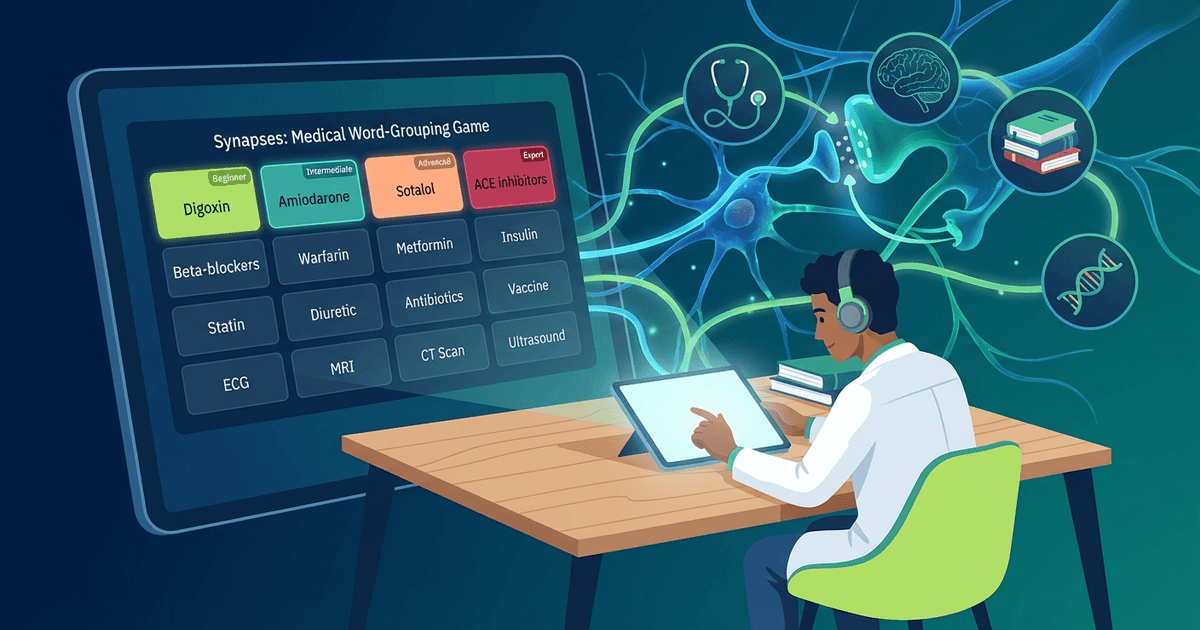
This is exactly what Oncourse Synapses trains. Unlike traditional flashcards that test isolated facts, Synapses is a daily medical word-grouping game that builds associative memory through active concept clustering. You get 16 medical terms and must group them into 4 sets of 4 that share clinical themes.
The result? When you see "hyperkalemia" on Step 1, your brain instantly recalls its cluster: ACE inhibitors, spironolactone, NSAIDs, and chronic kidney disease. Not as separate facts, but as one interconnected web.
What Makes Synapses Different from Regular Flashcards
Traditional spaced repetition apps like Anki show you individual cards: "What drug causes Stevens-Johnson syndrome?" → "Carbamazepine." One fact, one answer, move on.
Synapses flips this completely. Instead of testing whether you know carbamazepine causes SJS, it tests whether you can group carbamazepine with phenytoin, allopurinol, and lamotrigine as "drugs causing SJS." This grouping mirrors exactly how USMLE questions work—they dont ask you to recall isolated facts, they ask you to recognize patterns among options.
Research from Emory University School of Medicine shows that spaced repetition significantly improves knowledge retention in medical education. But Synapses goes beyond simple repetition by adding conceptual association, which creates stronger memory networks than isolated fact rehearsal.
The Science Behind Word-Grouping Games
When you group medical terms by shared characteristics, youre building what cognitive scientists call "associative memory networks." Each time you correctly identify that warfarin, heparin, dabigatran, and rivaroxaban belong together as anticoagulants, your brain strengthens the connections between these concepts.
This matters for USMLE because exam questions test lateral thinking. A Step 1 vignette might describe a patient with atrial fibrillation, then ask about stroke prevention. Your brain needs to instantly jump from "atrial fibrillation" → "stroke risk" → "anticoagulation" → "compare options." Students who practice this associative jumping score higher than those who memorize individual drug facts.
The game mechanics reinforce this through difficulty-graded challenges. Green groups (difficulty 1) might cluster obvious associations like "beta-blockers ending in -olol." Red groups (difficulty 4) require nuanced clinical thinking—grouping drugs by shared side effects or mechanisms that arent immediately obvious.
How to Play Synapses: Step-by-Step
Getting Started
Each day, Oncourse generates a fresh Synapses puzzle with 16 medical terms displayed in a 4x4 grid. Your goal: identify 4 groups of 4 terms that share a common clinical theme. You start with 4 lifelines—each wrong guess costs one lifeline.
The terms span all USMLE-relevant domains: pharmacology, pathology, microbiology, physiology, and clinical medicine. One day you might see drug names, the next day symptoms, the following day lab values.
The Color-Coded Difficulty System
Groups are color-coded by difficulty:
Green (Difficulty 1): Most obvious connections—drugs in the same class, symptoms of the same condition
Teal (Difficulty 2): Requires basic clinical knowledge—drugs sharing a mechanism or side effect
Orange (Difficulty 3): Advanced associations—conditions sharing a pathophysiology or treatment approach
Red (Difficulty 4): Expert-level groupings—subtle connections that require deep clinical reasoning
This progression matches USMLE difficulty curves. Early questions test straightforward recall, while later questions demand complex pattern recognition.
Strategy for Success
Start with the most obvious group—usually the green one. If you see four beta-blockers or four antibiotics, lock that in first. This gives you confidence and narrows the remaining options.
For tougher groups, think categorically:
Mechanism: Do these drugs work the same way?
Side effects: Do they share a common adverse reaction?
Clinical use: Are they all first-line for the same condition?
Pathophysiology: Do these conditions have the same underlying process?
When you complete the puzzle, you can instantly save all four groups to your Smart Notes—turning your game results into structured revision material.
Synapses vs Traditional Flashcard Methods
Speed of Recognition
Traditional flashcards train sequential processing: see term → recall definition → move on. Synapses trains parallel processing: see multiple terms → identify patterns → group by relationships.
This parallel processing is exactly what USMLE demands. When you see a question with four drug options, you dont evaluate each drug individually—you scan for patterns, eliminate groups, and identify the outlier.
Memory Persistence
Isolated facts fade without reinforcement. Associated concepts persist because theyre embedded in networks. When you forget one element of a Synapses group, the other three help you reconstruct it.
Students using traditional flashcards often report "knowing the fact but not seeing it in context." Synapses eliminates this by always presenting terms in relationship to others.
Clinical Relevance
Real medicine is pattern recognition. You dont diagnose myocardial infarction by remembering "chest pain = heart attack." You diagnose it by recognizing the constellation: chest pain + EKG changes + cardiac enzymes + patient risk factors.
Playing Synapses daily develops this constellation thinking. Instead of memorizing that "amiodarone causes pulmonary fibrosis," you learn to group amiodarone with bleomycin, methotrexate, and nitrofurantoin as "drugs causing pulmonary fibrosis." This grouping helps you both recognize the side effect and consider alternatives.
Integrating Synapses into Your USMLE Study Schedule
Daily Routine Integration
Synapses works best as a daily 5-10 minute ritual. Most students play it during study breaks or while commuting. The game takes 3-7 minutes to complete, depending on difficulty and your recognition speed.
The streak system encourages daily engagement—each completed game maintains your Oncourse streak, creating a habit loop that reinforces consistent study behavior.
Pairing with Other Study Methods
Synapses complements rather than replaces traditional study methods:
After reading First Aid: Play Synapses to test whether you can group the facts youve just learned
Before practice questions: Use it as a warm-up to activate pattern recognition thinking
During spaced reviews: Save your completed games to Smart Notes and review these concept clusters during spaced repetition sessions
The games work particularly well alongside UWorld practice. After missing a question because you didnt recognize a pattern, search for that pattern in future Synapses games.
Progress Tracking and Analytics
The daily leaderboard shows your ranking based on groups solved and completion time. Top performers typically complete all four groups in under 3 minutes—a benchmark that correlates with strong pattern recognition skills.
Your saved games in Smart Notes become a personal database of medical concept clusters. Over weeks and months, this database reveals your pattern recognition strengths and blind spots.
Advanced Synapses Strategies for High Scorers
Think Like the Test Maker
USMLE writers group distractors strategically. Three options might seem reasonable, but only one is correct. Synapses trains this exact thinking by presenting 16 terms where multiple groupings seem possible—you must identify the four correct ones.
Advanced players learn to think like puzzle creators. What would make this grouping challenging? What subtle connection am I missing? This meta-cognitive approach improves both game performance and exam reasoning.
Pattern Recognition Speed
Time pressure in Synapses mirrors USMLE conditions. You have roughly 1.5 minutes per USMLE question—similar to the 3-5 minutes most students take to complete Synapses.
Build speed by recognizing common patterns:
Drug suffixes (-pril, -sartan, -statin, -azole)
Disease classifications (autoimmune, infectious, neoplastic)
Anatomical relationships (muscles, nerves, arteries of a region)
Clinical presentations (causes of chest pain, shortness of breath, etc.)
Leveraging Mistakes
Wrong answers in Synapses are learning opportunities. When you incorrectly group terms, the game reveals the correct associations. These "mistake moments" create stronger memories than correct first attempts.
Keep a mental note of your errors. If you confused beta-blockers with ACE inhibitors, pay extra attention to drug suffix patterns in future games. This error-driven learning mirrors the proven effectiveness of retrieval practice in medical education.
Competitive Elements and Motivation
Leaderboard Psychology
The daily leaderboard taps into competitive motivation without creating unhealthy pressure. You compete against other medical students globally, but the focus remains on personal improvement rather than ranking alone.
Students who engage with the leaderboard report higher daily study consistency. The social element creates accountability—you dont want to break your streak while your peers advance.
Streak Maintenance
The streak system in Synapses connects to your overall Oncourse streak, creating an integrated motivation system. Each game completion reinforces your daily study habit, building the consistency that high USMLE scorers universally demonstrate.
Research shows that habit formation requires consistent daily triggers. Synapses serves as both trigger and reward—the daily puzzle provides the cue, completion gives satisfaction, and the streak creates long-term motivation.
Frequently Asked Questions
How long does each Synapses game take?
Most students complete a game in 3-7 minutes. Beginners might take up to 10 minutes while learning to recognize patterns, while advanced players often finish in under 3 minutes.
Can I play multiple games per day?
Each day features one unique puzzle designed to provide optimal spaced repetition. Playing the same puzzle repeatedly doesnt add educational value—the benefit comes from daily variety and pattern recognition practice.
How does Synapses align with my USMLE timeline?
Synapses works throughout your USMLE preparation. During content review phase, it reinforces concepts youre learning. During question practice phase, it warms up pattern recognition before QBank sessions. During final review, it maintains active recall without overwhelming cognitive load.
What happens if I miss a day?
Missing a day breaks your streak but doesnt affect your learning progress. The key is consistency over perfection—playing 25 days out of 30 is far better than playing perfectly for 10 days then stopping.
How do I save games to Smart Notes?
After completing any Synapses game, tap the "Save to Smart Notes" button. This creates a structured note with all four concept groups and their associated terms, perfect for spaced review sessions.
Does Synapses replace traditional flashcards?
No—Synapses complements traditional study methods. Use it for pattern recognition and concept association, while continuing flashcards for detailed fact memorization and spaced repetition of individual items.
Prepare smarter with Oncourse AI—adaptive MCQs, spaced repetition, and AI explanations built for USMLE. Download free on Android and iOS.