Back
FMGE Preparation 2026: Complete Study Plan, High-Yield Subjects and First-Attempt Strategy for Foreign Medical Graduates
Complete FMGE preparation guide for 2026 with subject-wise study plans, high-yield topics, mock test strategy, and proven first-attempt success techniques for foreign medical graduates.
FMGE Preparation 2026: Complete Study Plan, High-Yield Subjects and First-Attempt Strategy for Foreign Medical Graduates
You graduated from a foreign medical university and now face the FMGE — 300 MCQs standing between you and practicing medicine in India. With a pass rate hovering around 15-25%, first-attempt success isnt guaranteed. But it's absolutely achievable with the right strategy.
The numbers are stark: out of every 100 candidates, only 15-25 clear FMGE on their first attempt. The rest get caught in cycles of repeated failures, not because they lack knowledge, but because they approach this exam like any other medical test. FMGE isnt about clinical expertise — it's about rapid recall, pattern recognition, and strategic preparation.
If you have ever wondered why brilliant doctors fail FMGE multiple times while average students clear it in their first shot, this guide reveals exactly what separates success from failure.
What is FMGE and Who Must Take It?
The Foreign Medical Graduate Examination (FMGE) is the mandatory screening test conducted by the National Board of Examinations (NBE) for Indian citizens and Overseas Citizens of India (OCIs) who completed their MBBS from foreign universities.
Think of FMGE as your entry gate back into the Indian medical system. Without clearing this exam, your foreign medical degree carries no recognition in India — you cant get NMC registration, practice medicine, or pursue postgraduate studies.
Who must appear for FMGE:
Indian citizens with foreign medical degrees
Overseas Citizens of India (OCIs) with foreign medical degrees
Students who completed MBBS from universities outside India (except those with MCI/NMC recognition)
The exam serves as a quality assurance mechanism, ensuring foreign medical graduates possess knowledge equivalent to Indian MBBS standards before entering the healthcare system.
FMGE 2026 Exam Pattern: What You're Up Against
The FMGE 2026 follows a computer-based format that tests your grasp across 19 medical subjects. Here's the breakdown:
Exam Structure:
Total Questions: 300 MCQs (Multiple Choice Questions)
Duration: 5 hours (split into two sessions)
Part A: 100 questions, 2.5 hours (Pre-clinical and Para-clinical subjects)
Part B: 200 questions, 2.5 hours (Clinical subjects)
Passing Marks: 150/300 (50% minimum)
Marking Scheme: +1 for correct answers, no negative marking
Sessions: Conducted twice yearly (June and January)
Time Reality Check:
You get exactly 60 seconds per question. In Part B's clinical section, that's 45 seconds per MCQ when you factor in review time. The exam doesnt test deep clinical reasoning — it tests how quickly you can recall facts and eliminate wrong options.
Oncourse's timed mock tests simulate this exact time pressure, helping you build the speed needed for FMGE's rapid-fire format.
High-Yield Subjects: Your Priority Ranking for Maximum Marks
Not all FMGE subjects carry equal weightage. Smart candidates focus their energy where the marks are highest. Here's your subject-wise priority ranking:
Part A: Pre-Clinical & Para-Clinical (100 Marks)
Subject | Marks | Priority | Study Focus |
|---|---|---|---|
Anatomy | 17 | High | Embryology, CNS, Applied anatomy |
Physiology | 17 | High | CVS, Respiratory, Renal physiology |
Biochemistry | 17 | High | Clinical biochemistry, Metabolism |
Pathology | 13 | Medium | Systemic pathology, Hematology |
Microbiology | 13 | Medium | Bacteriology, Clinical infections |
Pharmacology | 13 | Medium | Clinical pharmacology, Toxicology |
Forensic Medicine | 10 | Low | Medico-legal procedures, Toxicology |
Part B: Clinical Subjects (200 Marks)
Subject Group | Marks | Priority | Key Areas |
|---|---|---|---|
Medicine & Allied | 48 | Highest | Internal medicine (33), Psychiatry (5), Dermatology (5), Radiotherapy (5) |
Surgery & Allied | 47 | Highest | General surgery (32), Anesthesiology (5), Orthopedics (5), Radiology (5) |
Community Medicine | 30 | High | Epidemiology, Biostatistics, Health programs |
Obstetrics & Gynecology | 30 | High | High-risk pregnancy, Gynecological procedures |
Pediatrics | 15 | Medium | Growth disorders, Pediatric emergencies |
Ophthalmology | 15 | Medium | Common eye conditions, Surgical procedures |
ENT | 15 | Medium | Head-neck conditions, Surgical anatomy |
Strategic Priority: Focus 60% of your time on Medicine, Surgery, Community Medicine, and OB-GYN — these four areas contribute 155 marks (77% of Part B).
You should start with high-yield subjects and use comprehensive lessons on anatomy and biochemistry topics to build your foundation early.
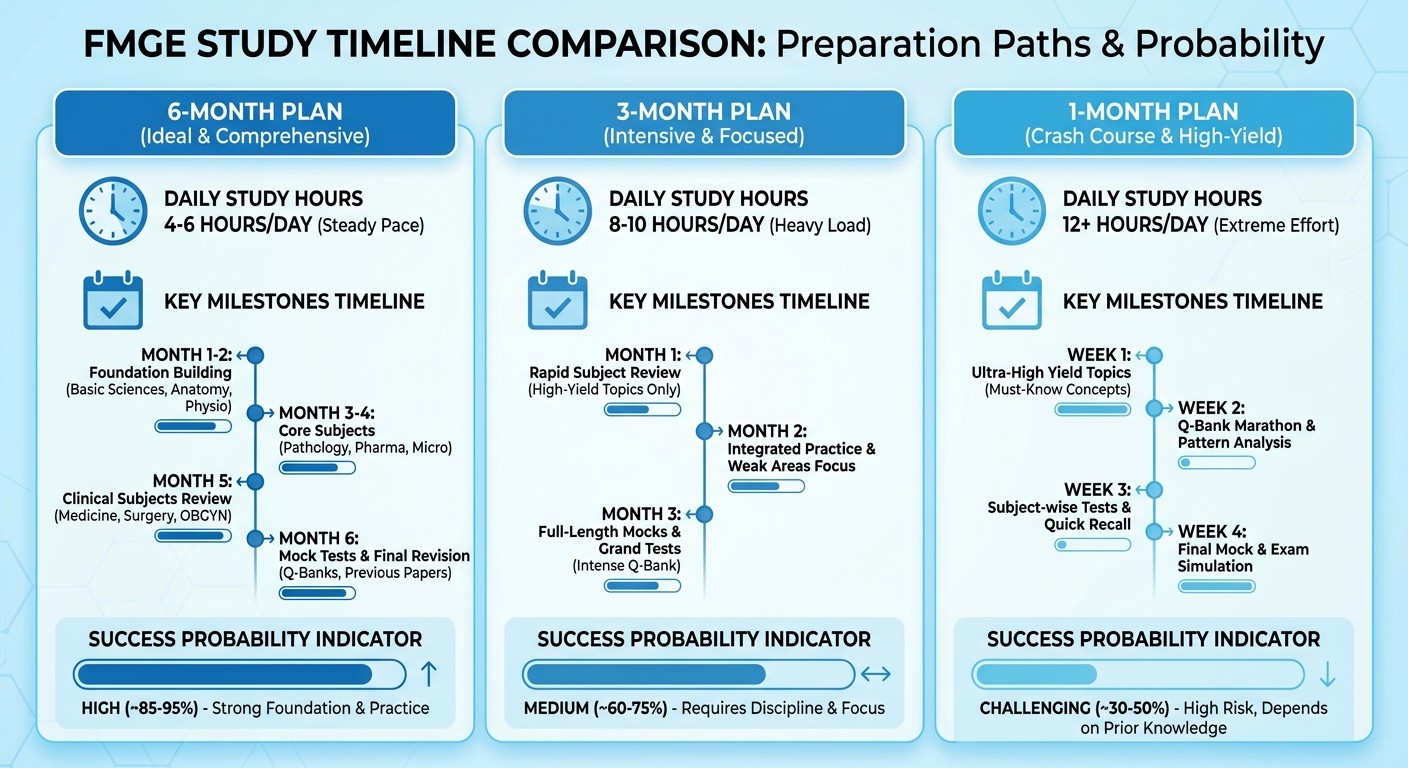
6-Month FMGE Study Plan: The Gold Standard Timeline
Six months provides the ideal buffer for comprehensive preparation and multiple revisions. Here's your week-by-week roadmap:
Months 1-2: Foundation Building
Weeks 1-4: High-Yield Pre-Clinical
Week 1: Anatomy (Systems + Embryology)
Week 2: Physiology (CVS + Respiratory + Renal)
Week 3: Biochemistry (Metabolism + Clinical biochemistry)
Week 4: Pathology (General + Systemic pathology)
Daily Schedule: 6-8 hours study, 100 MCQs practice, 1 hour revision Weeks 5-8: Para-Clinical & Clinical Foundation
Week 5: Pharmacology + Microbiology
Week 6: Medicine (Systems approach)
Week 7: Surgery (General surgery basics)
Week 8: Community Medicine + Forensic Medicine
Oncourse's adaptive question bank automatically adjusts difficulty based on your performance in each subject, ensuring you spend more time on weaker areas during this foundation phase.
Months 3-4: Clinical Mastery
Weeks 9-12: Major Clinical Subjects
Week 9: Medicine (Advanced topics + Case-based learning)
Week 10: Surgery (Surgical procedures + Complications)
Week 11: OB-GYN (Complete syllabus)
Week 12: Pediatrics + Community Medicine
Weeks 13-16: Minor Clinical Subjects
Week 13: Ophthalmology + ENT
Week 14: Psychiatry + Dermatology + Radiology
Week 15: Anesthesiology + Orthopedics
Week 16: First Complete Revision (All subjects)
Daily Schedule: 8-10 hours study, 150 MCQs, subject-wise mock tests
Months 5-6: Revision & Mock Tests
Weeks 17-20: Intensive Revision
Week 17: Pre-clinical subjects revision
Week 18: Major clinical subjects revision
Week 19: Minor clinical subjects revision
Week 20: Second complete revision + PYQ solving
Weeks 21-24: Final Preparation
Week 21: Full-length mock tests (3 tests)
Week 22: Weak area focused study + Mock tests
Week 23: Third revision + Mock tests (5 tests)
Week 24: Final review + Light revision
Mock Test Strategy: Minimum 15 full-length tests in the last 4 weeks. Analyze every incorrect answer and revisit those topics immediately.
3-Month Crash Course: High-Intensity Preparation
Short on time? The 3-month plan demands 10-12 hours daily study with laser focus on high-yield topics:
Month 1: Core Subjects (Weeks 1-4)
Week 1: Medicine + Surgery (alternate days)
Week 2: Anatomy + Physiology + Biochemistry
Week 3: Pathology + Pharmacology + Microbiology
Week 4: OB-GYN + Community Medicine + First Revision
Month 2: Complete Syllabus (Weeks 5-8)
Week 5: Complete all minor clinical subjects
Week 6: Forensic Medicine + Weak areas
Week 7: Second complete revision
Week 8: Mock tests + Third revision
Month 3: Final Sprint (Weeks 9-12)
Weeks 9-11: Daily mock tests + immediate error analysis + spot revision
Week 12: Final revision + PYQ solving + exam day preparation
Critical Success Factor: In the 3-month plan, you cant afford to waste time on low-yield topics. Stick religiously to high-weightage areas.
Oncourse's subject-wise progress tracking becomes crucial here — it shows exactly which topics need more attention in your limited timeframe.
1-Month Emergency Preparation: Last Resort Strategy
One month is extremely tight, but possible if you have a strong MBBS foundation. This plan assumes 14-16 hours daily study:
Week 1: Core Clinical Subjects
Medicine + Surgery (75 marks) — 4 days intensive study
OB-GYN + Community Medicine (60 marks) — 3 days
Week 2: Pre-Clinical High-Yield
Anatomy + Physiology + Biochemistry — 3 days each
Quick revision of these three subjects — 1 day
Week 3: Remaining Syllabus + Revision
Pathology + Pharmacology + Microbiology — 2 days
Pediatrics + Minor clinical subjects — 2 days
First complete revision — 3 days
Week 4: Mock Tests + Final Preparation
Daily full-length mock tests
Error analysis and spot revision
Previous year questions solving
Final 24-hour light revision
Reality Check: The 1-month strategy has a lower success probability. Consider it only if postponing the exam isnt an option.
First-Attempt Success Strategy: How to Beat the 75% Failure Rate
Most FMGE failures stem from predictable mistakes. Here's your first-attempt success blueprint:
1. Master the MCQ Pattern, Not Just Content
FMGE success depends more on MCQ-solving skills than clinical knowledge. The exam tests pattern recognition and elimination techniques, not diagnostic reasoning.
Winning MCQ Strategy:
Read the question stem completely before looking at options
Eliminate obviously wrong answers first
Look for qualifying words (always, never, most, least)
Choose the most specific answer among similar options
When confused between two options, pick the more common/practical answer
Practice this approach with specialized MCQ sets that mirror FMGE's question patterns exactly.
2. Follow the 40-40-20 Study Distribution
40% Time: High-yield subjects (Medicine, Surgery, OB-GYN, Community Medicine) 40% Time: MCQ practice and mock tests 20% Time: Other subjects and revision
This distribution ensures you secure maximum marks from major subjects while maintaining broad coverage.
3. Implement Active Recall Over Passive Reading
Replace passive textbook reading with active recall techniques:
Flashcards: Create fact-based flashcards for rapid recall
Self-Testing: Quiz yourself after each study session
Spaced Repetition: Review topics at increasing intervals
Teaching Method: Explain concepts aloud to reinforce memory
For effective spaced repetition, use flashcard systems that automatically schedule reviews based on your recall strength.
4. Build Exam Endurance Early
FMGE's 5-hour duration tests mental stamina as much as knowledge. Many candidates lose focus in the final hours, making careless errors.
Endurance Building Strategy:
Take full-length mock tests weekly from month 2 onwards
Practice under strict time constraints (no breaks)
Simulate exam day conditions (same timings, environment)
Build gradually from 2-hour to 5-hour test sessions
5. Master Time Management Per Section
Part A Timing (2.5 hours, 100 questions):
Aim to complete in 2 hours
Reserve 30 minutes for review and difficult questions
Spend maximum 90 seconds per question
Part B Timing (2.5 hours, 200 questions):
Complete in 2 hours 10 minutes
20 minutes for final review
Average 40 seconds per question (clinical questions are often shorter)
Common FMGE Preparation Mistakes to Avoid
Learning from others' failures can prevent your own. Here are the top mistakes that cause FMGE failure:
1. Studying Like It's MBBS All Over Again
Mistake: Reading textbooks cover-to-cover like in medical school. Reality: FMGE tests factual recall, not conceptual understanding. Solution: Focus on high-yield facts, mnemonics, and MCQ patterns.
2. Ignoring Subject Weightage
Mistake: Giving equal time to all 19 subjects. Reality: Medicine alone carries 33 marks — more than Pediatrics + Ophthalmology + ENT combined. Solution: Allocate study time proportional to marks weightage.
3. MCQ Practice Without Analysis
Mistake: Solving 1000+ MCQs but not analyzing wrong answers. Reality: Repeated mistakes indicate knowledge gaps, not bad luck. Solution: Create error logs and revisit weak topics immediately.
4. Over-Reliance on Foreign Medical Knowledge
Mistake: Assuming foreign medical education perfectly aligns with FMGE requirements. Reality: FMGE tests Indian medical education standards, protocols, and guidelines. Solution: Study India-specific content, especially in Community Medicine and clinical protocols.
5. Mock Test Avoidance Until Final Weeks
Mistake: Postponing mock tests until the last month. Reality: Mock tests identify weak areas that require weeks to strengthen. Solution: Start weekly mock tests from month 2 of preparation.
6. Perfectionist Approach to Every Subject
Mistake: Trying to master every topic in every subject. Reality: FMGE rewards breadth over depth — knowing something about everything beats knowing everything about something. Solution: Aim for 70-80% proficiency across all subjects rather than 100% in selected subjects.
Using Question Banks Effectively for FMGE Success
Question banks form the backbone of FMGE preparation, but most candidates use them incorrectly. Here's the strategic approach:
Phase 1: Topic-Wise Practice (Months 1-4)
Solve 50 MCQs per topic immediately after studying
Focus on understanding why wrong options are incorrect
Create subject-wise error logs
Repeat questions you got wrong after 48 hours
Phase 2: Subject-Wise Mixed Practice (Months 4-5)
Mix topics within each subject randomly
Time yourself — maintain 60 seconds per question average
Simulate mini-mock conditions
Track accuracy trends by subject
Phase 3: Full-Length Mock Tests (Months 5-6)
Minimum 2 mock tests per week
Complete tests in single sittings
Analyze performance immediately after each test
Focus subsequent study on low-scoring areas
Question Bank Quality Markers:
Updated with recent FMGE patterns
Detailed explanations for all options
India-specific content and guidelines
Subject-wise performance analytics
Previous Year Papers: Your Success Roadmap
FMGE previous year questions (PYQs) reveal exam patterns, repeated topics, and question styles. Here's how to leverage them effectively:
Pattern Analysis Strategy
Frequency Mapping: Identify topics asked in multiple years
Difficulty Trending: Notice if questions are becoming more clinical or factual
New Topic Introduction: Spot emerging areas gaining importance
Question Style Evolution: Adapt to changing MCQ formats
PYQ Integration Schedule
Month 1-2: Use PYQs to understand question patterns while studying topics
Month 3-4: Solve complete year papers subject-wise
Month 5: Solve complete year papers as full-length tests
Month 6: Final revision of frequently repeated PYQ topics
PYQ Success Tip: Questions in similar topics often repeat with slight variations. Mastering PYQ logic helps you crack similar questions even when the clinical scenario changes.
Mock Test Strategy: Last 4 Weeks Before FMGE
Your final month success depends entirely on mock test strategy. Here's your week-by-week approach:
Week 4 Before Exam
Target: 3 full-length mock tests
Focus: Overall performance assessment and major gap identification
Action: Deep dive study into subjects scoring below 50%
Week 3 Before Exam
Target: 4 full-length mock tests
Focus: Time management optimization and stamina building
Action: Fine-tune your question-solving approach and elimination techniques
Week 2 Before Exam
Target: 5 mock tests (including repeat tests where you scored poorly)
Focus: Confidence building and final knowledge gaps
Action: Light revision only — no new topics
Final Week
Target: 2-3 mock tests maximum
Focus: Maintaining exam readiness without burnout
Action: Review flashcards, solved PYQs, and confidence-building activities
Mock Test Analysis Framework: 1. Overall Score Trend: Are you consistently improving? 2. Subject-wise Breakdown: Which subjects are pulling your score down? 3. Question Type Analysis: Factual vs. clinical vs. applied questions performance 4. Time Management: Are you completing both parts comfortably? 5. Silly Mistakes: Pattern of careless errors to avoid on exam day
Frequently Asked Questions
How many hours should I study daily for FMGE preparation?
For 6-month preparation, aim for 6-8 hours daily initially, increasing to 10-12 hours in the final 2 months. Quality matters more than quantity — focused 6 hours beats distracted 10 hours.
Can I clear FMGE without coaching classes?
Yes, absolutely. FMGE is very much self-study friendly with the right resources and strategy. Focus on good question banks, mock tests, and structured study plans rather than expensive coaching programs.
What's the minimum percentage needed to pass FMGE?
You need 150 marks out of 300 total marks, which equals 50%. However, aiming for 60-65% gives you a comfortable buffer above the cutoff.
Should I attempt FMGE immediately after graduation or wait?
Attempt as soon as you're eligible. The longer you wait, the more your medical knowledge fades. Fresh MBBS graduates have the best recall of basic medical concepts.
How important are mock tests compared to studying textbooks?
For FMGE, mock tests are more important than textbooks. Aim for a 60-40 split favoring MCQ practice and mock tests over passive reading.
Which subjects should I prioritize if I have limited time?
Focus on Medicine (33 marks), Surgery (32 marks), Community Medicine (30 marks), and OB-GYN (30 marks). These four subjects provide 125 marks — nearly the passing threshold alone.
---
FMGE success isnt about being the smartest candidate — it's about being the most strategic. With focused preparation, consistent practice, and the right approach, your foreign medical degree can become your gateway back into Indian healthcare.
Prepare smarter with Oncourse AI — adaptive MCQs, spaced repetition, and AI explanations built for FMGE success. Download free on Android and iOS.