Digital Forensics Indian Medical PG Practice Questions and MCQs
Practice Indian Medical PG questions for Digital Forensics. These multiple choice questions (MCQs) cover important concepts and help you prepare for your exams.
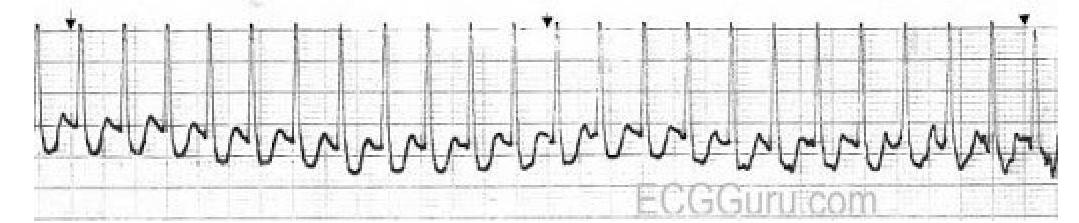
Digital Forensics Indian Medical PG Question 1: Identify the diagnosis based on the provided ECG image.
- A. VT
- B. PSVT (Correct Answer)
- C. AT
- D. Ventricular fibrillation
Digital Forensics Explanation: ***PSVT***
- The ECG shows a **narrow complex tachycardia** with a regular rhythm and a high heart rate, characteristic of **paroxysmal supraventricular tachycardia (PSVT)**.
- P waves are often **buried within the QRS complex** or T waves, or may be retrograde, which can be seen as small deflections or changes in the baseline in some leads.
*VT*
- **Ventricular tachycardia** is characterized by a **wide QRS complex** (>0.12 seconds), which is not observed in this ECG.
- While VT can be regular, the primary distinguishing feature is the QRS duration.
*AT*
- **Atrial tachycardia (AT)** is another form of supraventricular tachycardia, but it typically shows **distinct P waves** with an abnormal morphology, often separate from the T wave, which are not clearly visible or consistently distinct in this tracing.
- While it can present with narrow complex tachycardia, the mechanism differs from re-entrant PSVT.
*Ventricular fibrillation*
- **Ventricular fibrillation** is characterized by **chaotic, irregular electrical activity** with no distinguishable P waves, QRS complexes, or T waves, representing disorganized ventricular depolarization.
- The ECG in the image shows a consistent, regular rhythm with identifiable, albeit narrow, QRS complexes.
Digital Forensics Indian Medical PG Question 2: Match List-I with List-II and select the correct answer using the code given below the Lists:
- A. A→4 B→1 C→3 D→2
- B. A→3 B→4 C→1 D→2
- C. A→2 B→1 C→4 D→3 (Correct Answer)
- D. A→1 B→2 C→3 D→4
Digital Forensics Explanation: ***A→2 B→1 C→4 D→3***
- This is the correct matching based on public health indicator classification.
- **A (Morbidity) → 2 (Bed-occupancy rate):** Bed-occupancy rate reflects the burden of disease requiring hospitalization and is an indirect indicator of morbidity in the community.
- **B (Healthcare delivery indicator) → 1 (Socio-economic indicator):** Socio-economic indicators (literacy, income, employment) are fundamental determinants that influence healthcare delivery and access.
- **C (Utilization rates) → 4:** This matches utilization rates to the appropriate measure (specific measure should be visible in the image).
- **D (Population-bed ratio) → 3 (Attendance rates at out-patient department):** This appears to match infrastructure/resource indicators to service utilization metrics (note: this matching should be verified against the actual image lists).
*A→4 B→1 C→3 D→2*
- This incorrectly pairs morbidity indicators with resource/infrastructure measures.
- Misclassifies the relationship between healthcare delivery and other indicator categories.
*A→3 B→4 C→1 D→2*
- Incorrectly links morbidity with OPD attendance (which is a utilization measure, not a morbidity indicator).
- Mismatches healthcare delivery indicators with resource measures.
*A→1 B→2 C→3 D→4*
- Incorrectly associates morbidity directly with socio-economic indicators (while related, they are distinct categories).
- Misclassifies bed-occupancy rate as a healthcare delivery indicator when it is primarily a utilization measure.
**Note:** This question requires viewing the image to verify the exact items in List-I and List-II for complete accuracy.
Digital Forensics Indian Medical PG Question 3: What type of evidence do medical certificates provide?
- A. Testimonial evidence
- B. Indirect evidence
- C. Conditional release documentation
- D. Documentary evidence of a patient's condition (Correct Answer)
Digital Forensics Explanation: ***Documentary evidence of a patient's condition***
- Medical certificates are formal written documents prepared by a healthcare professional that provide **objective information** regarding a patient's medical status, diagnosis, treatment, and fitness for work or other activities.
- Under the **Indian Evidence Act, 1872 (Section 3)**, medical certificates are classified as **documentary evidence** - they serve as verifiable written records offering **factual proof** of a patient's health situation at a specific time.
- They are considered **direct evidence** that can be produced in court to establish medical facts.
*Testimonial evidence*
- This involves **oral statements** made under oath, typically in a court of law, by a witness who has direct knowledge of the facts.
- While a doctor might provide testimonial evidence when called as a witness, the certificate itself is not a spoken testimony but a **written document**.
*Indirect evidence*
- Also known as **circumstantial evidence**, this refers to facts that, when proven, suggest the existence of another fact without directly proving it.
- Medical certificates directly state the patient's condition, making them **direct documentary evidence**, not indirect or circumstantial evidence.
*Conditional release documentation*
- This type of document pertains to the **release of a patient from a hospital** or facility under certain conditions, such as follow-up appointments or medication adherence.
- While a medical certificate might be part of a discharge process, its primary legal classification is as **documentary evidence**, not a specific type of release documentation.
Digital Forensics Indian Medical PG Question 4: Virchow method of autopsy includes:-
- A. Organs are removed one by one (Correct Answer)
- B. In situ dissection combined with en bloc removal
- C. Organs are removed en bloc
- D. Organs are removed En masse
Digital Forensics Explanation: ***Organs are removed one by one***
- The **Virchow method** of autopsy involves the systematic removal and examination of each organ individually.
- This technique emphasizes the **in-depth inspection** of each organ for pathological changes, one at a time.
*In situ dissection combined with en bloc removal*
- This describes a combination of techniques, not solely the Virchow method. **In situ dissection** involves examining organs within the body cavity.
- Removing organs **en bloc** refers to taking out groups of organs together which is characteristic of other methods like Ghon or Letulle.
*Organs are removed En block*
- The **en bloc method** (e.g., Ghon's method) involves removing entire organ systems or groups of organs together to preserve anatomical relationships.
- This is distinct from the Virchow method, where individual organs are taken out separately.
*Organs are removed En masse*
- The **en masse method** (e.g., Letulle's method) involves removing all organs in a single block, maintaining all anatomical connections.
- This is a more extensive removal technique compared to the Virchow method of individual organ removal.
Digital Forensics Indian Medical PG Question 5: Which of the following is a primarily RNA based technique?
- A. Western blotting
- B. Northern blotting (Correct Answer)
- C. Southern blotting
- D. Sanger's technique
Digital Forensics Explanation: ***Northern blotting***
- **Northern blotting** is a molecular biology technique used to study **gene expression** by detecting specific **RNA molecules** (mRNA) in a sample.
- It involves separating RNA fragments by **gel electrophoresis**, transferring them to a membrane, and then detecting specific sequences using **labeled probes**.
*Western blotting*
- **Western blotting** is a technique used to detect specific **proteins** in a sample.
- It involves separating proteins by **gel electrophoresis**, transferring them to a membrane, and then detecting specific proteins using labeled **antibodies**.
*Southern blotting*
- **Southern blotting** is a molecular biology method used for the detection of **specific DNA sequences** in DNA samples.
- It involves separating **DNA fragments** by **gel electrophoresis**, transferring them to a membrane, and then hybridizing with a labeled probe.
*Sanger's technique*
- **Sanger sequencing**, or the **dideoxy chain-termination method**, is a widely used method for **DNA sequencing**.
- It uses **dideoxynucleotides** to terminate DNA synthesis at specific bases, allowing the determination of the **DNA sequence**.
More Digital Forensics Indian Medical PG questions available in the OnCourse app. Practice MCQs, flashcards, and get detailed explanations.