Tropical Dermatology Indian Medical PG Practice Questions and MCQs
Practice Indian Medical PG questions for Tropical Dermatology. These multiple choice questions (MCQs) cover important concepts and help you prepare for your exams.
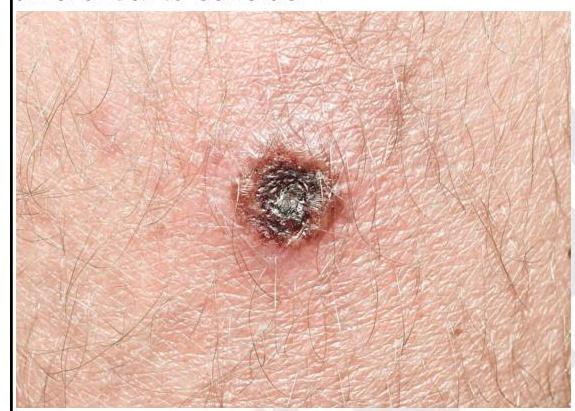
Tropical Dermatology Indian Medical PG Question 1: A forest officer develops the lesion as shown in the image. Which of the following is not a differential to consider?
- A. Cutaneous anthrax
- B. KFD (Correct Answer)
- C. Scrub typhus
- D. Healing brown recluse spider bite
Tropical Dermatology Explanation: ***KFD***
- **Kyasanur Forest Disease** (KFD) is a viral hemorrhagic fever, but it does **not** typically present with a **skin lesion** or eschar like the one shown.
- KFD is characterized by fever, headache, myalgia, and gastrointestinal symptoms, with hemorrhagic manifestations in severe cases, but not a primary cutaneous lesion.
*Cutaneous anthrax*
- **Cutaneous anthrax** commonly presents as an **eschar**, often with surrounding edema and vesicles, which can resemble the lesion in the image.
- Exposure through handling infected animal products or contact with contaminated soil is common, aligning with a forest officer's occupation.
*Scrub typhus*
- **Scrub typhus** characteristically causes an **eschar** (tache noire) at the bite site of the chigger mite.
- The lesion in the image, an ulcer with a central black crust, is highly suggestive of such an eschar seen in rickettsial infections.
*Healing brown recluse spider bite*
- A **brown recluse spider bite** can cause a **necrotic ulcer** with a central dark eschar as the wound heals, fitting the appearance of the lesion.
- The profession of a forest officer increases the likelihood of exposure to spiders in their natural habitat.
Tropical Dermatology Indian Medical PG Question 2: Kala azar is spread by –
- A. Black–fly
- B. Sand–fly (Correct Answer)
- C. Tsetse–fly
- D. House–fly
Tropical Dermatology Explanation: ***Sand–fly***
- Kala-azar, also known as **visceral leishmaniasis**, is transmitted to humans through the bite of an infected female **Phlebotomine sandfly**.
- The sandfly acts as a **biological vector**, harboring the **Leishmania parasites** in its gut.
*Black–fly*
- **Black flies** are vectors for **onchocerciasis** (river blindness), caused by the parasite *Onchocerca volvulus*.
- They are typically found near **fast-flowing water** and their bites often lead to skin nodules and eye lesions.
*Tsetse–fly*
- The **tsetse fly** is the vector for **African trypanosomiasis** (sleeping sickness), caused by species of *Trypanosoma*.
- This disease primarily affects central nervous system function, leading to changes in sleep patterns.
*House–fly*
- **House flies** are primarily **mechanical vectors** for various pathogens, meaning they can transfer microbes from contaminated surfaces to food.
- They are not known to transmit specific diseases like Kala-azar through a bite.
Tropical Dermatology Indian Medical PG Question 3: With reference to dengue virus, consider the following statements:
1. In India, all the four serotypes are found.
2. The reservoir of infection is both man and mosquito.
3. Adults usually have a milder disease than children.
4. Dengue hemorrhagic fever is caused by infection with more than one dengue virus. Which of the statements given above is/are correct?
- A. 2, 3 and 4
- B. 4 only
- C. 1, 2 and 4 (Correct Answer)
- D. 1 and 2 only
Tropical Dermatology Explanation: ***1, 2 and 4***
- **All four serotypes** (DEN-1, DEN-2, DEN-3, and DEN-4) of the dengue virus are endemic in India, contributing to the recurrent outbreaks seen across the country.
- Dengue is a **vector-borne disease**, meaning the virus cycles between humans (the primary reservoir) and mosquitoes (specifically *Aedes aegypti* and *Aedes albopictus*), making both essential for its transmission.
- **Dengue hemorrhagic fever (DHF)**, or severe dengue, is often associated with a **second infection by a different serotype** of the dengue virus due to antibody-dependent enhancement (ADE).
*2, 3 and 4*
- The statement that adults usually have a milder disease than children is **incorrect**; children often present with milder, non-specific symptoms, while adults are more likely to develop typical dengue fever or severe forms.
- The other statements regarding the presence of all four serotypes, the reservoir, and the cause of DHF are correct.
*4 only*
- While statement 4 (DHF caused by infection with more than one serotype) is correct, it overlooks the accuracy of statements 1 and 2.
- Omitting statements 1 and 2 makes this option incomplete as both are established facts about dengue.
*1 and 2 only*
- This option correctly identifies that all four serotypes exist in India and that humans and mosquitoes serve as reservoirs.
- However, it **incorrectly excludes statement 4** regarding the etiology of dengue hemorrhagic fever (DHF), which results from sequential infection with a different serotype.
Tropical Dermatology Indian Medical PG Question 4: NVBDCP includes all except ?
- A. Filariasis
- B. Malaria
- C. Kala-azar
- D. Yellow fever (Correct Answer)
Tropical Dermatology Explanation: ***Yellow fever***
- Yellow fever is a **viral hemorrhagic fever** transmitted by infected mosquitoes, primarily **Aedes aegypti**.
- While a significant public health concern, it is **not included in India's National Vector-Borne Disease Control Programme (NVBDCP)**, as it is not endemic to India.
*Filariasis*
- **Lymphatic filariasis** (elephantiasis) is a major vector-borne disease in India, caused by parasitic worms transmitted by mosquitoes.
- It is a key component of the NVBDCP, which focuses on its elimination through **mass drug administration** and vector control.
*Malaria*
- **Malaria**, caused by Plasmodium parasites transmitted by Anopheles mosquitoes, is a cornerstone of the NVBDCP.
- The program actively implements strategies for **case detection, treatment, vector control**, and preventing outbreaks.
*Kala-azar*
- **Kala-azar** (visceral leishmaniasis) is a severe parasitic disease transmitted by **sandflies**, making it a vector-borne disease.
- It is one of the six diseases targeted by the NVBDCP for elimination, particularly in endemic regions of India.
Tropical Dermatology Indian Medical PG Question 5: A patient, a resident of Himachal Pradesh, presented with a series of ulcers in a row on his right leg. The biopsy from the affected area was taken and cultured on Sabouraud's dextrose agar. What is the most likely causative organism?
- A. Cladosporium spp.
- B. Pseudoallescheria boydii
- C. Nocardia brasiliensis
- D. Sporothrix schenckii (Correct Answer)
Tropical Dermatology Explanation: ***Sporothrix schenckii***
- The presentation of "ulcers in a row" on the leg is highly suggestive of **lymphocutaneous sporotrichosis**, a characteristic finding where the infection spreads via lymphatic drainage.
- This fungus is endemic in certain regions including parts of **Himachal Pradesh**, and is typically acquired through contact with contaminated soil or plant material (e.g., rose thorns, sphagnum moss).
- Grows well on **Sabouraud's dextrose agar**, producing characteristic colonies.
*Cladosporium spp.*
- While *Cladosporium* can cause **phaeohyphomycosis** or allergic fungal sinusitis, it does not typically present with the classic lymphocutaneous lesions described.
- These fungi are common environmental contaminants and their infections are usually associated with chronic skin lesions, not a linear spread of ulcers.
*Pseudoallescheria boydii*
- *Pseudoallescheria boydii* is a common cause of **mycetoma** (Madura foot), characterized by chronic, destructive lesions with granulomas and sinus tracts that discharge grains.
- This presentation is distinct from the linear ulcerative lesions described in the patient.
*Nocardia brasiliensis*
- *Nocardia brasiliensis* is a bacterium (an actinomycete) that causes **actinomycetoma**, characterized by chronic, suppurative lesions with sinus tracts discharging grains.
- The characteristic **"ulcers in a row"** (lymphocutaneous spread pattern) is **not typical** of Nocardia infection, which presents as localized mycetoma rather than ascending lymphatic involvement.
- While Nocardia can grow on some fungal media, the clinical presentation is the key distinguishing feature here.
More Tropical Dermatology Indian Medical PG questions available in the OnCourse app. Practice MCQs, flashcards, and get detailed explanations.