Electrolytes and Body Fluids — Physiology
Free FMGE lesson notes, MCQs, tables, flowcharts & PYQ papers for Physiology
Try 10 free Electrolytes and Body Fluids questions
Answer each MCQ to check yourself, then unlock the explanation with your email.
1.5 mL of a solution containing 20 mg/mL of Evans blue dye is injected into plasma. If the final concentration of the dye is 0.015 mg/mL, what is the volume of the plasma?
Answer: B. 2 L
Which diagram represents the changes in extracellular and intracellular fluid volumes and osmolarities after the infusion of 3% NaCl, after osmotic equilibrium has been reached?
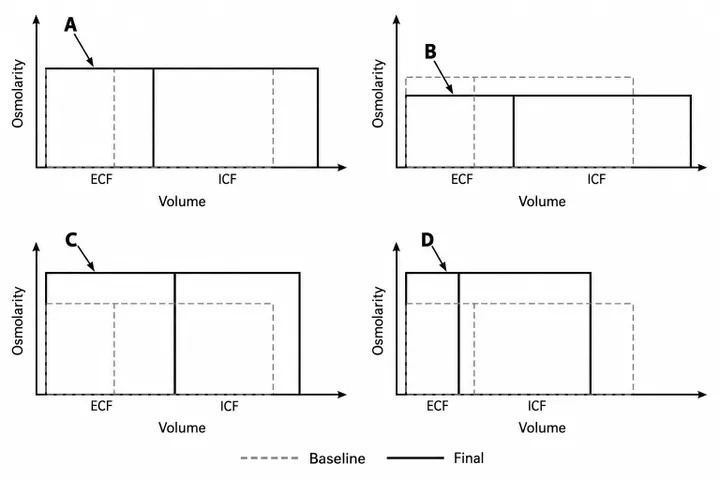
Answer: D. Diagram C
Assuming ideal behaviour and complete NaCl dissociation, calculate the osmolarity of a solution containing glucose 180 mg/dL, NaCl 117 mg/dL and urea reported as BUN 56 mg/dL
Answer: B. 70 mOsm/L
Which of the following is a major intracellular cation of the neuromuscular system?
Answer: C. Mg
What is the approximate osmolarity of human plasma?
Answer: B. 290 mOsm/L
In an untreated patient with hypernatremic dehydration due to diarrhea, with intact hypothalamic–pituitary function and renal concentrating ability, all of the following are expected, EXCEPT:
Answer: C. Suppressed AVP secretion
In the body-fluid chart, what percentage of body weight is contained in the intracellular compartment?
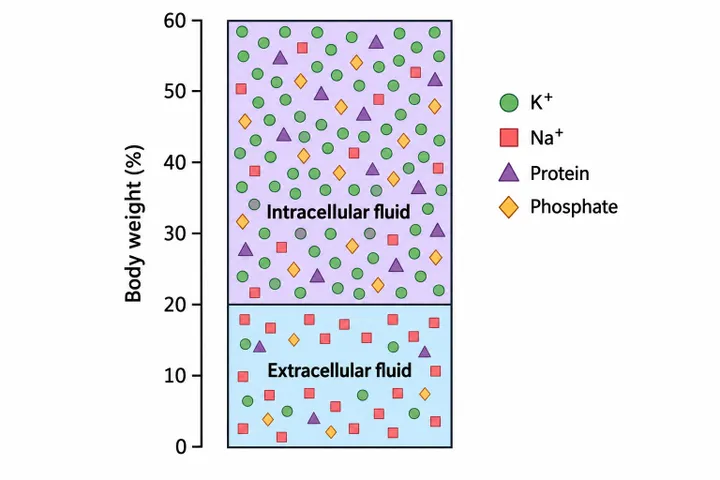
Answer: D. 40%
The body fluid compartments of a patient were measured, showing the following ion concentrations: - Sodium (Na): $10 \mathrm{mEq} / \mathrm{L}$ - Potassium (K): $140 \mathrm{mEq} / \mathrm{L}$ - Chloride (Cl): $15 \mathrm{mEq} / \mathrm{L}$ Based on these values, which fluid compartment is being described?
Answer: B. Intracellular fluid
All of the following decrease insensible water loss EXCEPT:
Answer: C. Prematurity
Which of the following is NOT true about osmotic adaptation?
Answer: C. Predominant urea and glucose accumulation
Chapter Downloads
10 chapters


About Electrolytes and Body Fluids for FMGE
Electrolytes and Body Fluids is an important topic within Physiology for FMGE preparation. Understanding the core concepts, key applications, and frequently tested areas in Electrolytes and Body Fluids can make a significant difference in your exam performance. This page brings together all the study resources you need for Electrolytes and Body Fluids in one place.
The downloadable PDFs include a comprehensive MCQ question bank with answer keys, concise lesson notes that cover high-yield points, comparison tables for quick revision, and flowcharts that simplify complex mechanisms and classifications. Previous year questions (PYQs) are also available so you can see exactly how Electrolytes and Body Fluids has been tested in past FMGE exams.
All resources are free to download and designed for offline study. Whether you are doing a first read or a last-minute revision, these PDFs give you a structured way to cover Electrolytes and Body Fluids under Physiology. For an even more interactive experience — with spaced-repetition flashcards, adaptive question practice, and AI-powered explanations — download the Oncourse app.
Frequently Asked Questions
How do I download Electrolytes and Body Fluids MCQ PDF for FMGE?
Are the Electrolytes and Body Fluids question banks free?
How many Electrolytes and Body Fluids MCQs can I get for FMGE?
What formats are available for Electrolytes and Body Fluids study material?
Is the Electrolytes and Body Fluids content updated for the latest FMGE syllabus?
More Physiology downloads
Browse other topics