Antimicrobial Agents — Pharmacology
Free FMGE lesson notes, MCQs, tables, flowcharts & PYQ papers for Pharmacology
Try 10 free Antimicrobial Agents questions
Answer each MCQ to check yourself, then unlock the explanation with your email.
A 28-year-old man has laboratory-confirmed uncomplicated Plasmodium falciparum malaria acquired in Assam and can take oral medication. Under India's national malaria programme, which oral blood-schizonticidal regimen is first-line?
Answer: A. Artemether plus lumefantrine
An 18-year-old boy from Rajasthan weighing 50 kg has laboratory-confirmed uncomplicated mixed P. vivax and P. falciparum malaria. He has documented normal G6PD activity and can take oral medication. Using the Indian national adult age-band ACT-SP dosing schedule, which regimen is due on treatment day 2 (the second day of treatment)?
Answer: D. Artesunate 200 mg + primaquine 15 mg
Under NTEP 2021 PMDT guidance, which resistance profile permits consideration for the 9–11-month shorter oral bedaquiline-containing regimen, assuming all other eligibility criteria are met?
Answer: C. Rifampicin-resistant but fluoroquinolone-sensitive TB
Time-dependent killing is exhibited by all the following drugs EXCEPT:
Answer: B. Gentamicin
Which of the following is primarily a bactericidal drug?
Answer: D. Gentamicin
The eruption shown developed during rapid intravenous antibiotic infusion. Which drug most characteristically causes this reaction?
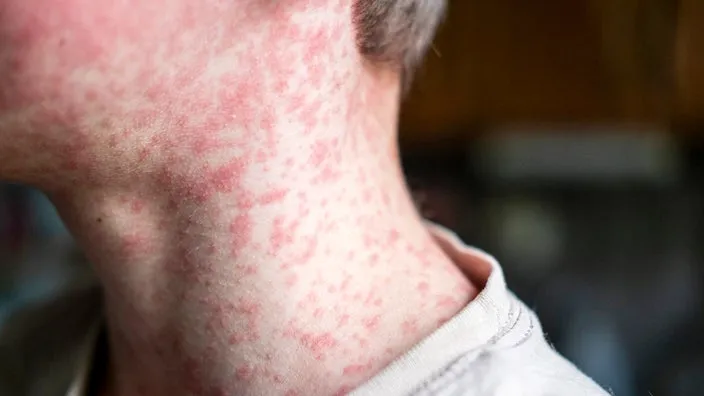
Answer: C. Vancomycin
A 45-year-old man is placed on an antifungal agent for systemic infection and is noted to have decreased peripheral blood leukocyte and platelet counts. Bone marrow suppression is a common adverse effect of which of the following drugs?
Answer: A. Flucytosine
Which antifungal undergoes predominantly spontaneous nonenzymatic degradation and requires no dose adjustment in renal or hepatic impairment?
Answer: A. Anidulafungin
Which of the following statements about silver sulfadiazine is NOT true?
Answer: D. Possesses immunomodulatory action
Which of the following drugs is NOT useful in Urinary Tract Infections (UTI)?
Answer: C. Moxifloxacin
Chapter Downloads
12 chapters


About Antimicrobial Agents for FMGE
Antimicrobial Agents is an important topic within Pharmacology for FMGE preparation. Understanding the core concepts, key applications, and frequently tested areas in Antimicrobial Agents can make a significant difference in your exam performance. This page brings together all the study resources you need for Antimicrobial Agents in one place.
The downloadable PDFs include a comprehensive MCQ question bank with answer keys, concise lesson notes that cover high-yield points, comparison tables for quick revision, and flowcharts that simplify complex mechanisms and classifications. Previous year questions (PYQs) are also available so you can see exactly how Antimicrobial Agents has been tested in past FMGE exams.
All resources are free to download and designed for offline study. Whether you are doing a first read or a last-minute revision, these PDFs give you a structured way to cover Antimicrobial Agents under Pharmacology. For an even more interactive experience — with spaced-repetition flashcards, adaptive question practice, and AI-powered explanations — download the Oncourse app.
Frequently Asked Questions
How do I download Antimicrobial Agents MCQ PDF for FMGE?
Are the Antimicrobial Agents question banks free?
How many Antimicrobial Agents MCQs can I get for FMGE?
What formats are available for Antimicrobial Agents study material?
Is the Antimicrobial Agents content updated for the latest FMGE syllabus?
More Pharmacology downloads
Browse other topics