Cardiology — Pediatrics
Free FMGE lesson notes, MCQs, tables, flowcharts & PYQ papers for Pediatrics
Try 10 free Cardiology questions
Answer each MCQ to check yourself, then unlock the explanation with your email.
Which feature of a major Jones manifestation is characteristic of acute rheumatic fever?
Answer: C. Delayed-onset Sydenham chorea
The child shown below is suffering from a congenital heart disease. Which congenital heart defect is most commonly seen in these children?

Answer: A. Atrioventricular septal defect
A 2-year-old boy has recurrent dusky episodes, central cyanosis, and clubbing. Examination shows a normal-sized heart, a parasternal heave, a systolic thrill at the left mid-sternal border, and a single second heart sound with an inaudible pulmonary component. What is the most likely diagnosis?
Answer: A. Fallot tetralogy
Strawberry tongue is a clinical sign seen in which of the following conditions?
Answer: D. Kawasaki disease
A 3-year-old child has persistent fever for 15 days, a polymorphous rash, bilateral nonpurulent conjunctival injection, oral erythema, and edema of the hands and feet. ESR and CRP are elevated. What is the appropriate initial treatment?
Answer: C. IVIg plus aspirin
Which congenital heart disease is associated with the defect shown in the diagram below?
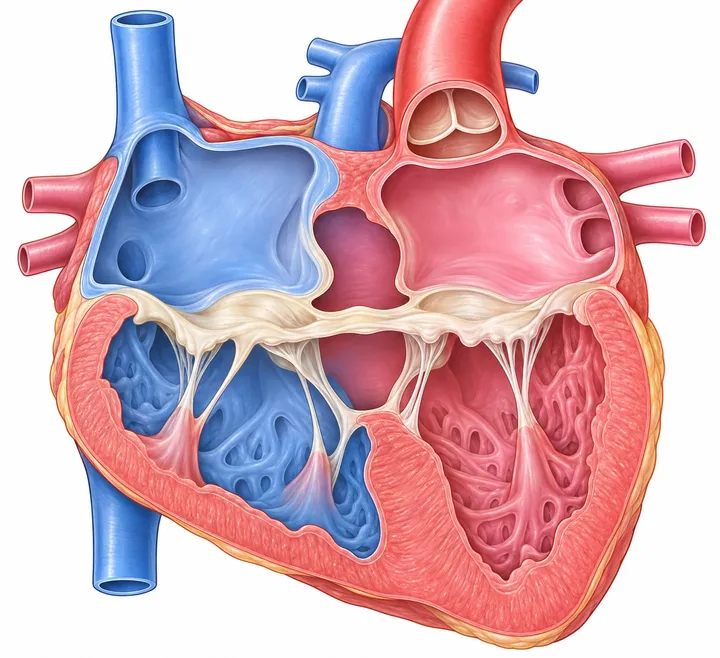
Answer: A. Endocardial cushion defect
In typical complete (d-) transposition of the great arteries, all of the following statements are true EXCEPT:
Answer: D. Causes jaundice immediately after birth
Which manifestation of acute rheumatic fever typically responds rapidly to salicylates and resolves without permanent sequelae?
Answer: D. Rheumatic arthritis
Which of the following is NOT characteristic of acute rheumatic fever?
Answer: A. Frequent joint deformities
An infant has an interrupted aortic arch, hypocalcemia and thymic aplasia. What is the most likely diagnosis?
Answer: B. DiGeorge syndrome
Chapter Downloads
12 chapters
Congenital Heart Diseases: Cyanotic

Congenital Heart Diseases: Acyanotic

Rheumatic Heart Disease

Kawasaki Disease

Infective Endocarditis

Myocarditis and Cardiomyopathies

Arrhythmias in Children

Heart Failure in Children

Pulmonary Hypertension

Systemic Hypertension

Dyslipidemia in Children

Cardiac Evaluation and Diagnostics
About Cardiology for FMGE
Cardiology is an important topic within Pediatrics for FMGE preparation. Understanding the core concepts, key applications, and frequently tested areas in Cardiology can make a significant difference in your exam performance. This page brings together all the study resources you need for Cardiology in one place.
The downloadable PDFs include a comprehensive MCQ question bank with answer keys, concise lesson notes that cover high-yield points, comparison tables for quick revision, and flowcharts that simplify complex mechanisms and classifications. Previous year questions (PYQs) are also available so you can see exactly how Cardiology has been tested in past FMGE exams.
All resources are free to download and designed for offline study. Whether you are doing a first read or a last-minute revision, these PDFs give you a structured way to cover Cardiology under Pediatrics. For an even more interactive experience — with spaced-repetition flashcards, adaptive question practice, and AI-powered explanations — download the Oncourse app.
Frequently Asked Questions
How do I download Cardiology MCQ PDF for FMGE?
Are the Cardiology question banks free?
How many Cardiology MCQs can I get for FMGE?
What formats are available for Cardiology study material?
Is the Cardiology content updated for the latest FMGE syllabus?
More Pediatrics downloads
Browse other topics