Diseases of the Lens — Ophthalmology
Free FMGE lesson notes, MCQs, tables, flowcharts & PYQ papers for Ophthalmology
Try 10 free Diseases of the Lens questions
Answer each MCQ to check yourself, then unlock the explanation with your email.
An infant presents with bilateral white pupillary reflex. On slit lamp examination, a zone of opacity is observed around the fetal nucleus with spoke-like radial opacities. What is the most likely diagnosis?
Answer: C. Lamellar cataract
In historical cataract surgery, which presentation is generally unsuitable for routine intracapsular extraction because of strong hyaloideocapsular attachment?
Answer: A. Mature cataract at 25 years
What is the approximate water content of the human lens?
Answer: B. 64%
Which is NOT a recognised association or complication of microspherophakia?
Answer: B. Hypermetropia
Infantile nucleus of the crystalline lens refers to the nucleus developed from which period?
Answer: D. Birth to the onset of puberty
Which of the following syndromes is associated with lenticonus?
Answer: D. Alport syndrome
Following ionizing-radiation injury, lens opacities characteristically develop in the posterior subcapsular region and may extend into the cortex. Which lens region is typically relatively spared?
Answer: A. Nuclear region
A 60-year-old male presents with coloured halos. On Fincham's test, the halos split and then reunite. The most probable diagnosis is?
Answer: D. Senile immature cataract
An elderly patient presents with white, dandruff-like deposits on the anterior lens surface, seen during slit-lamp examination. What is the most likely diagnosis?
Answer: D. Pseudoexfoliation syndrome
A patient with short stature has the ocular finding shown. What is the most likely diagnosis?
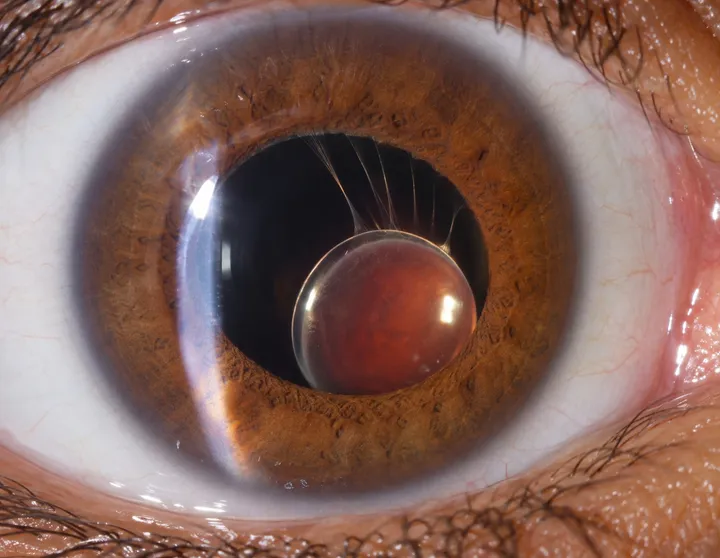
Answer: B. Weill–Marchesani syndrome
Chapter Downloads
12 chapters
Lens Anatomy and Physiology

Age-Related Cataract

Congenital and Developmental Cataracts

Traumatic Cataract

Metabolic Cataracts

Drug-Induced Cataracts

Cataract Surgery Techniques

Intraocular Lens Implants

Complications of Cataract Surgery

Posterior Capsular Opacification

Lens Subluxation and Dislocation

Specialty IOLs
About Diseases of the Lens for FMGE
Diseases of the Lens is an important topic within Ophthalmology for FMGE preparation. Understanding the core concepts, key applications, and frequently tested areas in Diseases of the Lens can make a significant difference in your exam performance. This page brings together all the study resources you need for Diseases of the Lens in one place.
The downloadable PDFs include a comprehensive MCQ question bank with answer keys, concise lesson notes that cover high-yield points, comparison tables for quick revision, and flowcharts that simplify complex mechanisms and classifications. Previous year questions (PYQs) are also available so you can see exactly how Diseases of the Lens has been tested in past FMGE exams.
All resources are free to download and designed for offline study. Whether you are doing a first read or a last-minute revision, these PDFs give you a structured way to cover Diseases of the Lens under Ophthalmology. For an even more interactive experience — with spaced-repetition flashcards, adaptive question practice, and AI-powered explanations — download the Oncourse app.
Frequently Asked Questions
How do I download Diseases of the Lens MCQ PDF for FMGE?
Are the Diseases of the Lens question banks free?
How many Diseases of the Lens MCQs can I get for FMGE?
What formats are available for Diseases of the Lens study material?
Is the Diseases of the Lens content updated for the latest FMGE syllabus?
More Ophthalmology downloads
Browse other topics