Nephrology — Internal Medicine
Free FMGE lesson notes, MCQs, tables, flowcharts & PYQ papers for Internal Medicine
Try 5 free Nephrology questions
Answer each MCQ to check yourself, then unlock the explanation with your email.
A 36-year-old man develops muscle soreness and reddish-brown urine after four hours of unaccustomed strenuous exercise. Urine dipstick is positive for blood, but microscopy shows no red blood cells. What most likely accounts for the urine discoloration?
Answer: C. Myoglobinuria
A 70-year-old man develops acute kidney injury 2 days after coronary angiography. Examination shows mottled skin and a black great toe; blood testing shows eosinophilia. Creatinine has risen from 1.2 to 3.6 mg/dL. Which renal biopsy finding is most likely?
Answer: C. Intravascular cholesterol clefts
A 58-year-old man presents with the foot changes shown and progressive bilateral foot numbness for two years. Peripheral pulses are diminished. What is the most likely underlying disease?
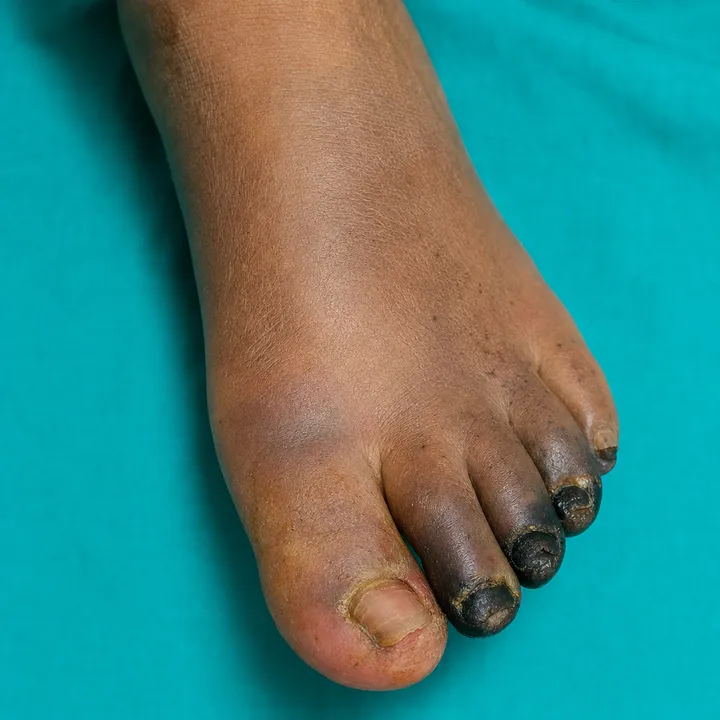
Answer: B. Diabetes mellitus
A 30-year-old man presents with 2 weeks of generalized edema and hypertension. Urine testing shows protein excretion of 1.5 g/day and microscopic hematuria. Serum complement levels are decreased, and anti-hepatitis C antibodies and serum HCV RNA are positive. Renal biopsy shows mesangial and endocapillary proliferation, duplication (double contours) of glomerular basement membranes, and subendothelial immune deposits containing IgG and C3. What is the most likely diagnosis?
Answer: D. Membranoproliferative glomerulonephritis
In an adult with nephrotic syndrome, which noninvasive investigation is most specific for primary membranous nephropathy?
Answer: B. Serum anti-PLA2R antibodies
Chapter Downloads
12 chapters
Acute Kidney Injury

Chronic Kidney Disease

Glomerular Diseases

Tubulointerstitial Diseases

Nephrotic and Nephritic Syndromes

Urinary Tract Infections

Renal Replacement Therapy

Fluid and Electrolyte Disorders

Acid-Base Disorders

Kidney in Systemic Diseases

Kidney Stones and Obstructive Uropathy

Hypertension in Kidney Disease
About Nephrology for FMGE
Nephrology is an important topic within Internal Medicine for FMGE preparation. Understanding the core concepts, key applications, and frequently tested areas in Nephrology can make a significant difference in your exam performance. This page brings together all the study resources you need for Nephrology in one place.
The downloadable PDFs include a comprehensive MCQ question bank with answer keys, concise lesson notes that cover high-yield points, comparison tables for quick revision, and flowcharts that simplify complex mechanisms and classifications. Previous year questions (PYQs) are also available so you can see exactly how Nephrology has been tested in past FMGE exams.
All resources are free to download and designed for offline study. Whether you are doing a first read or a last-minute revision, these PDFs give you a structured way to cover Nephrology under Internal Medicine. For an even more interactive experience — with spaced-repetition flashcards, adaptive question practice, and AI-powered explanations — download the Oncourse app.
Frequently Asked Questions
How do I download Nephrology MCQ PDF for FMGE?
Are the Nephrology question banks free?
How many Nephrology MCQs can I get for FMGE?
What formats are available for Nephrology study material?
Is the Nephrology content updated for the latest FMGE syllabus?
More Internal Medicine downloads
Browse other topics