
Surgical wound classification — MCQs

The surgical equipment used during a craniectomy is sterilized using pressurized steam at 121°C for 15 minutes. Reuse of these instruments can cause transmission of which of the following pathogens?
Two hours after admission to the intensive care unit, a 56-year-old man with necrotizing pancreatitis develops profound hypotension. His blood pressure is 80/50 mm Hg and he is started on vasopressors. A central venous access line is placed. Which of the following is most likely to decrease the risk of complications from this procedure?
During the examination of a gunshot wound, the forensic pathologist notes an entrance wound with abrasion collar and soot deposition. The wound shows a stellate-shaped pattern with irregular margins. This pattern most likely indicates which of the following?
A 43-year-old woman comes to the physician because of a 3-month history of a painless ulcer on the sole of her right foot. There is no history of trauma. She has been dressing the ulcer once daily at home with gauze. She has a 15-year history of poorly-controlled type 1 diabetes mellitus and hypertension. Current medications include insulin and lisinopril. Vital signs are within normal limits. Examination shows a 2 x 2-cm ulcer on the plantar aspect of the base of the great toe with whitish, loose tissue on the floor of the ulcer and a calloused margin. A blunt metal probe reaches the deep plantar space. Sensation to vibration and light touch is decreased over both feet. Pedal pulses are intact. An x-ray of the right foot shows no abnormalities. Which of the following is the most appropriate initial step in management?
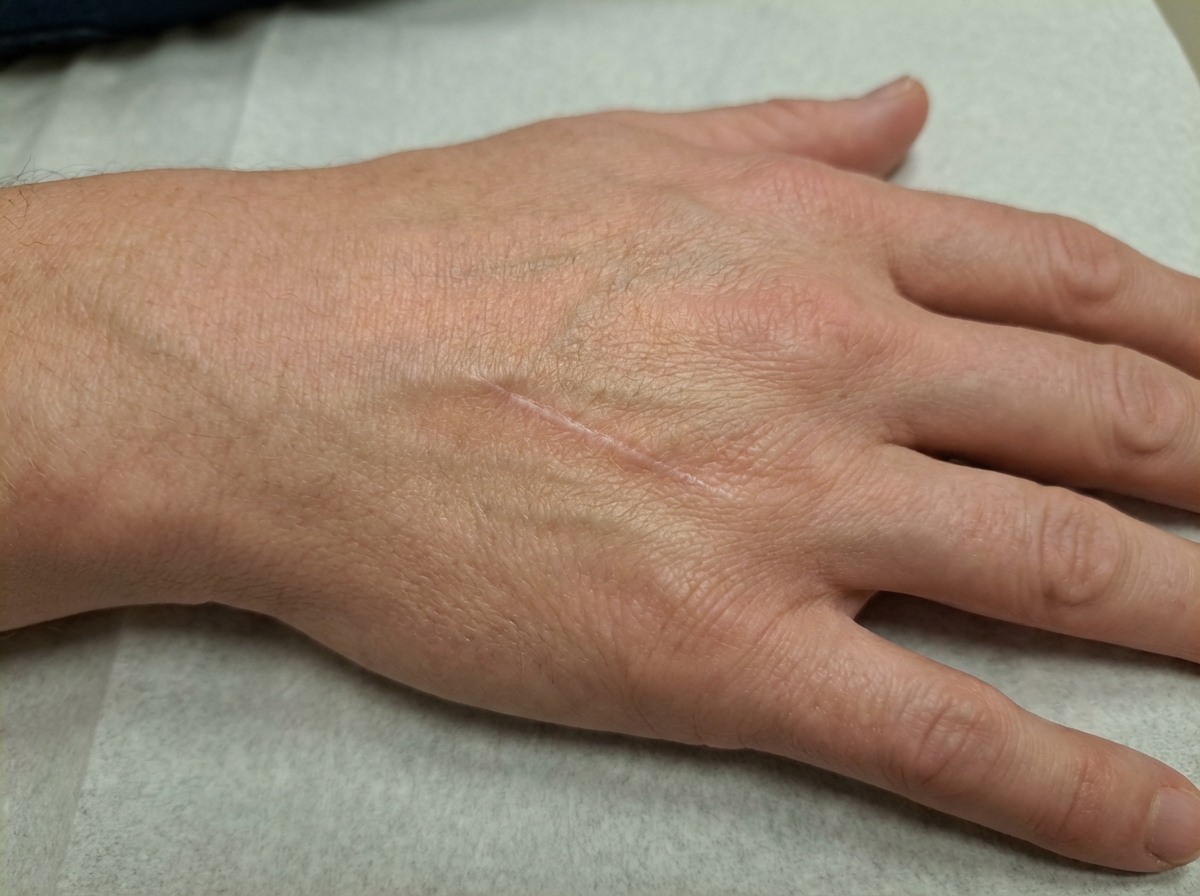
A 16-year-old boy presents to the emergency department after a skateboarding accident. He fell on a broken bottle and received a 4 cm wound on the dorsal aspect of his left hand. His vitals are stable and he was evaluated by the surgeon on call who determined that suturing was not required. After several weeks the wound has almost completely healed (see image). Which of the following is the correct description of this patient's wound before healing?
A previously healthy 5-year-old boy is brought to the emergency department 15 minutes after sustaining an injury to his right hand. His mother says that she was cleaning the bathroom when he accidentally knocked over the drain cleaner bottle and spilled the liquid onto his hand. On arrival, he is crying and holding his right hand in a flexed position. His temperature is 37.7°C (99.8°F), pulse is 105/min, respirations are 25/min, and blood pressure is 105/65 mm Hg. Examination of the right hand shows a 4 x 4 cm area of reddened, blistered skin. The area is very tender to light touch. His ability to flex and extend the right hand are diminished. Radial pulses are palpable. Capillary refill time is less than 3 seconds. Which of the following is the most appropriate next step in management?
A 38-year-old, working, first-time mother brings her 9-month-old male infant to the pediatrician for "wounds that simply won't heal" and bleeding gums. She exclaims, "I have been extra careful with him making sure to not let him get dirty, I boil his baby formula for 15 minutes each morning before I leave for work to give to the caregiver, and he has gotten all of his vaccinations." This infant is deficient in a molecule that is also an essential co-factor for which of the following reactions?
A 15-year-old boy is brought to the emergency department by ambulance after his mother found him having muscle spasms and stiffness in his room. His mother stated he scraped his foot on a rusty razor on the bathroom floor 2 days prior. On presentation, his temperature is 102.0°F (38.9°C), blood pressure is 108/73 mmHg, pulse is 122/min, and respirations are 18/min. On physical exam, he is found to have severe muscle spasms and rigid abdominal muscles. In addition, he has a dirty appearing wound on his right foot. The patient's mother does not recall any further vaccinations since age 12. Finally, he is found to have difficulty opening his mouth so he is intubated. Which of the following treatment(s) should be provided to this patient?
A 39-year-old man comes to the physician for a follow-up examination. He was treated for a urinary tract infection with trimethoprim-sulfamethoxazole 2 months ago. He is paraplegic as a result of a burst lumbar fracture that occurred after a fall 5 years ago. He has hypertension and type 2 diabetes mellitus. Current medications include enalapril and metformin. He performs clean intermittent catheterization daily. He has smoked one pack of cigarettes daily for 19 years. His temperature is 37.1°C (98.8°F), pulse is 95/min, respirations are 14/min, and blood pressure is 120/80 mm Hg. He appears malnourished. Examination shows palpable pedal pulse. Multiple dilated tortuous veins are present over both lower extremities. There is a 2-cm wound surrounded by partial-thickness loss of skin and a pink wound bed over the right calcaneum. Neurologic examination shows paraparesis. His hemoglobin A1c is 6.5%, and fingerstick blood glucose concentration is 134 mg/dL. Which of the following is most likely to have prevented this patient's wound?
A 63-year-old man comes to the emergency department because of pain in his left groin for the past hour. The pain began soon after he returned from a walk. He describes it as 8 out of 10 in intensity and vomited once on the way to the hospital. He has had a swelling of the left groin for the past 2 months. He has chronic obstructive pulmonary disease and hypertension. Current medications include amlodipine, albuterol inhaler, and a salmeterol-fluticasone inhaler. He appears uncomfortable. His temperature is 37.4°C (99.3°F), pulse is 101/min, and blood pressure is 126/84 mm Hg. Examination shows a tender bulge on the left side above the inguinal ligament that extends into the left scrotum; lying down or applying external force does not reduce the swelling. Coughing does not make the swelling bulge further. There is no erythema. The abdomen is distended. Bowel sounds are hyperactive. Scattered rhonchi are heard throughout both lung fields. Which of the following is the most appropriate next step in management?
Want unlimited practice?
Get full access to all questions, explanations, and performance tracking.
Scan to download app