
Surgical site infections — MCQs

A 56-year-old previously healthy woman with no other past medical history is post-operative day one from an open reduction and internal fixation of a fractured right radius and ulna after a motor vehicle accident. What is one of the primary ways of preventing postoperative pneumonia in this patient?
Two hours after admission to the intensive care unit, a 56-year-old man with necrotizing pancreatitis develops profound hypotension. His blood pressure is 80/50 mm Hg and he is started on vasopressors. A central venous access line is placed. Which of the following is most likely to decrease the risk of complications from this procedure?
A 62-year-old man comes to the physician because of an oozing skin ulceration on his foot for 1 week. He has a history of type 2 diabetes mellitus and does not adhere to his medication regimen. Physical exam shows purulent discharge from an ulcer on the dorsum of his left foot. Pinprick sensation is decreased bilaterally to the level of the mid-tibia. A culture of the wound grows beta-hemolytic, coagulase-positive cocci in clusters. The causal organism most likely produces which of the following virulence factors?
Five days after being admitted to the hospital for a scald wound, a 2-year-old boy is found to have a temperature of 40.2°C (104.4°F). He does not have difficulty breathing, cough, or painful urination. He initially presented one hour after spilling a pot of boiling water on his torso while his mother was cooking dinner. He was admitted for fluid resuscitation, nutritional support, pain management, and wound care, and he was progressing well until today. He has no other medical conditions. Other than analgesia during this hospital stay, he does not take any medications. He appears uncomfortable but not in acute distress. His pulse is 150/min, respirations are 41/min, and blood pressure is 90/50 mm Hg. Pulse oximetry on room air shows an oxygen saturation of 99%. Examination shows uneven, asymmetrical scalding covering his anterior torso in arrow-like patterns with surrounding erythema and purulent discharge. The remainder of the examination shows no abnormalities. His hemoglobin is 13.4 g/dL, platelet count is 200,000/mm3, and leukocyte count is 13,900/mm3. Which of the following is the most appropriate initial pharmacological treatment for this patient?
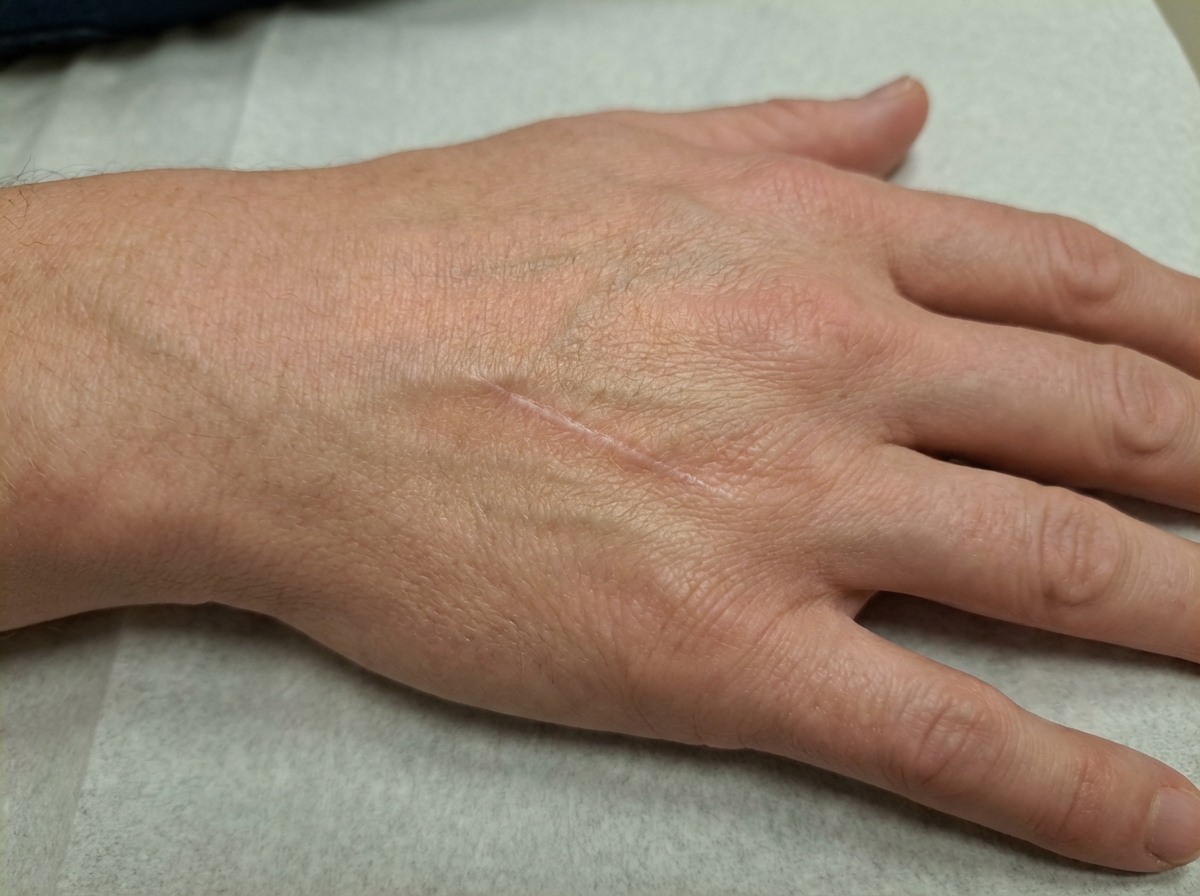
A 16-year-old boy presents to the emergency department after a skateboarding accident. He fell on a broken bottle and received a 4 cm wound on the dorsal aspect of his left hand. His vitals are stable and he was evaluated by the surgeon on call who determined that suturing was not required. After several weeks the wound has almost completely healed (see image). Which of the following is the correct description of this patient's wound before healing?
A 63-year-old female recovering from a total shoulder arthroplasty completed 6 days ago presents complaining of joint pain in her repaired shoulder. Temperature is 39 degrees Celsius. Physical examination demonstrates erythema and significant tenderness around the incision site. Wound cultures reveal Gram-positive cocci that are resistant to nafcillin. Which of the following organisms is the most likely cause of this patient's condition?
A 67-year-old man is brought to the emergency department because of severe dyspnea and orthopnea for 6 hours. He has a history of congestive heart disease and an ejection fraction of 40%. The medical history is otherwise unremarkable. He appears confused. At the hospital, his blood pressure is 165/110 mm Hg, the pulse is 135/min, the respirations are 48/min, and the temperature is 36.2°C (97.2°F). Crackles are heard at both lung bases. There is pitting edema from the midtibia to the ankle bilaterally. The patient is intubated and admitted to the critical care unit for mechanical ventilation and treatment. Intravenous morphine, diuretics, and nitroglycerine are initiated. Which of the following is the most effective method to prevent nosocomial infection in this patient?
A 37-year-old-woman presents to the emergency room with complaints of fever and abdominal pain. Her blood pressure is 130/74 mmHg, pulse is 98/min, temperature is 101.5°F (38.6°C), and respirations are 23/min. The patient reports that she had a laparoscopic cholecystectomy 4 days ago but has otherwise been healthy. She is visiting her family from Nebraska and just arrived this morning from a 12-hour drive. Physical examination revealed erythema and white discharge from abdominal incisions and tenderness upon palpations at the right upper quadrant. What is the most probable cause of the patient’s fever?
A 43-year-old man is brought to the emergency department 40 minutes after falling off a 10-foot ladder. He has severe pain and swelling of his right ankle and is unable to walk. He did not lose consciousness after the fall. He has no nausea. He appears uncomfortable. His temperature is 37°C (98.6°F), pulse is 98/min, respirations are 16/min, and blood pressure is 110/80 mm Hg. He is alert and oriented to person, place, and time. Examination shows multiple abrasions over both lower extremities. There is swelling and tenderness of the right ankle; range of motion is limited by pain. The remainder of the examination shows no abnormalities. An x-ray of the ankle shows an extra-articular calcaneal fracture. Intravenous analgesia is administered. Which of the following is the most appropriate next step in the management of this patient?
A 35-year-old man suffers severe polytrauma including traumatic brain injury (GCS 6), pulmonary contusions, splenic laceration, and open femur fracture. He undergoes damage control surgery with splenectomy and external fixation. On ICU day 4, he develops worsening hypoxemia (PaO2/FiO2 ratio 150), bilateral infiltrates on chest X-ray, normal pulmonary capillary wedge pressure, petechiae, and altered mental status beyond his head injury. Fat globules are noted in urine. Platelet count drops from 245,000 to 89,000/μL. Evaluate the diagnosis and management priority.
Want unlimited practice?
Get full access to all questions, explanations, and performance tracking.
Scan to download app