
External fixation principles — MCQs

A 36-year-old male is taken to the emergency room after jumping from a building. Bilateral fractures to the femur were stabilized at the scene by emergency medical technicians. The patient is lucid upon questioning and his vitals are stable. Pain only at his hips was elicited. Cervical exam was not performed. What is the best imaging study for this patient?
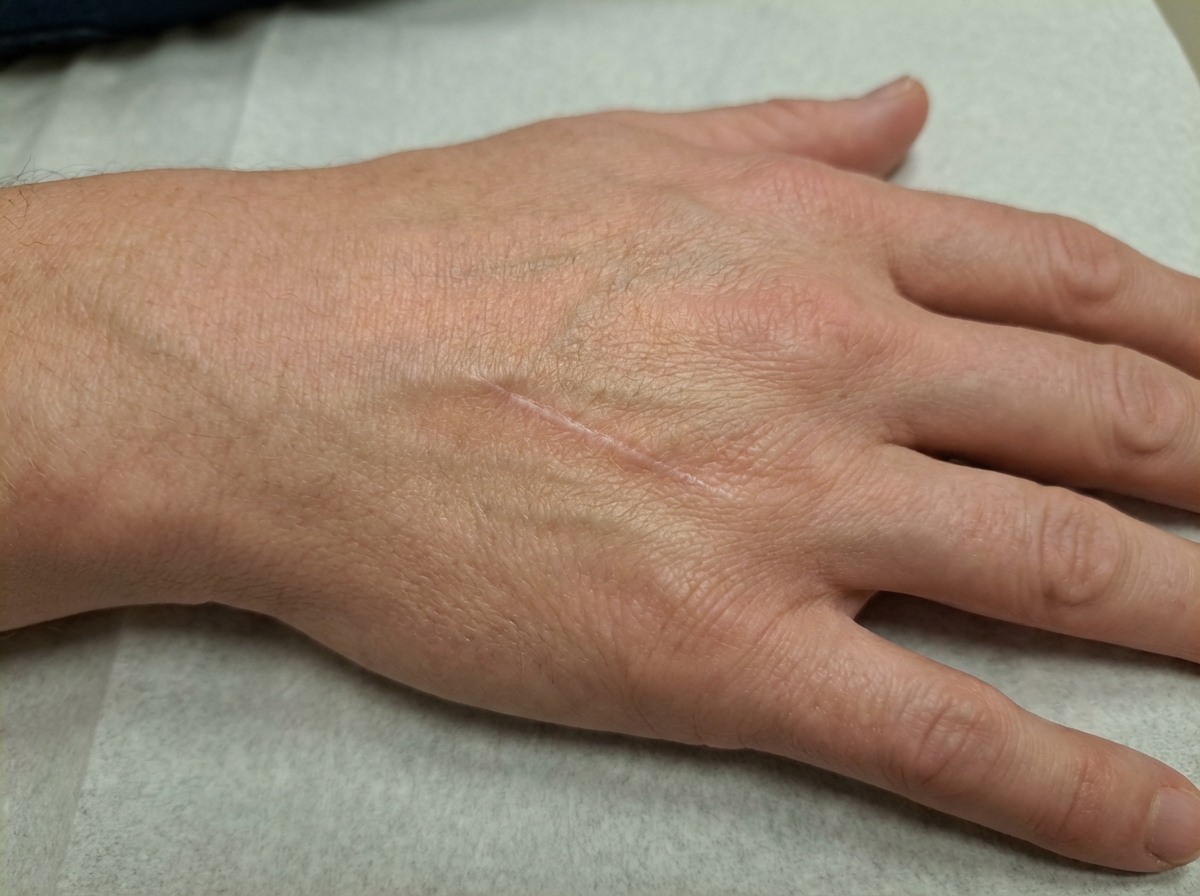
A 16-year-old boy presents to the emergency department after a skateboarding accident. He fell on a broken bottle and received a 4 cm wound on the dorsal aspect of his left hand. His vitals are stable and he was evaluated by the surgeon on call who determined that suturing was not required. After several weeks the wound has almost completely healed (see image). Which of the following is the correct description of this patient's wound before healing?
A 54-year-old male carpenter accidentally amputated his right thumb while working in his workshop 30 minutes ago. He reports that he was cutting a piece of wood, and his hand became caught up in the machinery. He is calling the emergency physician for advice on how to transport his thumb and if it is necessary. Which of the following is the best information for this patient?
A 7-year-old boy is brought by his parents to his pediatrician with a one-day history of fever, chills, and pain in the right upper extremity. The patient's mother says that he has injured his right index finger while playing in the garden 3 days earlier. His temperature is 38.8°C (101.8°F), pulse is 120/min, respiratory rate is 24/min, and blood pressure is 102/70 mm Hg. On physical examination, there is an infected wound present on the tip of the right index finger. Irregular linear subcutaneous red streaks are seen on the ventral surface of the right forearm, which is warm and tender to palpation. There is painful right infraclavicular lymphadenopathy present. Which of the following is the most common microorganism known to cause this patient's condition?
A 63-year-old female recovering from a total shoulder arthroplasty completed 6 days ago presents complaining of joint pain in her repaired shoulder. Temperature is 39 degrees Celsius. Physical examination demonstrates erythema and significant tenderness around the incision site. Wound cultures reveal Gram-positive cocci that are resistant to nafcillin. Which of the following organisms is the most likely cause of this patient's condition?
A 25-year-old man is admitted to the emergency department because of an episode of acute psychosis with suicidal ideation. He has no history of serious illness and currently takes no medications. Despite appropriate safety precautions, he manages to leave the examination room unattended. Shortly afterward, he is found lying outside the emergency department. A visitor reports that she saw the patient climbing up the facade of the hospital building. He does not respond to questions but points to his head when asked about pain. His pulse is 131/min, respirations are 22/min, and blood pressure is 95/61 mm Hg. Physical examination shows a 1-cm head laceration and an open fracture of the right tibia. He opens his eyes spontaneously. Pupils are equal, round, and reactive to light. Breath sounds are decreased over the right lung field, and the upper right hemithorax is hyperresonant to percussion. Which of the following is the most appropriate next step in management?
A 17-year-old boy comes to the emergency department following an injury during football practice. He fell and landed on the lateral aspect of his right shoulder. He is holding his right arm supported by his left arm, with his right arm adducted against his side. He is tender to palpation directly over the middle third of his clavicle. Radiographs reveal a non-displaced fracture of the middle third of the clavicle. Which of the following is the most appropriate treatment at this time?
A 28-year-old soldier is brought back to a military treatment facility 45 minutes after sustaining injuries in a building fire from a mortar attack. He was trapped inside the building for around 20 minutes. On arrival, he is confused and appears uncomfortable. He has a Glasgow Coma Score of 13. His pulse is 113/min, respirations are 18/min, and blood pressure is 108/70 mm Hg. Pulse oximetry on room air shows an oxygen saturation of 96%. Examination shows multiple second-degree burns over the chest and bilateral upper extremities and third-degree burns over the face. There are black sediments seen within the nose and mouth. The lungs are clear to auscultation. Cardiac examination shows no abnormalities. The abdomen is soft and nontender. Intravenous fluid resuscitation is begun. Which of the following is the most appropriate next step in management?
A 50-year-old manual laborer sustained a comminuted distal radius fracture treated with ORIF 3 months ago. Despite supervised hand therapy, he has persistent stiffness with 30-degree wrist extension (normal 70), weak grip strength at 40% of contralateral side, and visible muscle atrophy. He reports burning pain with light touch and keeps his hand wrapped in a sock. Skin appears mottled with decreased hair growth. He is applying for disability and has a pending lawsuit. Evaluate the clinical picture and appropriate next step.
A 16-year-old basketball player presents with chronic anterior knee pain worse with jumping and kneeling. Examination shows tenderness at the inferior pole of the patella and pain with resisted knee extension. X-ray shows elongation and fragmentation of the inferior patellar pole. He has failed 6 months of physical therapy, activity modification, and NSAIDs. His AAU season starts in 6 weeks and a college scout will be attending. His parents want definitive treatment. Evaluate the management approach balancing medical and contextual factors.
Want unlimited practice?
Get full access to all questions, explanations, and performance tracking.
Scan to download app