
Lung resection procedures — MCQs

A 57-year-old man presents to his family physician for a routine exam. He feels well and reports no new complaints since his visit last year. Last year, he had a colonoscopy which showed no polyps, a low dose chest computerized tomography (CT) scan that showed no masses, and routine labs which showed a fasting glucose of 93 mg/dL. He is relatively sedentary and has a body mass index (BMI) of 24 kg/m^2. He has a history of using methamphetamines, alcohol (4-5 drinks per day since age 30), and tobacco (1 pack per day since age 18), but he joined Alcoholics Anonymous and has been in recovery, not using any of these for the past 7 years. Which of the following is indicated at this time?
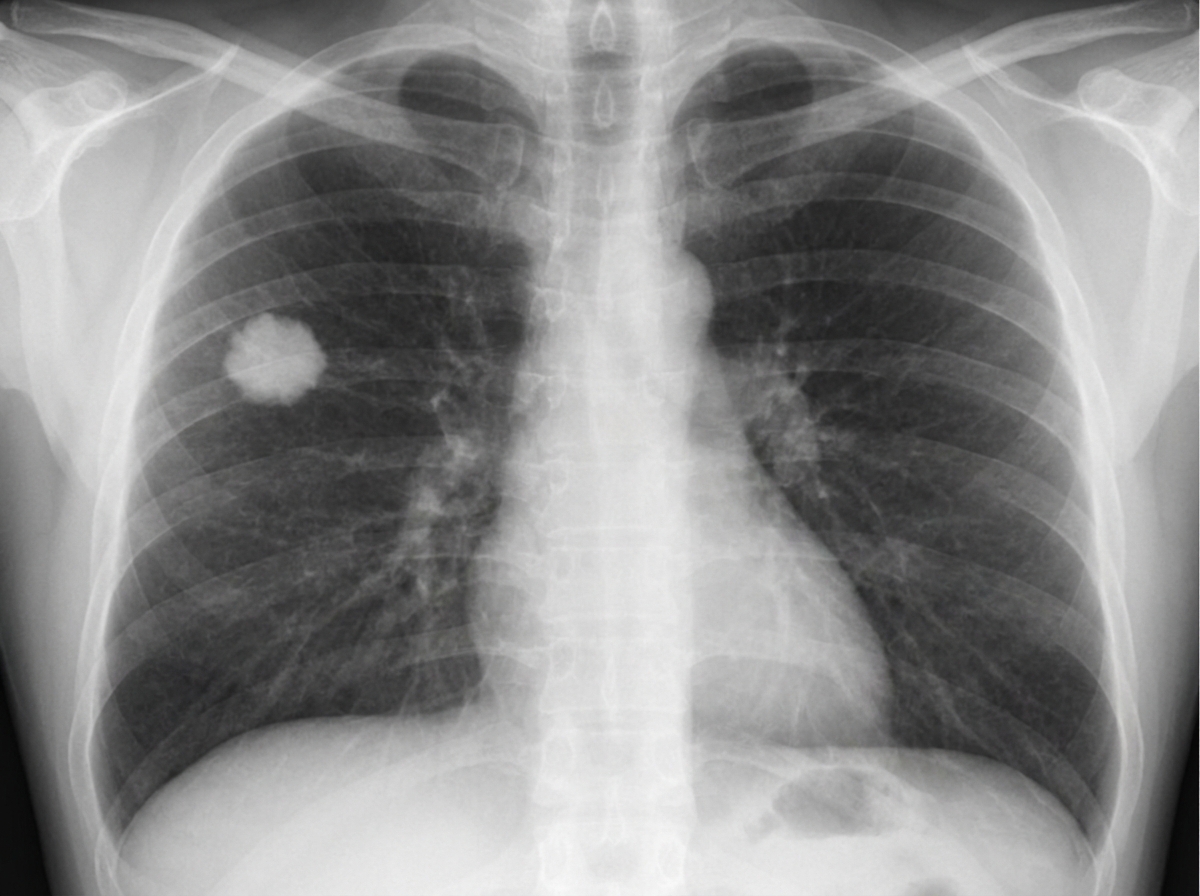
A 60-year-old man comes to the physician for an examination prior to a scheduled cholecystectomy. He has hypertension treated with hydrochlorothiazide. His mother had chronic granulomatous disease of the lung. He works in a glass manufacturing plant. He has smoked two packs of cigarettes daily for 38 years. His vital signs are within normal limits. Examination shows no abnormalities. Laboratory studies are within the reference range. An x-ray of the chest is shown. Which of the following is the most appropriate next step in management?
A 56-year-old previously healthy woman with no other past medical history is post-operative day one from an open reduction and internal fixation of a fractured right radius and ulna after a motor vehicle accident. What is one of the primary ways of preventing postoperative pneumonia in this patient?
A 61-year-old man comes to the physician because of a 3-month history of worsening exertional dyspnea and a persistent dry cough. For 37 years he has worked in a naval shipyard. He has smoked 1 pack of cigarettes daily for the past 40 years. Pulmonary examination shows fine bibasilar end-expiratory crackles. An x-ray of the chest shows diffuse bilateral infiltrates predominantly in the lower lobes and pleural reticulonodular opacities. A CT scan of the chest shows pleural plaques and subpleural linear opacities. The patient is most likely to develop which of the following conditions?
A 35-year-old woman volunteers for a study on respiratory physiology. Pressure probes A and B are placed as follows: Probe A: between the parietal and visceral pleura Probe B: within the cavity of an alveolus The probes provide a pressure reading relative to atmospheric pressure. To obtain a baseline reading, she is asked to sit comfortably and breathe normally. Which of the following sets of values will most likely be seen at the end of inspiration?
A 62-year-old man comes to the physician for a follow-up examination after having been diagnosed with stage II adenocarcinoma of the left lower lung lobe without evidence of distant metastases 1 week ago following an evaluation for a chronic cough. He has hypertension and type 2 diabetes mellitus. He has smoked one pack of cigarettes daily for the past 40 years. His current medications include metformin, sitagliptin, and enalapril. He is 177 cm (5 ft 10 in) tall and weighs 65 kg (143 lb); BMI is 20.7 kg/m2. He appears lethargic. Vital signs are within normal limits. Pulse oximetry shows an oxygen saturation of 98%. Examination shows inspiratory wheezing at the left lung base. The remainder of the examination shows no abnormalities. A complete blood count and serum concentrations of electrolytes, creatinine, glucose, and liver enzymes are within the reference range. Spirometry shows an FEV1 of 1.6 L. The diffusing lung capacity for carbon monoxide (DLCO) is 66% of predicted. Which of the following is the most appropriate next step in the management of this patient?
In which of the following pathological states would the oxygen content of the trachea resemble the oxygen content in the affected alveoli?
A 56-year-old man presents to the emergency department with severe chest pain and a burning sensation. He accidentally drank a cup of fluid at his construction site 2 hours ago. The liquid was later found to contain lye. On physical examination, his blood pressure is 100/57 mm Hg, respiratory rate is 21/min, pulse is 84/min, and temperature is 37.7°C (99.9°F). The patient is sent immediately to the radiology department. The CT scan shows air in the mediastinum, and a contrast swallow study confirms the likely diagnosis. Which of the following is the best next step in the management of this patient’s condition?
A 45-year-old man presents with a 3-day history of fever, right upper quadrant pain, and jaundice. He has a history of choledocholithiasis. On examination, temperature is 39.4°C, BP is 85/50 mmHg, HR is 122 bpm, and he is confused. RUQ ultrasound shows a dilated common bile duct of 14 mm with a shadowing calculus. Total bilirubin is 8.2 mg/dL, WBC is 22,000/µL, and alkaline phosphatase is markedly elevated. After initiating IV fluids and broad-spectrum antibiotics, what is the most appropriate next step?
A 70-year-old man with severe ischemic cardiomyopathy (EF 25%) has recurrent ventricular tachycardia despite optimal medical therapy and ICD placement. Cardiac MRI shows a large anteroseptal scar with viable myocardium in the lateral and inferior walls. He has three-vessel coronary disease. His daughter is advocating for heart transplantation, but he has multiple comorbidities including obesity (BMI 37) and active tobacco use. Evaluate the management priority and rationale.
Want unlimited practice?
Get full access to all questions, explanations, and performance tracking.
Scan to download app