
Exposure and environmental control — MCQs

A 34-year-old male is brought to the emergency department by fire and rescue following a motor vehicle accident in which the patient was an unrestrained driver. The paramedics report that the patient was struck from behind by a drunk driver. He was mentating well at the scene but complained of pain in his abdomen. The patient has no known past medical history. In the trauma bay, his temperature is 98.9°F (37.2°C), blood pressure is 86/51 mmHg, pulse is 138/min, and respirations are 18/min. The patient is somnolent but arousable to voice and pain. His lungs are clear to auscultation bilaterally. He is diffusely tender to palpation on abdominal exam with bruising over the left upper abdomen. His distal pulses are thready, and capillary refill is delayed bilaterally. Two large-bore peripheral intravenous lines are placed to bolus him with intravenous 0.9% saline. Chest radiograph shows multiple left lower rib fractures. Which of the following parameters is most likely to be seen in this patient?
A 27-year-old soldier is brought to the emergency department of a military hospital 20 minutes after being involved in a motor vehicle accident during a training exercise. He was an unrestrained passenger. On arrival, he has shortness of breath and chest pain. He appears pale and anxious. His temperature is 37°C (98.6°F), pulse is 110/min, respirations are 20/min, and blood pressure is 100/65 mm Hg. He is alert and oriented to person, place, and time. Examination shows pale conjunctivae and mucous membranes. There is bruising on the chest, extremities, and abdomen. The lungs are clear to auscultation. He has normal heart sounds and flat neck veins. The abdomen is flat, soft, and mildly tender. The remainder of the physical examination shows no abnormalities. High-flow oxygen is applied, and intravenous fluid resuscitation is begun. A chest x-ray is obtained. Which of the following is the most appropriate next step in management?
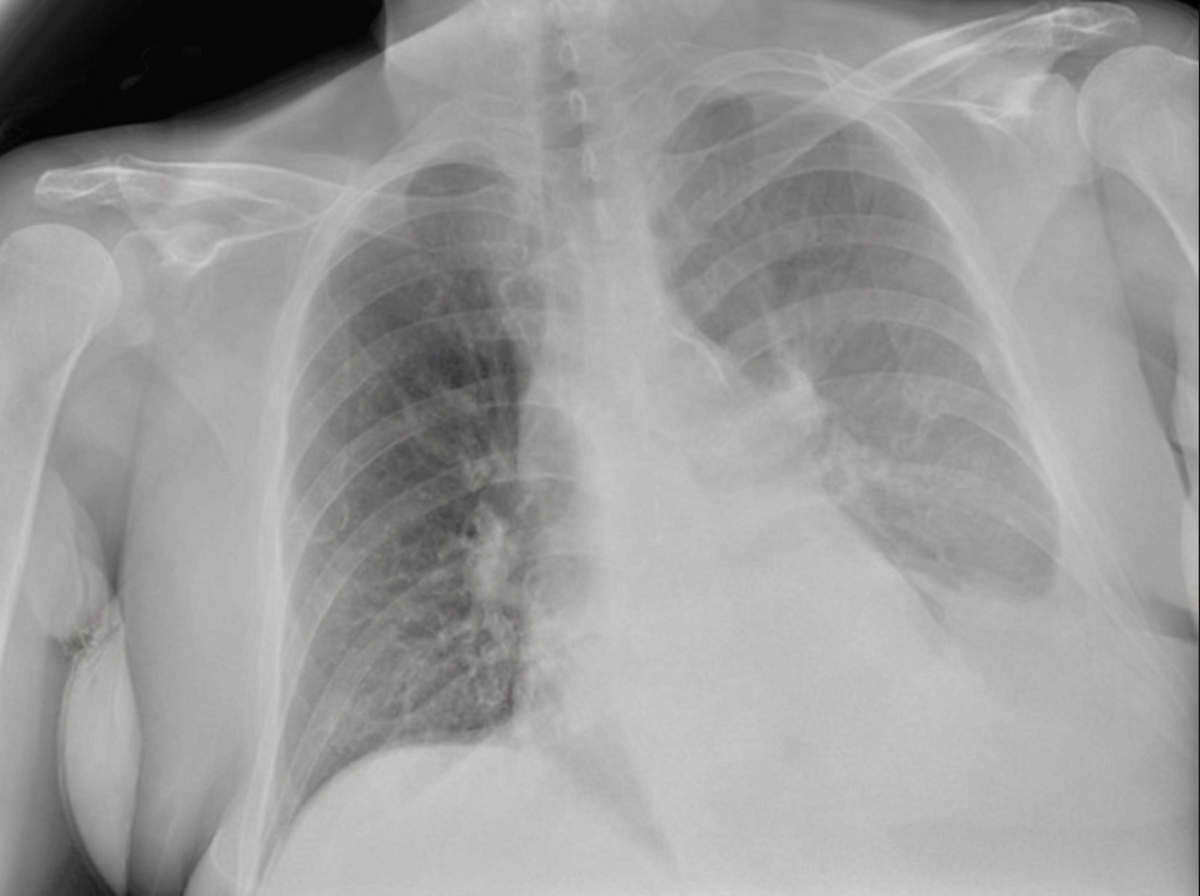
A trauma 'huddle' is called. Morphine is administered for pain. Low-flow oxygen is begun. A traumatic diaphragmatic rupture is suspected. Infusion of 0.9% saline is begun. Which of the following is the most appropriate next step in management?
A 78-year-old woman is brought to the emergency ward by her son for lethargy and generalized weakness. The patient speaks in short utterances and does not make eye contact with the provider or her son throughout the interview and examination. You elicit that the patient lives with her son and daughter-in-law, and she reports vague weakness for the last couple days. The emergency room provider notices 3-4 healing bruises on the patient's upper extremities; otherwise, examination is not revealing. Routine chemistries and blood counts are unremarkable; non-contrast head CT demonstrates normal age-related changes. Which of the following is the most appropriate next step in management?
A 45-year-old man is found deceased in his bedroom. Time of death needs to be established for legal purposes. The body temperature is 32°C (89.6°F), and the ambient temperature is 20°C (68°F). Rigor mortis is complete in all muscle groups. Assuming normal conditions, which of the following best estimates the postmortem interval?
A 28-year-old male presents to his primary care physician with complaints of intermittent abdominal pain and alternating bouts of constipation and diarrhea. His medical chart is not significant for any past medical problems or prior surgeries. He is not prescribed any current medications. Which of the following questions would be the most useful next question in eliciting further history from this patient?
A 25-year-old man is admitted to the emergency department because of an episode of acute psychosis with suicidal ideation. He has no history of serious illness and currently takes no medications. Despite appropriate safety precautions, he manages to leave the examination room unattended. Shortly afterward, he is found lying outside the emergency department. A visitor reports that she saw the patient climbing up the facade of the hospital building. He does not respond to questions but points to his head when asked about pain. His pulse is 131/min, respirations are 22/min, and blood pressure is 95/61 mm Hg. Physical examination shows a 1-cm head laceration and an open fracture of the right tibia. He opens his eyes spontaneously. Pupils are equal, round, and reactive to light. Breath sounds are decreased over the right lung field, and the upper right hemithorax is hyperresonant to percussion. Which of the following is the most appropriate next step in management?
A 67-year-old man is brought to the emergency room after being involved in a traffic accident. He currently complains of bilateral hip pain. His vital signs are within the normal range, and he is hemodynamically stable. The pelvic compression test is positive. External genitalia appears normal, except there is blood at the urethral meatus and a contusion at the base of the scrotum. Digital rectal examination (DRE) shows a high-riding ballotable prostate. An X-ray reveals the presence of a pelvic fracture. Which of the following initial actions is the most appropriate for this patient?
A mass casualty incident occurs with 25 casualties arriving simultaneously at a community hospital emergency department. The trauma team has limited resources with 2 operating rooms available and 4 surgeons present. Among the arriving patients: Patient A has traumatic amputation of forearm with tourniquet in place and stable vitals; Patient B has flail chest, respiratory distress, and unstable vitals; Patient C is in cardiac arrest with penetrating chest wound; Patient D has a femur fracture with stable vitals; Patient E has GCS 4 with bilateral blown pupils. Evaluate the triage priority according to ATLS mass casualty protocols.
A 35-year-old pregnant woman at 32 weeks gestation is involved in a motor vehicle collision. She is hemodynamically stable with blood pressure 105/70 mmHg, heart rate 100/min. She has left upper quadrant tenderness and left lower rib fractures. FAST examination shows fluid in the splenorenal recess. Fetal heart tones are 150/min and reassuring. CT scan shows a Grade III splenic laceration. After 6 hours of observation with stable vital signs and hemoglobin, she suddenly develops blood pressure 85/50 mmHg and heart rate 125/min. Evaluate the management priority.
Want unlimited practice?
Get full access to all questions, explanations, and performance tracking.
Scan to download app