
Alcohol use disorder — MCQs

One hour after undergoing an uncomplicated laparoscopic appendectomy, a 22-year-old man develops agitation and restlessness. He also has tremors, diffuse sweating, headache, and nausea with dry heaves. One liter of lactated ringer's was administered during the surgery and he had a blood loss of approximately 100 mL. His urine output was 100 mL. His pain has been controlled with intravenous morphine. He was admitted to the hospital 3 days ago and has not eaten in 18 hours. He has no history of serious illness. He is a junior in college. His mother has Hashimoto's thyroiditis. He has experimented with intravenous illicit drugs. He drinks 3 beers and 2 glasses of whiskey daily during the week and more on the weekends with his fraternity. He appears anxious. His temperature is 37.4°C (99.3°F), pulse is 120/min, respirations are 19/min, and blood pressure is 142/90 mm Hg. He is alert and fully oriented but keeps asking if his father, who is not present, can leave the room. Mucous membranes are moist and the skin is warm. Cardiac examination shows tachycardia and regular rhythm. The lungs are clear to auscultation. His abdomen has three port sites with clean and dry bandages. His hands tremble when his arms are extended with fingers spread apart. Which of the following is the most appropriate next step in management?
A 42-year-old homeless man is brought to the emergency room after he was found unconscious in a park. He has alcohol on his breath and is known to have a history of chronic alcoholism. A noncontrast CT scan of the head is normal. The patient is treated for acute alcohol intoxication and admitted to the hospital. The next day, the patient demands to be released. His vital signs are a pulse 120/min, a respiratory rate 22/min, and blood pressure 136/88 mm Hg. On physical examination, the patient is confused, agitated, and sweating profusely, particularly from his palms. Generalized pallor is present. What is the mechanism of action of the drug recommended to treat this patient’s most likely condition?
A 26-year-old man with a history of alcoholism presents to the emergency department with nausea, vomiting, and right upper quadrant pain. Serum studies show AST and ALT levels >5000 U/L. A suicide note is found in the patient's pocket. The most appropriate initial treatment for this patient has which of the following mechanisms of action?
A 40-year-old homeless man is brought to the emergency department after police found him in the park lying on the ground with a minor cut at the back of his head. He is confused with slurred speech and fails a breathalyzer test. Pupils are normal in size and reactive to light. A bolus of intravenous dextrose, thiamine, and naloxone is given in the emergency department. The cut on the head is sutured. Blood and urine are drawn for toxicology screening. The blood-alcohol level comes out to be 200 mg/dL. Liver function test showed an AST of 320 U/L, ALT of 150 U/L, gamma-glutamyl transferase of 100 U/L, and total and direct bilirubin level are within normal limits. Which additional physical examination finding is most likely to be present in this patient?
A 48-year-old man is brought to the emergency department by his wife 20 minutes after she witnessed him vigorously shaking for about 1 minute. During this episode, he urinated on himself. He feels drowsy and has nausea. He has a history of chronic alcoholism; he has been drinking 15 beers daily for the past 3 days. Before this time, he drank 8 beers daily. His last drink was 2 hours ago. He appears lethargic. His vital signs are within normal limits. Physical and neurologic examinations show no other abnormalities. On mental status examination, he is confused and not oriented to time. Laboratory studies show: Hematocrit 44.0% Leukocyte count 12,000/mm3 Platelet count 320,000/mm3 Serum Na+ 112 mEq/L Cl- 75 mEq/L K+ 3.8 mEq/L HCO3- 13 mEq/L Urea nitrogen 6 mEq/L Creatinine 0.6 mg/dL Albumin 2.1 g/dL Glucose 80 mg/dL Urgent treatment for this patient's current condition puts him at increased risk for which of the following adverse events?
A 39-year-old man presents to the emergency department for severe abdominal pain. His pain is located in the epigastric region of his abdomen, which he describes as sharp and persistent. His symptoms began approximately 2 days prior to presentation, and he has tried acetaminophen and ibuprofen, which did not improve his symptoms. He feels nauseated and has had 2 episodes of non-bloody, non-bilious emesis. He has a medical history of hypertension and hyperlipidemia for which he is on chlorthalidone and simvastatin. He has smoked 1 pack of cigarettes per day for the last 20 years and drinks 1 pint of vodka per day. On physical exam, there is tenderness to palpation of the upper abdomen, and the patient is noted to have tender hepatomegaly. Serum studies demonstrate: Amylase: 350 U/L (25-125 U/L) Lipase: 150 U/L (12-53 U/L) AST: 305 U/L (8-20 U/L) ALT: 152 U/L (8-20 U/L) He is admitted to the hospital and started on intravenous fluids and morphine. Approximately 18 hours after admission the patient reports to feeling anxious, tremulous, and having trouble falling asleep. His blood pressure is 165/105 mmHg and pulse is 140/min. On exam, the patient appears restless and diaphoretic. Which of the following will most likely improve this patient's symptoms?
A 33-year-old woman presents with anxiety, poor sleep, and occasional handshaking and sweating for the past 10 months. She says that the best remedy for her symptoms is a “glass of a good cognac” after work. She describes herself as a “moderate drinker”. However, on a more detailed assessment, the patient confesses that she drinks 1–2 drinks per working day and 3–5 drinks on days-off when she is partying. She was once involved in a car accident while being drunk. She works as a financial assistant and describes her job as “demanding”. She is divorced and lives with her 15-year-old daughter. She says that she often hears from her daughter that she should stop drinking. She realizes that the scope of the problem might be larger than she perceives, but she has never tried stopping drinking. She does not feel hopeless, but sometimes she feels guilty because of her behavior. She does not smoke and does not report illicit drugs use. Which of the following medications would be a proper part of the management of this patient?
A middle aged man is brought in by emergency medical services after being found unconscious, lying on the street next to an empty bottle of vodka. His past medical history is unknown. Upon evaluation, he opens his eyes spontaneously and is able to obey commands. After peripheral access is obtained, IV normal saline and glucose are administered. Suddenly, the patient becomes confused and agitated. Horizontal nystagmus is noted on exam. This acute presentation was likely caused by a deficiency in which of the following?
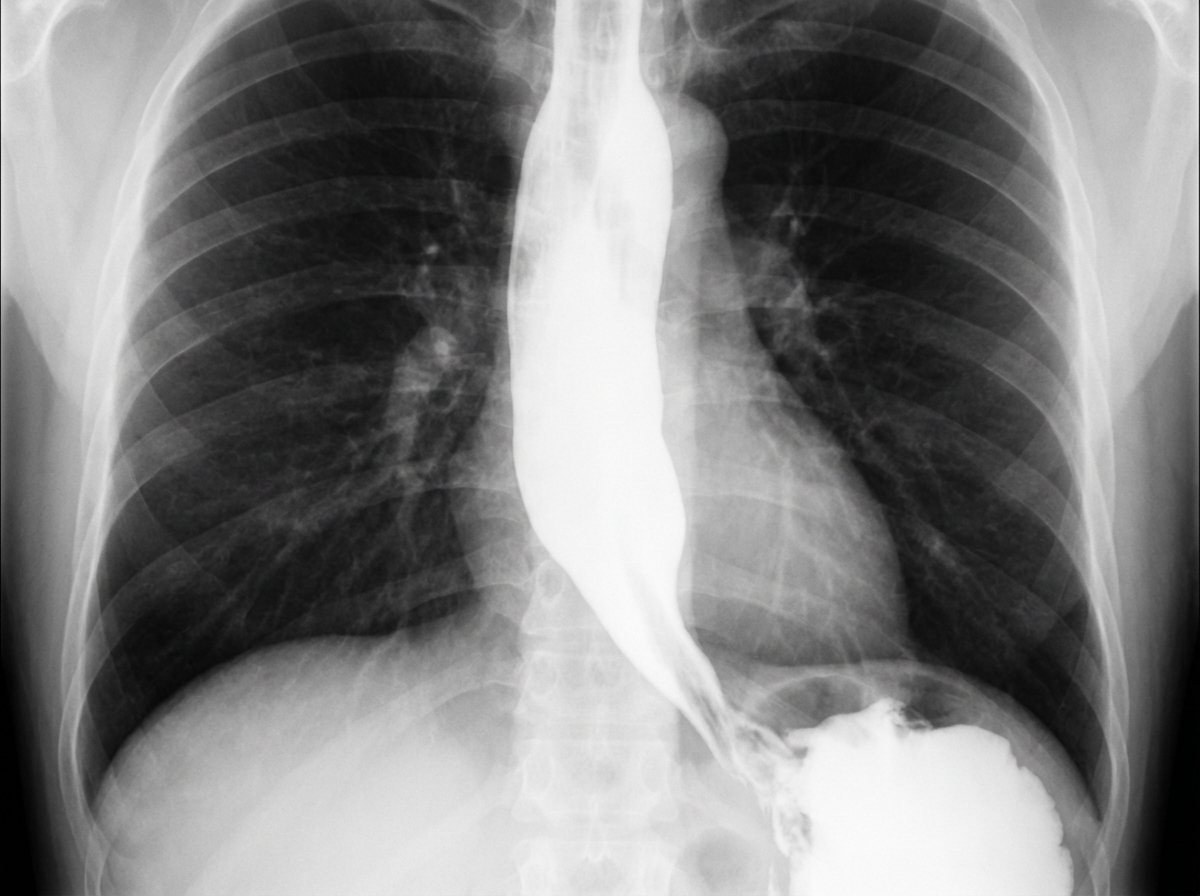
A 62-year-old man is referred to a gastroenterologist because of difficulty swallowing for the past 5 months. He has difficulty swallowing both solid and liquid foods, but there is no associated pain. He denies any shortness of breath or swelling in his legs. He immigrated from South America 10 years ago. He is a non-smoker and does not drink alcohol. His physical examination is unremarkable. A barium swallow study was ordered and the result is given below. Esophageal manometry confirms the diagnosis. What is the most likely underlying cause of this patient’s condition?
A mother presents to the family physician with her 16-year-old son. She explains, "There's something wrong with him doc. His grades are getting worse, he's cutting class, he's gaining weight, and his eyes are often bloodshot." Upon interviewing the patient apart from his mother, he seems withdrawn and angry at times when probed about his social history. The patient denies abuse and sexual history. What initial test should be sent to rule out the most likely culprit of this patient's behavior?
Want unlimited practice?
Get full access to all questions, explanations, and performance tracking.
Scan to download app