
Heat production mechanisms — MCQs

An investigator is studying a hereditary defect in the mitochondrial enzyme succinyl-CoA synthetase. In addition to succinate, the reaction catalyzed by this enzyme produces a molecule that is utilized as an energy source for protein translation. This molecule is also required for which of the following conversion reactions?
A 20-year-old woman reports to student health complaining of 5 days of viral symptoms including sneezing and a runny nose. She started coughing 2 days ago and is seeking cough medication. She additionally mentions that she developed a fever 2 days ago, but this has resolved. On exam, her temperature is 99.0°F (37.2°C), blood pressure is 118/76 mmHg, pulse is 86/min, and respirations are 12/min. Changes in the activity of warm-sensitive neurons in which part of her hypothalamus likely contributed to the development and resolution of her fever?
A 26-year-old medical student who is preparing for Step 1 exams is woken up by her friend for breakfast. She realizes that she must have fallen asleep at her desk while attempting to study through the night. While walking with her friend to breakfast, she realizes that she has not eaten since breakfast the previous day. Using this as motivation to review some biochemistry, she pauses to consider what organs are responsible for allowing her to continue thinking clearly in this physiologic state. Which of the following sets of organs are associated with the major source of energy currently facilitating her cognition?
A 2-month-old boy is presented to the clinic for a well-child visit by his parents. They are concerned with his weak cry and difficulty with feeding. Birth history reveals that the boy was born at the 37th week of gestation by cesarean section due to poor fetal movement and fetal distress. His Apgar scores were 3 and 5 at 1st and 5th minute respectively and his birth weight was 2.5 kg (6 lb). His vital signs include heart rate 120/min, respiratory rate 40/min, blood pressure 90/50 mm Hg, and temperature 37.0°C (98.6°F). Physical examination reveals a malnourished boy with a small narrow forehead and a small jaw. His mouth is small and he has comparatively small genitals. He has a poor muscle tone. After repeated follow-up, he gains weight rapidly but his height fails to increase. Developmental milestones are delayed at the age of 3 years. Genetic testing reveals Prader-Willi syndrome. Which of the following is the most common mechanism for the development of this patient’s condition?
You have been asked to deliver a lecture to medical students about the effects of various body hormones and neurotransmitters on the metabolism of glucose. Which of the following statements best describes the effects of sympathetic stimulation on glucose metabolism?
An investigator is studying muscle contraction in tissue obtained from the thigh muscle of an experimental animal. After injection of radiolabeled ATP, the tissue is stimulated with electrical impulses. Radioassay of these muscle cells is most likely to show greatest activity in which of the following structures?
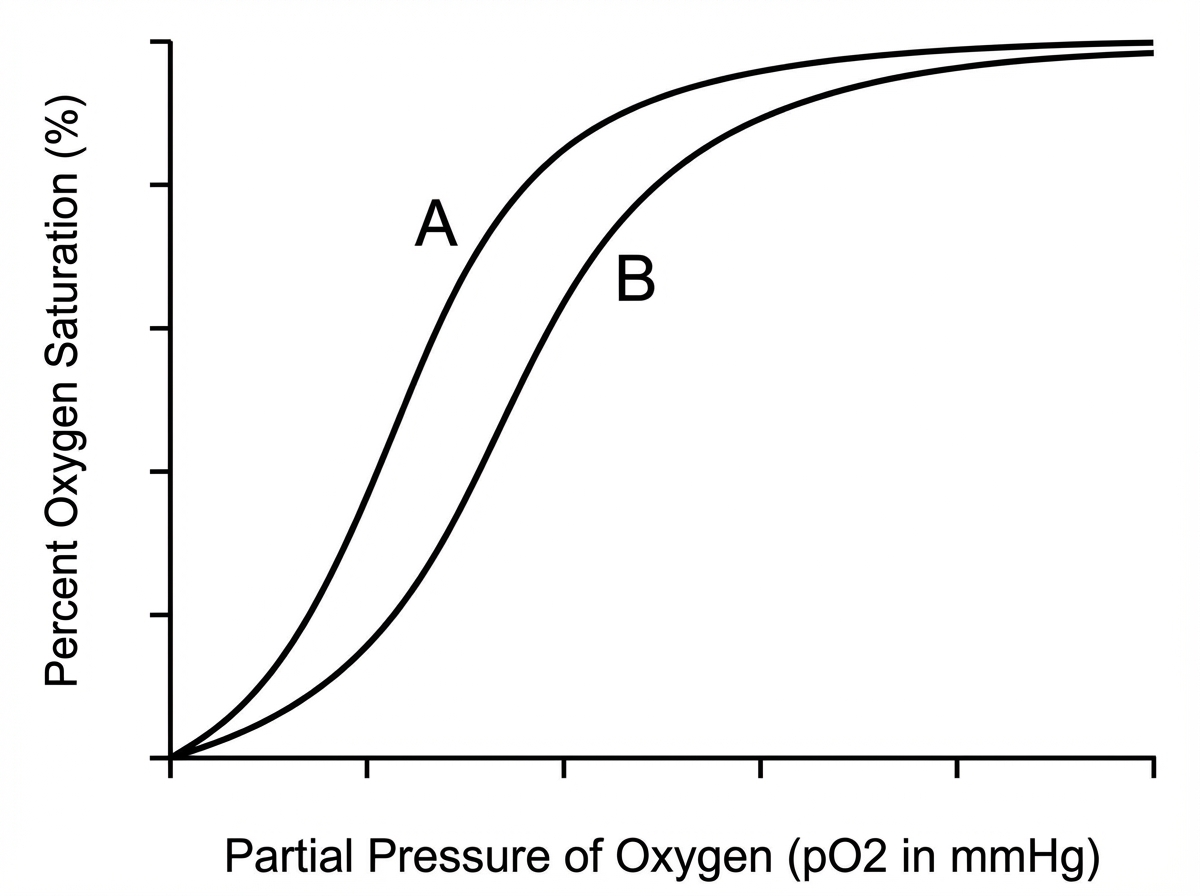
An investigator is conducting a study on hematological factors that affect the affinity of hemoglobin for oxygen. An illustration of two graphs (A and B) that represent the affinity of hemoglobin for oxygen is shown. Which of the following best explains a shift from A to B?
A 42-year-old man undergoes therapeutic hypothermia (target temperature 33°C/91.4°F) following cardiac arrest with return of spontaneous circulation. During the cooling phase, he develops shivering, which increases oxygen consumption and interferes with target temperature achievement. He is already on sedation and neuromuscular blockade is being considered. Evaluate the most appropriate management strategy considering both efficacy and safety.
A 72-year-old woman with end-stage renal disease on hemodialysis develops fever (103°F/39.4°C) with rigors during dialysis. Blood cultures from both the dialysis catheter and peripheral site grow gram-positive cocci. Despite appropriate antibiotics and catheter removal, she has persistent fevers of 101-102°F (38.3-38.9°C) for 7 days. She feels better and inflammatory markers are decreasing. Evaluate the most likely explanation for persistent fever.
A 19-year-old man at a rave party is brought to the ED with agitation, temperature of 107°F (41.7°C), severe hypertension (180/110 mm Hg), tachycardia, dilated pupils, and diaphoresis. His friends report he took 'Molly.' Despite aggressive cooling, his temperature remains dangerously elevated and he develops rhabdomyolysis. Evaluate the most appropriate additional pharmacologic intervention.
Want unlimited practice?
Get full access to all questions, explanations, and performance tracking.
Scan to download app