
Heat loss mechanisms — MCQs

A 35-year-old woman presents to the clinic for a several-month history of heat intolerance. She lives in a small apartment with her husband and reports that she always feels hot and sweaty, even when their air conditioning is on high. On further questioning, she's also had a 4.5 kg (10 lb) unintentional weight loss. The vital signs include: heart rate 102/min and blood pressure 150/80 mm Hg. The physical exam is notable for warm and slightly moist skin. She also exhibits a fine tremor in her hands when her arms are outstretched. Which of the following laboratory values is most likely low in this patient?
A 25-year-old man presents to the emergency department after a motor vehicle accident. He was the unrestrained front seat driver in a head on collision. The patient is unresponsive and his medical history is unknown. His temperature is 99.5°F (37.5°C), blood pressure is 67/38 mmHg, pulse is 190/min, respirations are 33/min, and oxygen saturation is 98% on room air. The patient is started on IV fluids, blood products, and norepinephrine. A FAST exam is performed and a pelvic binder is placed. One hour later, his temperature is 98.3°F (36.8°C), blood pressure is 119/66 mmHg, pulse is 110/min, respirations are 15/min, and oxygen saturation is 97% on room air. The patient is currently responsive. Management of the patient's pelvic fracture is scheduled by the orthopedic service. While the patient is waiting in the emergency department he suddenly complains of feeling hot, aches, and a headache. The patient's temperature is currently 101°F (38.3°C). He has not been given any pain medications and his past medical history is still unknown. Which of the following is the most likely diagnosis?
What is the primary mechanism for maintaining constant cerebral blood flow despite changes in systemic blood pressure?
A 15-year-old boy is brought to the emergency department by his father 10 minutes after falling into a frozen lake during ice fishing. He was in the water for less than 1 minute before his father managed to pull him out. On arrival, his clothes are still wet and he appears scared. His body temperature is 36.2°C (97.1°F), pulse is 102/min, blood pressure is 133/88 mm Hg. Which of the following mechanisms contributes most to maintaining this patient's core body temperature?
A 19-year-old woman is brought to the emergency department by ambulance 30 minutes after her neighbor found her unconscious on a running trail. Her neighbor reports that she has been training for a marathon since the beginning of the summer. She is alert and oriented but becomes irritable when realizing that she is at a hospital and refuses to answer questions. She appears tired. She is 174 cm (5 ft 7 in) tall and weighs 51 kg (112 lb). Her temperature is 35.5°C (96°F), pulse is 44/min, respirations are 20/min, and blood pressure is 84/48 mm Hg. Examination shows dry, scaly skin and dry mucous membranes. Cardiopulmonary examination shows a high-frequency, mid-to-late systolic murmur that is heard best at the apex. Her hemoglobin concentration is 11.9 g/dL. Which of the following is the most likely diagnosis?
A group of investigators is studying thermoregulatory adaptations of the human body. A subject is seated in a thermally insulated isolation chamber with an internal temperature of 48°C (118°F), a pressure of 1 atmosphere, and a relative humidity of 10%. Which of the following is the primary mechanism of heat loss in this subject?
A 50-year-old man is brought to his neurologist by his wife for bizarre behavior. On several occasions over the last several days, he had started to complain about ‘bunnies, tigers, and emus’ in the living room. The patient has a history of multiple sclerosis and was last seen by his primary neurologist 2 weeks ago for complaints of new left upper extremity weakness. On physical exam, his temperature is 37.0°C (98.6°F), the heart rate is 70/min, the blood pressure is 126/78 mm Hg, the respiratory rate is 16/min, and the oxygen saturation is 98% on room air. The exam is disrupted by the patient’s repeated comments about various animals in the exam room. His neurologic exam is unchanged from his neurologist's last documented exam. The basic metabolic panel is as follows: Na+ 138 mEq/L K+ 3.9 mEq/L Cl- 101 mEq/L HCO3- 24 mEq/L BUN 10 mg/dL Cr 0.6 mg/dL Glucose 356 mg/dL Which of the following is the most likely etiology of this patient's presentation?
A 67-year-old man presents to the emergency department acutely confused. The patient's wife found him mumbling incoherently in the kitchen this morning as they were preparing for a hike. The patient was previously healthy and only had a history of mild forgetfulness, depression, asthma, and seasonal allergies. His temperature is 98.5°F (36.9°C), blood pressure is 122/62 mmHg, pulse is 119/min, and oxygen saturation is 98% on room air. The patient is answering questions inappropriately and seems confused. Physical exam is notable for warm, flushed, and dry skin. The patient's pupils are dilated. Which of the following is also likely to be found in this patient?
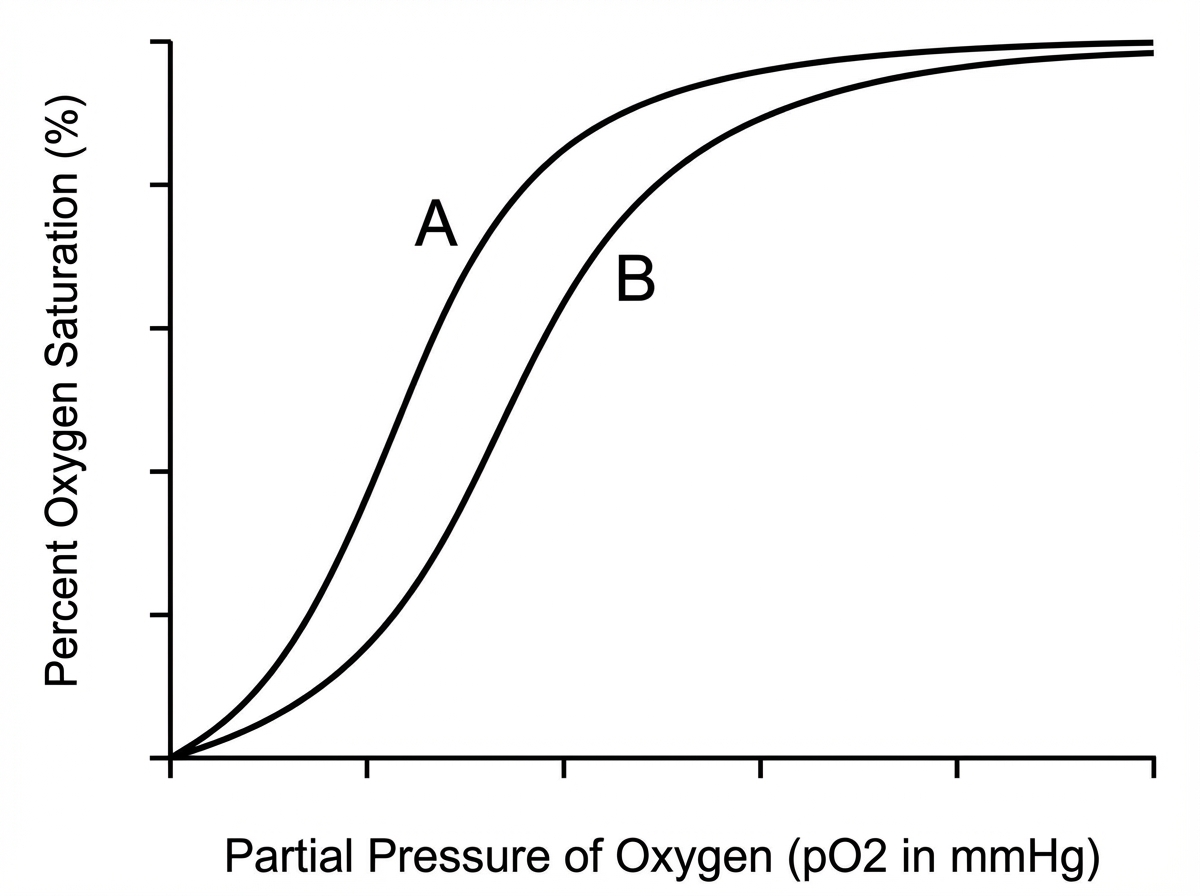
An investigator is conducting a study on hematological factors that affect the affinity of hemoglobin for oxygen. An illustration of two graphs (A and B) that represent the affinity of hemoglobin for oxygen is shown. Which of the following best explains a shift from A to B?
An investigator studying new drug delivery systems administers an aerosol containing 6.7-μm sized particles to a healthy subject via a nonrebreather mask. Which of the following is the most likely route of clearance of the particulate matter in this subject?
Want unlimited practice?
Get full access to all questions, explanations, and performance tracking.
Scan to download app