
High altitude adaptation — MCQs

A 24-year-old professional athlete is advised to train in the mountains to enhance his performance. After 5 months of training at an altitude of 1.5 km (5,000 feet), he is able to increase his running pace while competing at sea-level venues. Which of the following changes would produce the same effect on the oxygen-hemoglobin dissociation curve as this athlete's training did?
An experiment to determine the effects of gravity on blood pressure is conducted on 3 individuals of equal height and blood pressure oriented in different positions in space. Participant A is strapped in a supine position on a bed turned upside down in a vertical orientation with his head towards the floor and his feet towards the ceiling. Participant B is strapped in a supine position on a bed turned downwards in a vertical orientation with his head towards the ceiling and his feet just about touching the floor. Participant C is strapped in a supine position on a bed in a horizontal orientation. Blood pressure readings are then taken at the level of the head, heart, and feet from all 3 participants. Which of these positions will have the lowest recorded blood pressure reading?
A 34-year-old woman comes to a physician for a routine health maintenance examination. She moved to Denver 1 week ago after having lived in New York City all her life. She has no history of serious illness and takes no medications. Which of the following sets of changes is most likely on analysis of a blood sample obtained now compared to prior to her move? Erythropoietin level | O2 saturation | Plasma volume
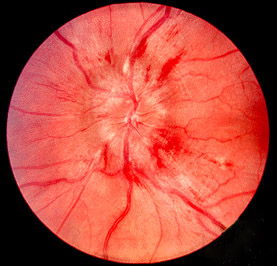
A 72-year-old woman comes to the emergency department 1 hour after the sudden onset of a diffuse, dull, throbbing headache. She also reports blurred vision, nausea, and one episode of vomiting. She has a history of poorly controlled hypertension. A photograph of her fundoscopic examination is shown. Which of the following is the most likely underlying cause of this patient's symptoms?
A 37-year-old G1P0 woman presents to her primary care physician for a routine checkup. She has a history of diabetes and hypertension but has otherwise been healthy with no change in her health status since the last visit. She is expecting her first child 8 weeks from now. She also enrolled in a study about pregnancy where serial metabolic panels and arterial blood gases are obtained. Partial results from these studies are shown below: Serum: Na+: 141 mEq/L Cl-: 108 mEq/L pH: 7.47 pCO2: 30 mmHg HCO3-: 21 mEq/L Which of the following disease processes would most likely present with a similar panel of metabolic results?
A 25-year-old man is in the middle of an ascent up a mountain, at an elevation of about 4,500 meters. This is the 4th day of his expedition. His friend notices that in the last few hours, he has been coughing frequently and appears to be short of breath. He has used his albuterol inhaler twice in the past 4 hours, but it does not seem to help. Within the past hour, he has coughed up some frothy, slightly pink sputum and is now complaining of nausea and headache. Other than his asthma, which has been well-controlled on a steroid inhaler, he is healthy. Which of the following is the most likely cause of this man’s symptoms?
A 72-year-old obese man presents as a new patient to his primary care physician because he has been feeling tired and short of breath after recently moving to Denver. He is a former 50 pack-year smoker and has previously had deep venous thrombosis. Furthermore, he previously had a lobe of the lung removed due to lung cancer. Finally, he has a family history of a progressive restrictive lung disease. Laboratory values are obtained as follows: Oxygen tension in inspired air = 130 mmHg Alveolar carbon dioxide tension = 48 mmHg Arterial oxygen tension = 58 mmHg Respiratory exchange ratio = 0.80 Respiratory rate = 20/min Tidal volume = 500 mL Which of the following mechanisms is consistent with these values?
A previously healthy 21-year-old man comes to the physician for the evaluation of lethargy, headache, and nausea for 2 months. His headache is holocephalic and most severe upon waking up. He is concerned about losing his spot on next season's college track team, given a recent decline in his performance during winter training. He recently moved into a new house with friends, where he lives in the basement. He does not smoke or drink alcohol. His current medications include ibuprofen and a multivitamin. His mother has systemic lupus erythematosus and his father has hypertension. His temperature is 37°C (98.6°F), pulse is 80/min, respirations are 18/min, and blood pressure is 122/75 mm Hg. Pulse oximetry on room air shows an oxygen saturation of 98%. Physical examination shows no abnormalities. Laboratory studies show: Hemoglobin 19.6 g/dL Hematocrit 59.8% Leukocyte count 9,000/mm3 Platelet count 380,000/mm3 Which of the following is the most likely cause of this patient's symptoms?
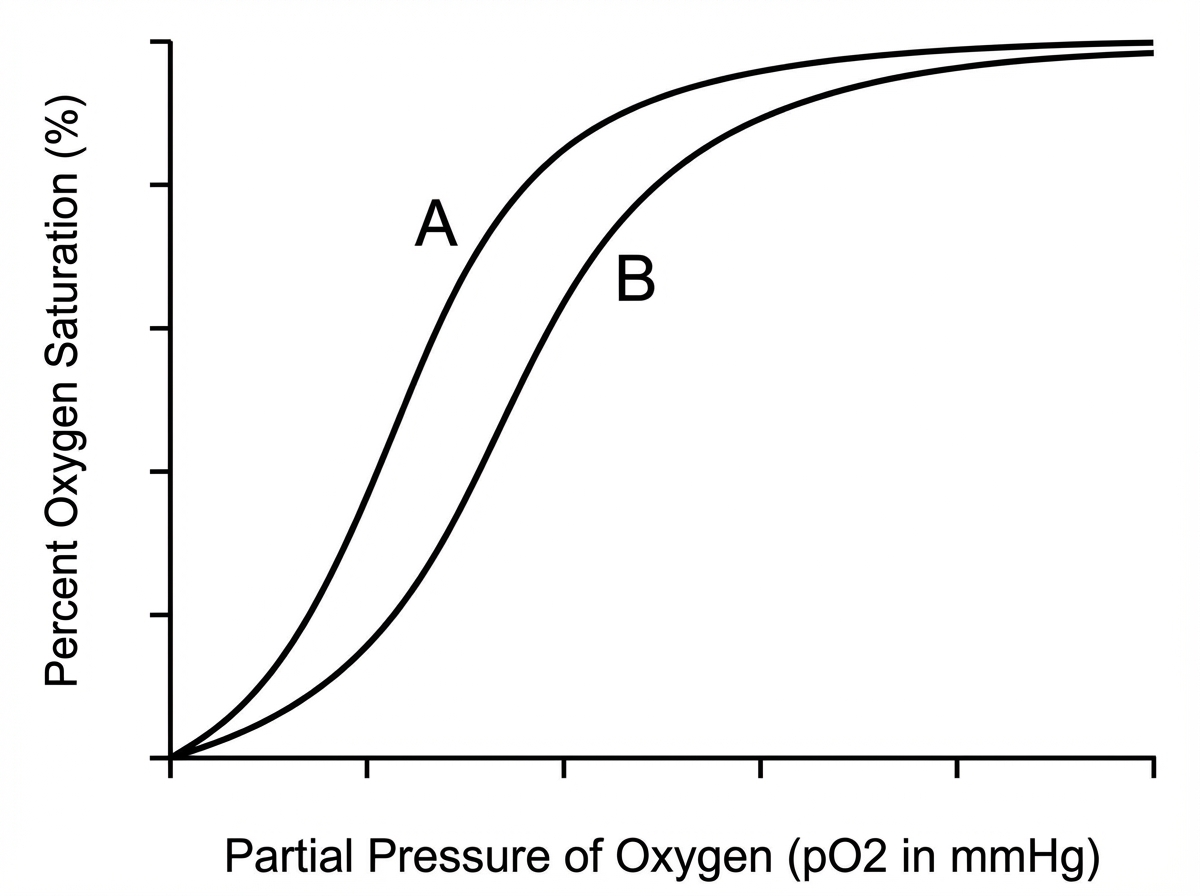
An investigator is conducting a study on hematological factors that affect the affinity of hemoglobin for oxygen. An illustration of two graphs (A and B) that represent the affinity of hemoglobin for oxygen is shown. Which of the following best explains a shift from A to B?
A 21-year-old man is admitted to the intensive care unit for respiratory failure requiring mechanical ventilation. His minute ventilation is calculated to be 7.0 L/min, and his alveolar ventilation is calculated to be 5.1 L/min. Which of the following is most likely to decrease the difference between minute ventilation and alveolar ventilation?
Want unlimited practice?
Get full access to all questions, explanations, and performance tracking.
Scan to download app