
Potassium balance and regulation — MCQs

A 17-year-old male presents to your office complaining of polyuria, polydipsia, and unintentional weight loss of 12 pounds over the past 3 months. On physical examination, the patient is tachypneic with labored breathing. Which of the following electrolyte abnormalities would you most likely observe in this patient?
A medical student is studying human physiology. She learns that there is a membrane potential across cell membranes in excitable cells. The differential distribution of anions and cations both inside and outside the cells significantly contributes to the genesis of the membrane potential. Which of the following distributions of anions and cations best explains the above phenomenon?
A new drug has been shown to block epithelial sodium channels in the cortical collecting duct. Which of the following is most likely to be decreased upon drug administration?
What is the primary mechanism for maintaining acid-base balance during prolonged vomiting?
A 63-year-old woman presents to your outpatient clinic complaining of headaches, blurred vision, and fatigue. She has a blood pressure of 171/91 mm Hg and heart rate of 84/min. Physical examination is unremarkable. Her lab results include K+ of 3.1mEq/L and a serum pH of 7.51. Of the following, which is the most likely diagnosis for this patient?
A 57-year-old male is found to have an elevated prostate specific antigen (PSA) level on screening labwork. PSA may be elevated in prostate cancer, benign prostatic hypertrophy (BPH), or prostatitis. Which of the following best describes the physiologic function of PSA?
A 32-year-old woman is admitted to the emergency department for 36 hours of intense left-sided back pain that extends into her left groin. She reports that the pain started a day after a charitable 5 km (3.1 mi) marathon. The past medical history is relevant for multiple complaints of eye dryness and dry mouth. Physical examination is unremarkable, except for intense left-sided costovertebral pain. The results from laboratory tests are shown. Laboratory test Result Serum Na+ 137 Serum Cl- 110 Serum K+ 3.0 Serum creatinine (SCr) 0.82 Arterial blood gas Result pH 7.28 pO2 98 mm Hg pCO2 28.5 mm Hg SaO2% 98% HCO3- 15 mm Hg Which of the following explains this patient’s condition?
A 54-year-old man presents with 3 days of non-bloody and non-bilious emesis every time he eats or drinks. He has become progressively weaker and the emesis has not improved. He denies diarrhea, fever, or chills and thinks his symptoms may be related to a recent event that involved sampling many different foods. His temperature is 97.5°F (36.4°C), blood pressure is 133/82 mmHg, pulse is 105/min, respirations are 15/min, and oxygen saturation is 98% on room air. Physical exam is notable for a weak appearing man with dry mucous membranes. His abdomen is nontender. Which of the following laboratory changes would most likely be seen in this patient?
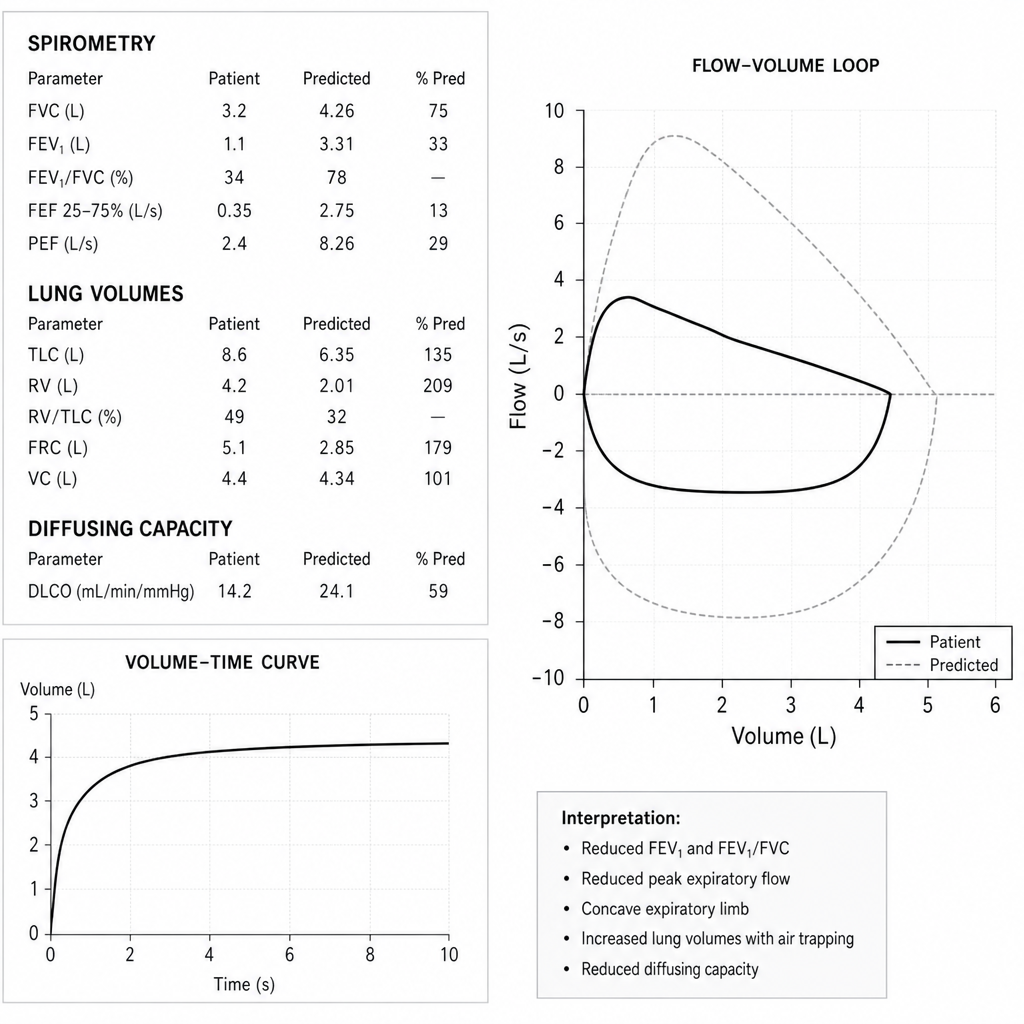
A 58-year-old man with chronic obstructive pulmonary disease is evaluated in the pulmonary function laboratory. Spirometry reveals an FEV1 of 1.1 L, FVC of 3.2 L, and a flow-volume loop. On the loop, peak expiratory flow is markedly reduced and the expiratory limb is concave toward the volume axis, while the inspiratory limb is normal in contour. Which of the following additional findings is most consistent with this pattern?
Renal clearance of substance Y is experimentally studied. At a constant glomerular filtration rate, it is found that the amount of substance Y excreted is greater than the amount filtered. This holds true across all physiologic values on the titration curve. Substance Y is most similar to which of the following?
Want unlimited practice?
Get full access to all questions, explanations, and performance tracking.
Scan to download app