
Loop of Henle function — MCQs

A 66-year-old man with congestive heart failure presents to the emergency department complaining of worsening shortness of breath. These symptoms have worsened over the last 3 days. He has a blood pressure of 126/85 mm Hg and heart rate of 82/min. Physical examination is notable for bibasilar crackles. A chest X-ray reveals bilateral pulmonary edema. His current medications include metoprolol succinate and captopril. You wish to add an additional medication targeted towards his symptoms. Of the following, which statement is correct regarding loop diuretics?
Which transport mechanism is primarily responsible for calcium reabsorption in the proximal tubule?
An investigator is studying physiologic renal responses to common medical conditions. She measures urine osmolalities in different parts of the nephron of a human subject in the emergency department. The following values are obtained: Portion of nephron Osmolality (mOsmol/kg) Proximal convoluted tubule 300 Loop of Henle, descending limb 1200 Loop of Henle, ascending limb 250 Distal convoluted tubule 100 Collecting duct 1200 These values were most likely obtained from an individual with which of the following condition?
A 57-year-old male is found to have an elevated prostate specific antigen (PSA) level on screening labwork. PSA may be elevated in prostate cancer, benign prostatic hypertrophy (BPH), or prostatitis. Which of the following best describes the physiologic function of PSA?
An 81-year-old man presents to his primary care physician for his yearly exam. His past medical history is significant for osteopenia, nephrolithiasis, and hypertension. His family history is significant for relatives who had early onset kidney failure. He takes occasional acetaminophen and supplemental calcium/vitamin D. He is physically active with a normal body mass index (BMI) and has no current concerns. Review of his laboratory results today were compared with those from 15 years ago with the following findings: Results today: Serum creatinine concentration: 1.1 mg/dL Urine creatinine concentration: 100 mg/dL Urine volume: 1000 mL/day Results 15 years ago: Serum creatinine concentration: 1.1 mg/dL Urine creatinine concentration: 120 mg/dL Urine volume: 1000 mL/day Which is the most likely cause of these changes in his creatinine clearance?
A 28-year-old research assistant is brought to the emergency department for severe chemical burns 30 minutes after accidentally spilling hydrochloric acid on himself. The burns cover both hands and forearms. His temperature is 37°C (98.6°F), pulse is 112/min, respirations are 20/min, and blood pressure is 108/82 mm Hg. Initial stabilization and resuscitation is begun, including respiratory support, fluid resuscitation, and cardiovascular stabilization. The burned skin is irrigated with saline water to remove the chemical agent. Which of the following is the most appropriate method to verify adequate fluid infusion in this patient?
A 32-year-old man is brought to the Emergency Department after 3 consecutive days of diarrhea, fatigue and weakness. His stool has been soft and mucoid, with no blood stains. The patient just came back from a volunteer mission in Guatemala, where he remained asymptomatic. His personal medical history is unremarkable. Today his blood pressure is 98/60 mm Hg, pulse is 110/min, respiratory rate is 19/min, and his body temperature is 36.7°C (98.1°F). On physical exam, he has sunken eyes, dry mucosa, mild diffuse abdominal tenderness, and hyperactive bowel sounds. Initial laboratory tests are shown below: Serum creatinine (SCr) 1.8 mg/dL Blood urea nitrogen (BUN) 50 mg/dL Serum sodium 132 mEq/L Serum potassium 3.5 mEq/L Serum chloride 102 mEq/L Which of the following phenomena would you expect in this patient?
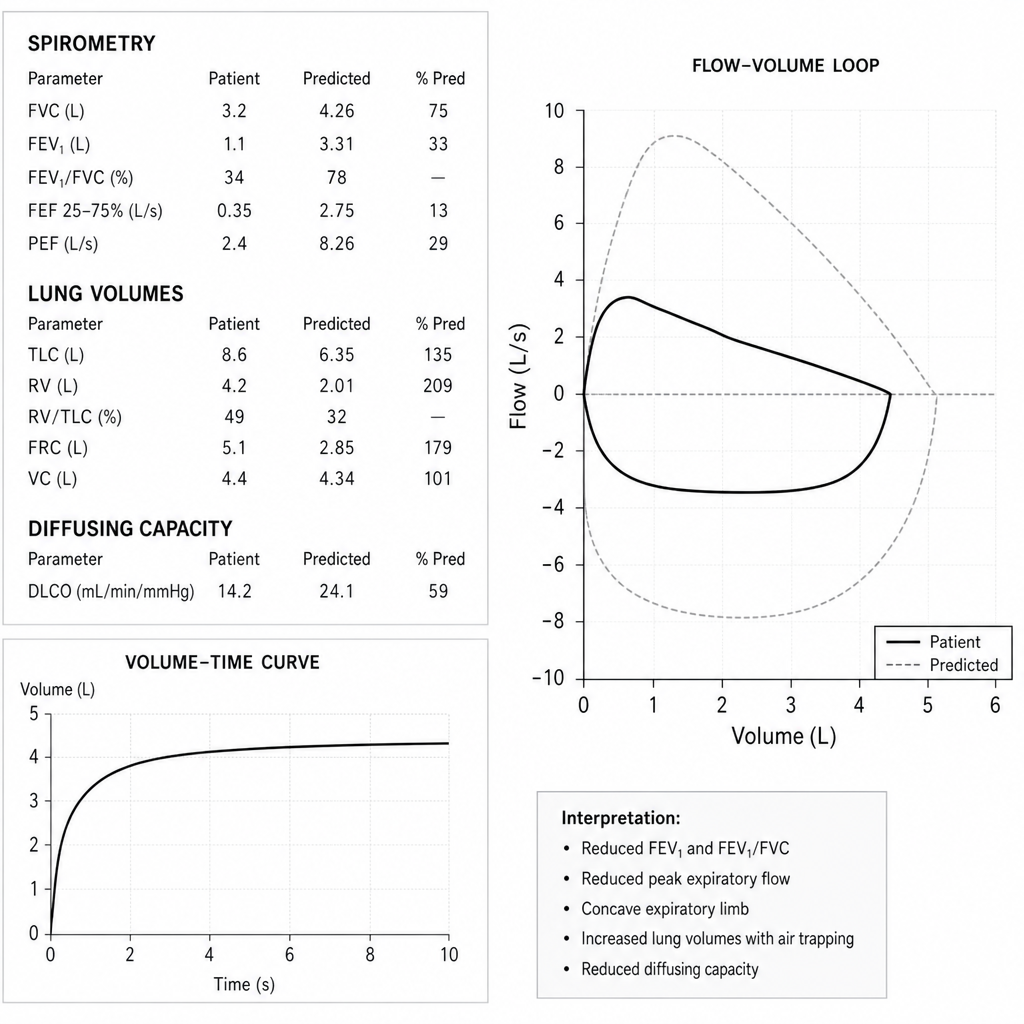
A 58-year-old man with chronic obstructive pulmonary disease is evaluated in the pulmonary function laboratory. Spirometry reveals an FEV1 of 1.1 L, FVC of 3.2 L, and a flow-volume loop. On the loop, peak expiratory flow is markedly reduced and the expiratory limb is concave toward the volume axis, while the inspiratory limb is normal in contour. Which of the following additional findings is most consistent with this pattern?
Renal clearance of substance Y is experimentally studied. At a constant glomerular filtration rate, it is found that the amount of substance Y excreted is greater than the amount filtered. This holds true across all physiologic values on the titration curve. Substance Y is most similar to which of the following?
A 30-year-old man presents to his physician for a follow-up appointment for a blood pressure of 140/90 mm Hg during his last visit. He was advised to record his blood pressure at home with an automated device twice every day. He recorded a wide range of blood pressure values in the past week, ranging from 110/70 mm Hg to 135/84 mm Hg. The medical history is unremarkable and he takes no medications. He occasionally drinks alcohol after work, but denies smoking and illicit drug use. Which of the following factors is responsible for maintaining a near-normal renal blood flow over a wide range of systemic blood pressures?
Want unlimited practice?
Get full access to all questions, explanations, and performance tracking.
Scan to download app