
Microcirculation physiology — MCQs

On cardiology service rounds, your team sees a patient admitted with an acute congestive heart failure exacerbation. In congestive heart failure, decreased cardiac function leads to decreased renal perfusion, which eventually leads to excess volume retention. To test your knowledge of physiology, your attending asks you which segment of the nephron is responsible for the majority of water absorption. Which of the following is a correct pairing of the segment of the nephron that reabsorbs the majority of all filtered water with the means by which that segment absorbs water?
A scientist is studying the excretion of a novel toxin X by the kidney in order to understand the dynamics of this new substance. He discovers that this new toxin X has a clearance that is half that of inulin in a particular patient. This patient's filtration fraction is 20% and his para-aminohippuric acid (PAH) dynamics are as follows: Urine volume: 100 mL/min Urine PAH concentration: 30 mg/mL Plasma PAH concentration: 5 mg/mL Given these findings, what is the clearance of the novel toxin X?
During a clinical study evaluating the effects of exercise on muscle perfusion, 15 healthy individuals perform a 20-minute treadmill run at submaximal effort. Before and after the treadmill session, perfusion of the quadriceps muscle is evaluated with contrast-enhanced magnetic resonance imaging. The study shows a significant increase in muscle blood flow per unit of tissue mass. Which of the following local changes is most likely involved in the observed change in perfusion?
An 8-year-old boy is shifted to a post-surgical floor following neck surgery. The surgeon has restricted his oral intake for the next 24 hours. He does not have diarrhea, vomiting, or dehydration. His calculated fluid requirement is 1500 mL/day. However, he receives 2000 mL of intravenous isotonic fluids over 24 hours. Which of the following physiological parameters in the boy’s circulatory system is most likely to be increased?
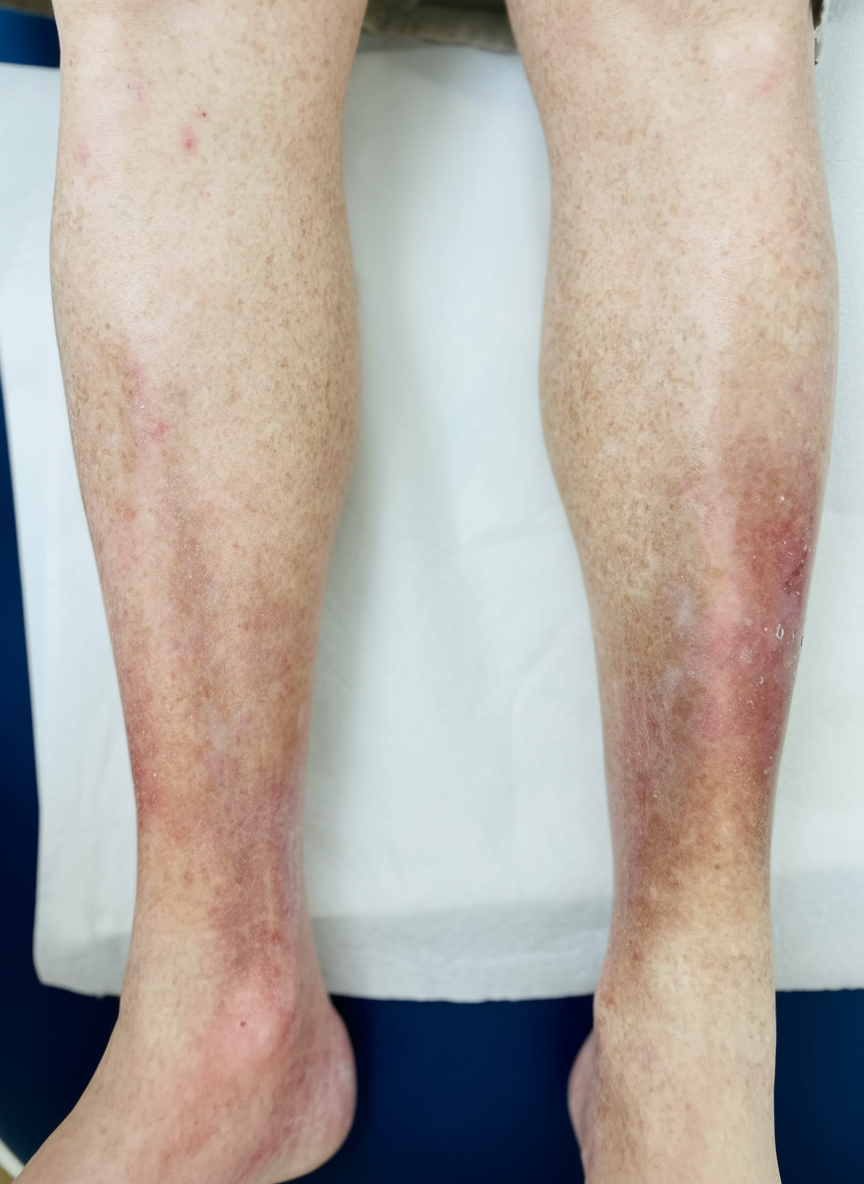
A 67-year-old woman comes to the physician with a 6-month history of pain and swelling of both legs. The symptoms are worst at the end of the day and are associated with itching of the overlying skin. Physical examination shows bilateral pitting ankle edema. An image of one of the ankles is shown. This patient is at greatest risk for which of the following complications?
A researcher is studying proteins that contribute to intestinal epithelial permeability. He has isolated intestinal tissue from several mice. After processing the tissue into its individual components, he uses a Western blot analysis to identify a protein that forms part of a multi-protein complex at the apical aspect of epithelial cells. The complex is known to provide a diffusion barrier between the apical and basolateral aspects of epithelial cells. Which of the following proteins is this researcher most likely investigating?
A 31-year-old female with a history of anxiety has a panic attack marked by dizziness, weakness, and blurred vision. Which of the following most likely accounts for the patient’s symptoms?
An otherwise healthy 65-year-old man comes to the physician for a follow-up visit for elevated blood pressure. Three weeks ago, his blood pressure was 160/80 mmHg. Subsequent home blood pressure measurements at days 5, 10, and 15 found: 165/75 mm Hg, 162/82 mm Hg, and 170/80 mmHg, respectively. He had a cold that was treated with over-the-counter medication 4 weeks ago. Pulse is 72/min and blood pressure is 165/79 mm Hg. Physical examination shows no abnormalities. Laboratory studies, including thyroid function studies, serum electrolytes, and serum creatinine, are within normal limits. Which of the following is the most likely underlying cause of this patient's elevated blood pressure?
A 73-year-old woman presents to clinic with a week of fatigue, headache, and swelling of her ankles bilaterally. She reports that she can no longer go on her daily walk around her neighborhood without stopping frequently to catch her breath. At night she gets short of breath and has found that she can only sleep well in her recliner. Her past medical history is significant for hypertension and a myocardial infarction three years ago for which she had a stent placed. She is currently on hydrochlorothiazide, aspirin, and clopidogrel. She smoked 1 pack per day for 30 years before quitting 10 years ago and socially drinks around 1 drink per month. She denies any illicit drug use. Her temperature is 99.0°F (37.2°C), pulse is 115/min, respirations are 18/min, and blood pressure is 108/78 mmHg. On physical exam there is marked elevations of her neck veins, bilateral pitting edema in the lower extremities, and a 3/6 holosystolic ejection murmur over the right sternal border. Echocardiography shows the following findings: End systolic volume (ESV): 100 mL End diastolic volume (EDV): 160 mL How would cardiac output be determined in this patient?
An investigator is studying the role of different factors in inflammation and hemostasis. Alpha-granules from activated platelets are isolated and applied to a medium containing inactive platelets. When ristocetin is applied, the granules bind to GpIb receptors, inducing a conformational change in the platelets. Binding of the active component of these granules to GpIb receptors is most likely responsible for which of the following steps of hemostasis?
Want unlimited practice?
Get full access to all questions, explanations, and performance tracking.
Scan to download app