
Filtration barrier components — MCQs

A 12-year-old boy is found on a routine auditory screening to have mild high frequency hearing impairment. On exam, he has no ear pain, no focal neurological deficits, and no cardiac murmurs. He has not had any recent illness. Laboratory studies show: Serum: Creatinine: 0.7 mg/dl Protein: 3.8 g/dl Antistreptolysin O titer: 60 Todd units (12-166 normal range) Urinalysis: Microscopic heme Protein: 4+ RBCs: 6/hpf A kidney biopsy is taken. Which of the following findings is most characteristic of this patient’s disease?
A 43-year-old man comes to the physician for a 1-week history of swelling around his eyes and decreased urination. His pulse is 87/min, and blood pressure is 152/95 mm Hg. Physical examination shows 1+ periorbital and pretibial edema. Serum studies show a urea nitrogen concentration of 21 mg/dL and a creatinine concentration of 1.4 mg/dL. Urinalysis shows 3+ blood and 1+ protein. Further evaluation of this patient is most likely to show which of the following?
A 45-year-old man presents with a 3-day history of right-sided flank pain due to a lodged ureteral stone. What changes would be expected to be seen at the level of glomerular filtration?
On cardiology service rounds, your team sees a patient admitted with an acute congestive heart failure exacerbation. In congestive heart failure, decreased cardiac function leads to decreased renal perfusion, which eventually leads to excess volume retention. To test your knowledge of physiology, your attending asks you which segment of the nephron is responsible for the majority of water absorption. Which of the following is a correct pairing of the segment of the nephron that reabsorbs the majority of all filtered water with the means by which that segment absorbs water?
A scientist is studying the excretion of a novel toxin X by the kidney in order to understand the dynamics of this new substance. He discovers that this new toxin X has a clearance that is half that of inulin in a particular patient. This patient's filtration fraction is 20% and his para-aminohippuric acid (PAH) dynamics are as follows: Urine volume: 100 mL/min Urine PAH concentration: 30 mg/mL Plasma PAH concentration: 5 mg/mL Given these findings, what is the clearance of the novel toxin X?
A 12-year-old boy presents to your office with facial swelling and dark urine. He has no other complaints other than a sore throat 3 weeks ago that resolved after 6 days. He is otherwise healthy, lives at home with his mother and 2 cats, has no recent history of travel, and no sick contacts. On physical examination his temperature is 99°F (37.2°C), blood pressure is 130/85 mmHg, pulse is 80/min, respirations are 19/min, and pulse oximetry is 99% on room air. Cardiopulmonary and abdominal examinations are unremarkable. There is mild periorbital and pedal edema. Urinalysis shows 12-15 RBC/hpf, 2-5 WBC/hpf, and 30 mg/dL protein. Which additional finding would you expect to see on urinalysis?
A 47-year-old man comes to the physician for a routine health maintenance examination. He states that he has felt fatigued and dizzy on several occasions over the past week. He has back pain for which he takes ibuprofen. Digital rectal examination shows no abnormalities. Laboratory studies show a hemoglobin concentration of 15 g/dL, a serum urea nitrogen concentration of 22 mg/dL, a serum creatinine concentration of 1.4 mg/dL, and a serum calcium concentration of 8.4 mg/dL. His prostate-specific antigen (PSA) level is 0.3 ng/mL (N < 4.5). An intravenous infusion of para-aminohippurate (PAH) is administered and its clearance is calculated. The patient's effective renal plasma flow is estimated to be 660 mL/min (N = 500–1350). The filtration fraction is calculated to be 9% (N = 17–23). Which of the following is the most likely cause of this patient's laboratory abnormalities?
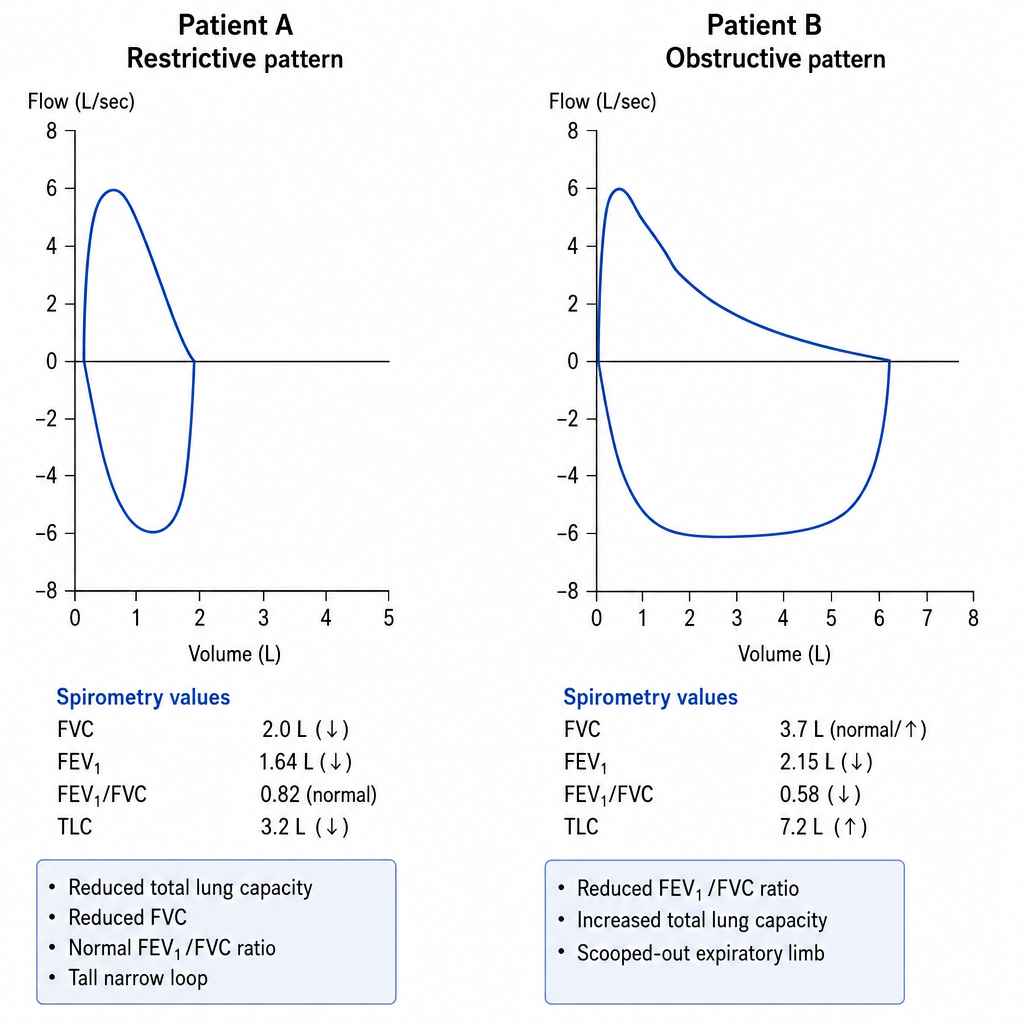
A pulmonologist reviews spirometry tracings from two patients with dyspnea. Patient A's loop demonstrates a reduced total lung capacity, reduced FVC, normal FEV1/FVC ratio (0.82), and a tall narrow loop. Patient B's loop shows a reduced FEV1/FVC ratio (0.58), increased total lung capacity, and a scooped-out expiratory limb. Which of the following correctly identifies the underlying mechanism responsible for the reduced expiratory flow in Patient B?
A 9-year-old boy is brought to the physician's office by his mother because of facial swelling for the past 2 days. The mother says that her son has always been healthy and active but is becoming increasingly lethargic and now has a puffy face. Upon inquiry, the boy describes a foamy appearance of his urine, but denies having blood in the urine, urinary frequency at night, or pain during urination. He has no history of renal or urinary diseases. Physical examination is unremarkable, except for generalized swelling of the face and pitting edema on the lower limbs. Dipstick analysis reveals 4+ proteinuria. An abdominal ultrasound shows normal kidney size and morphology. A renal biopsy yields no findings under light and fluorescence microscopy; however, glomerular podocyte foot effacement is noted on electron microscopy. Which of the following changes in Starling forces occurs in this patient's condition?
A 70-year-old female with chronic kidney failure secondary to diabetes asks her nephrologist to educate her about the techniques used to evaluate the degree of kidney failure progression. She learns about the concept of glomerular filtration rate (GFR) and learns that it can be estimated by measuring the levels of some substances. The clearance of which of the following substances is the most accurate estimate for GFR?
Want unlimited practice?
Get full access to all questions, explanations, and performance tracking.
Scan to download app