
Pancreatic exocrine function — MCQs

A 42-year-old woman is brought to the emergency department because of a 5-day history of epigastric pain, fever, nausea, and malaise. Five weeks ago she had acute biliary pancreatitis and was treated with endoscopic retrograde cholangiopancreatography and subsequent cholecystectomy. Her maternal grandfather died of pancreatic cancer. She does not smoke. She drinks 1–2 beers daily. Her temperature is 38.7°C (101.7°F), respirations are 18/min, pulse is 120/min, and blood pressure is 100/70 mm Hg. Abdominal examination shows epigastric tenderness and three well-healed laparoscopy scars. The remainder of the examination shows no abnormalities. Laboratory studies show: Hemoglobin 10 g/dL Leukocyte count 15,800/mm3 Serum Na+ 140 mEq/L Cl− 103 mEq/L K+ 4.5 mEq/L HCO3- 25 mEq/L Urea nitrogen 18 mg/dL Creatinine 1.0 mg/dL Alkaline phosphatase 70 U/L Aspartate aminotransferase (AST, GOT) 22 U/L Alanine aminotransferase (ALT, GPT) 19 U/L γ-Glutamyltransferase (GGT) 55 U/L (N = 5–50) Bilirubin 1 mg/dl Glucose 105 mg/dL Amylase 220 U/L Lipase 365 U/L (N = 14–280) Abdominal ultrasound shows a complex cystic fluid collection with irregular walls and septations in the pancreas. Which of the following is the most likely diagnosis?
A group of investigators is performing a phase I trial of a novel drug among patients with chronic right upper quadrant pain. Iminodiacetic acid labeled with technetium 99m is administered intravenously and subjects are subsequently imaged with a gamma camera. It is found that administration of the experimental drug increases the amount of iminodiacetic acid in the intestines. The effect of this novel drug is most similar to that of a substance secreted by which of the following cells?
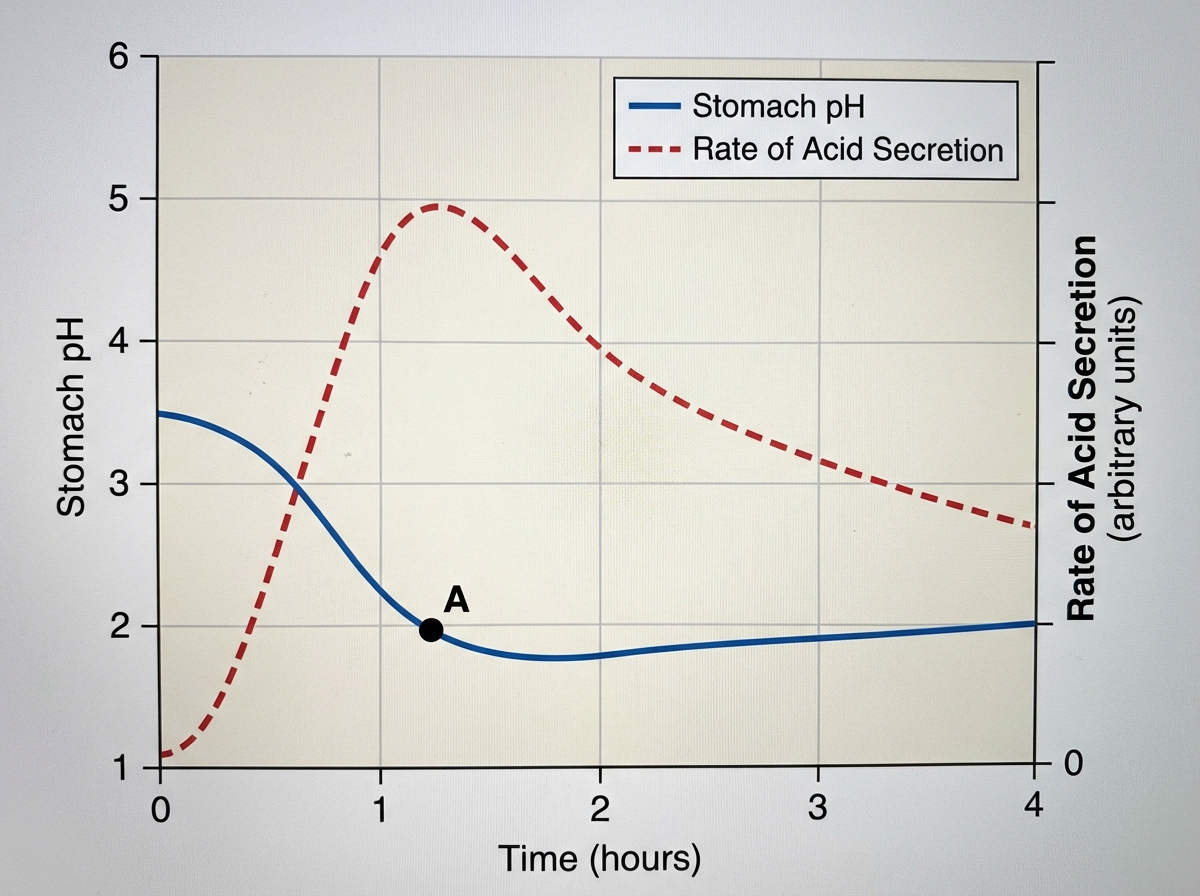
Nine healthy subjects participate in a study of gastric secretions. Subjects are asked to eat a meal at hour 0, at which time the pH of stomach contents and rate of stomach acid secretions are measured over the next 4 hours. Results of the study are shown. Which of the following mediators is most active at point A in the graph?
During a study on gastrointestinal hormones, a volunteer is administered the hormone secreted by S cells. Which of the following changes most likely represent the effect of this hormone on gastric and duodenal secretions? $$$ Gastric H+ %%% Duodenal HCO3- %%% Duodenal Cl- $$$
A 56-year-old woman presents to the emergency department with an episode of nausea and severe unrelenting right upper abdominal pain. She had a cholecystectomy for gallstones a year earlier and has since experienced frequent recurrences of abdominal pain, most often after a meal. Her past medical history is otherwise unremarkable and she only takes medications for her pain when it becomes intolerable. Her physical exam is normal except for an intense abdominal pain upon deep palpation of her right upper quadrant. Her laboratory values are unremarkable with the exception of a mildly elevated alkaline phosphatase, amylase, and lipase. Her abdominal ultrasound shows a slightly enlarged common bile duct at 8 mm in diameter (N = up to 6 mm) and a normal pancreatic duct. The patient is referred to a gastroenterology service for an ERCP (endoscopic retrograde cholangiopancreatography) to stent her common bile duct. During the procedure the sphincter at the entrance to the duct is constricted. Which statement best describes the regulation of the function of the sphincter which is hampering the cannulation of the pancreatic duct in this patient?
A 28-year-old man presents to the emergency department with diffuse abdominal pain and nausea for the past 5 hours. The pain started with a dull ache but is now quite severe. He notes that he “just doesn’t feel like eating” and has not eaten anything for almost a day. Although the nausea is getting worse, the patient has not vomited. He notes no medical issues in the past and is not currently taking any medications. He admits to drinking alcohol (at least 2–3 bottles of beer per day after work and frequent binge-drinking weekends with friends). He says that he does not smoke or use illicit drugs. Vital signs include: pulse rate 120/min, respiratory rate 26/min, and blood pressure 100/70 mm Hg. On examination, the patient’s abdomen is diffusely tender. His breath smells like alcohol, with a fruity tinge to it. Bowel sounds are present. No other findings are noted. Fingerstick glucose is 76mg/dL. After the examination, the patient suddenly and spontaneously vomits. Which of the following is the underlying mechanism of the most likely diagnosis in this patient?
A group of scientists is studying the mechanism of action of various pancreatic hormones in rats. The scientists studied hormone A, which is secreted by the β-cells of the pancreas, and found that hormone A binds to a complex dimeric receptor on the cell membrane and exerts its effects via phosphorylation and subsequent downstream signaling that includes dephosphorylation of different intracellular proteins. Now they are studying hormone B, which is secreted by the α-cells and antagonizes the actions of hormone A. Which 2nd messenger system would hormone B utilize to exert its cellular effects?
An 11-year-old boy who recently emigrated from Ukraine is brought to the physician for the evaluation of failure to thrive. Genetic analysis shows the deletion of the 508th codon in a gene on chromosome 7. The deletion results in defective post-translational folding of a protein and retention of the misfolded protein in the rough endoplasmic reticulum. The activity of which of the following channels is most likely to be increased as a result of the defect?
A 61-year-old woman presents to the urgent care unit with a 2-week history of abdominal pain after meals. The patient reports vomiting over the past few days. The past medical history is significant for osteoarthritis and systemic lupus erythematosus. She regularly drinks alcohol. She does not smoke cigarettes. The patient currently presents with vital signs within normal limits. On physical examination, the patient appears to be in moderate distress, but she is alert and oriented. The palpation of the abdomen elicits tenderness in the epigastric region. The CT of the abdomen shows no signs of an acute process. The laboratory results are listed below. Which of the following is the most likely diagnosis? Na+ 139 mEq/L K+ 4.4 mEq/L Cl- 109 mmol/L HCO3- 20 mmol/L BUN 14 mg/dL Cr 1.0 mg/dL Glucose 101 mg/dL Total cholesterol 187 mg/dL LDL 110 mg/dL HDL 52 mg/dL TG 120 mg/dL AST 65 IU/L ALT 47 IU/L GGT 27 IU/L Amylase 512 U/L Lipase 1,262 U/L
A 29-year-old man presents for the evaluation of infertility. He has a history of recurrent lower respiratory tract infections, productive cough, abdominal pain, and diarrhea. Physical examination reveals clubbing and bilateral crackles on chest auscultation. Chest X-ray reveals increased pulmonary markings and peripheral bronchi with a ‘tram track’ appearance. Which of the following pathophysiologies is responsible for the patient’s condition?
Want unlimited practice?
Get full access to all questions, explanations, and performance tracking.
Scan to download app