
ST segment evaluation — MCQs

A 60-year-old male engineer who complains of shortness of breath when walking a few blocks undergoes a cardiac stress test because of concern for coronary artery disease. During the test he asks his cardiologist about what variables are usually used to quantify the functioning of the heart. He learns that one of these variables is stroke volume. Which of the following scenarios would be most likely to lead to a decrease in stroke volume?
A 43-year-old woman presents to a physician with weakness and fatigue for a week. She mentions that she has been taking oral fluconazole for the last 4 weeks for the treatment of tinea capitis. She also says that she loves coffee and usually consumes 4–6 cups of coffee every day. On physical examination, her vital signs are stable and examination of all systems, including nervous system, is normal. Her laboratory evaluation reveals that her serum potassium level is 3.1 mmol/L (3.1 mEq/L). The physician orders an ECG. Which of the following findings is most likely to be present?
A 71-year-old man presents to the emergency department with severe substernal chest pain. An initial EKG demonstrates ST elevation in leads V2, V3, V4, and V5 with reciprocal changes. The patient is started on aspirin and heparin and is transferred to the cardiac catheterization lab. The patient recovers over the next several days. On the floor, the patient complains of feeling very fatigued and feels too weak to ambulate even with the assistance of physical therapy. Chest radiography reveals an enlarged cardiac silhouette with signs of fluid bilaterally in the lung bases. His temperature is 98.4°F (36.9°C), blood pressure is 85/50 mmHg, pulse is 110/min, respirations are 13/min, and oxygen saturation is 97% on room air. Which of the following would be expected to be seen in this patient?
A 61-year-old man is brought to the emergency department by ambulance because of severe retrosternal chest pain and shortness of breath for 30 minutes. Paramedics report that an ECG recorded en route to the hospital showed ST-segment elevation in I, aVL, and the precordial leads. On arrival, the patient is unresponsive to painful stimuli. Examination shows neither respiration nor pulse. Despite appropriate lifesaving measures, he dies 10 minutes later. Which of the following is the most likely cause of death in this patient?
A 50-year-old man presents the emergency department for intense chest pain, profuse sweating, and shortness of breath. The onset of these symptoms was 3 hours ago. The chest pain began after a heated discussion with a colleague at the community college where he is employed. Upon arrival, he is found conscious and responsive; the vital signs include a blood pressure of 130/80 mm Hg, a heart rate at 90/min, a respiratory rate at 20/min, and a body temperature of 36.4°C (97.5°F). His medical history is significant for hypertension diagnosed 7 years ago, which is well-controlled with a calcium channel blocker. The initial electrocardiogram (ECG) shows ST-segment depression in multiple consecutive leads, an elevated cardiac troponin T level, and normal kidney function. Which of the following would you expect to find in this patient?
A 55-year-old man comes to the emergency department because of left-sided chest pain and difficulty breathing for the past 30 minutes. His pulse is 88/min. He is pale and anxious. Serum studies show increased cardiac enzymes. An ECG shows ST-elevations in leads I, aVL, and V5-V6. A percutaneous coronary intervention is performed. In order to localize the site of the lesion, the catheter must pass through which of the following structures?
A cardiologist is studying how a new virus that infects the heart affects the electrical conduction system of the cardiac myocytes. He decides to obtain electrocardiograms on patients with this disease in order to see how the wave patterns and durations change over time. While studying these records, he asks a medical student who is working with him to interpret the traces. Specifically, he asks her to identify the part that represents initial ventricular depolarization. Which of the following characteristics is most consistent with this feature of the electrocardiogram?
In the coronary steal phenomenon, vessel dilation is paradoxically harmful because blood is diverted from ischemic areas of the myocardium. Which of the following is responsible for the coronary steal phenomenon?
In a patient with acute myocardial ischemia, which of the following cardiovascular structures is at greatest risk of damage?
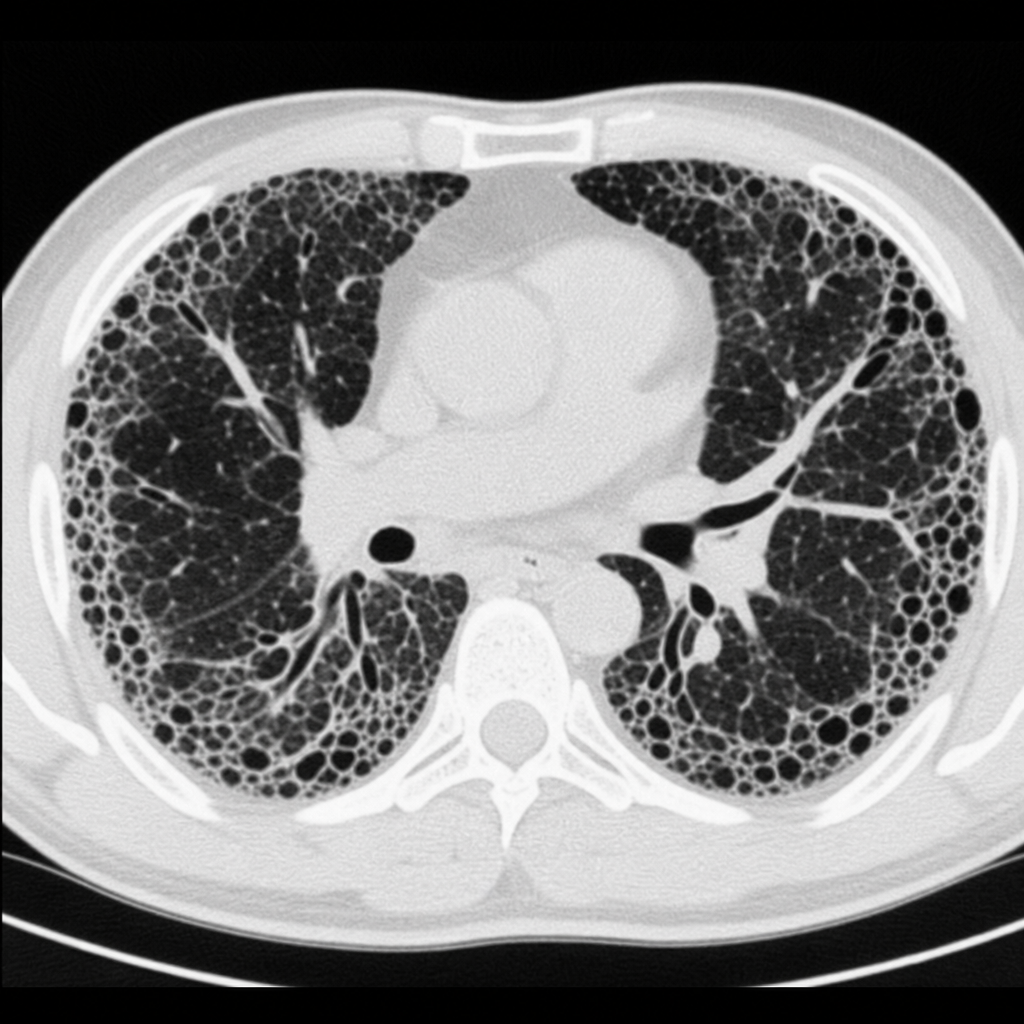
A 19-year-old male college student presents with progressive exertional dyspnea over 6 months. He has a history of childhood radiation therapy to the chest for mediastinal lymphoma. High-resolution CT of the chest shows bilateral interstitial fibrosis with honeycombing and traction bronchiectasis. Pulmonary function testing yields the following results: FVC 3.1 L (predicted 4.8 L), FEV1 2.7 L (predicted 4.0 L), FEV1/FVC 87%, TLC 3.4 L (predicted 6.2 L), DLCO 58% of predicted. Which of the following physiological mechanisms best accounts for the reduced DLCO in this patient?
Want unlimited practice?
Get full access to all questions, explanations, and performance tracking.
Scan to download app