
Bundle branch blocks — MCQs

A 39-year-old female with poorly controlled systemic lupus erythematosus (SLE) presents to the emergency room with a cough and pleuritic chest pain. She states that she developed these symptoms 2 days prior. The pain appears to improve when the patient leans forward. She currently takes hydroxychloroquine for her systemic lupus erythematosus but has missed several doses recently. Her temperature is 99°F (37.2°C), blood pressure is 135/80 mmHg, pulse is 115/min, and respirations are 22/min. Physical examination reveals a rise in jugular venous pressure during inspiration. In addition to tachycardia, which of the following EKG patterns is most likely to be seen in this patient?
A researcher measures action potential propagation velocity in various regions of the heart in a 42-year-old Caucasian female. Which of the following set of measurements corresponds to the velocities found in the atrial muscle, AV Node, Purkinje system, and ventricular muscle, respectively?
A 77-year-old man presents to his primary care physician with lightheadedness and a feeling that he is going to "pass out". He has a history of hypertension that is treated with captopril. In the office, his temperature is 38.3°C (100.9°F), the pulse is 65/min, and the respiratory rate is 19/min. His sitting blood pressure is 133/91 mm Hg. Additionally, his supine blood pressure is 134/92 mm Hg and standing blood pressure is 127/88 mm Hg. These are similar to his baseline blood pressure measured during previous visits. An ECG rhythm strip is obtained in the office. Of the following, what is the likely cause of his presyncope?
The medical student on the pediatric cardiology team is examining a 9-year-old girl who was referred by her primary care physician for unexplained hypertension. She is accompanied by her mother who reveals that the child is generally well but has been significantly less active than her peers for the past year. On exam, the medical student notes a thin girl in no apparent distress appearing slightly younger than stated age. Vital signs reveal a BP is 160/80, HR 80, RR 16. Physical exam is notable only for a clicking sound is noted around the time of systole but otherwise the cardiac exam is normal. Pedal pulses could not be palpated. Which of the following physical exam findings was most likely missed by both the medical student and primary care physician?
A cardiologist is studying how a new virus that infects the heart affects the electrical conduction system of the cardiac myocytes. He decides to obtain electrocardiograms on patients with this disease in order to see how the wave patterns and durations change over time. While studying these records, he asks a medical student who is working with him to interpret the traces. Specifically, he asks her to identify the part that represents initial ventricular depolarization. Which of the following characteristics is most consistent with this feature of the electrocardiogram?
A researcher is studying how electrical activity propagates across the heart. In order to do this, he decides to measure the rate at which an action potential moves within various groups of cardiac muscle tissue. In particular, he isolates fibers from areas of the heart with the following characteristics: A) Dysfunction leads to fixed PR intervals prior to a dropped beat B) Dysfunction leads to increasing PR intervals prior to a dropped beat C) Dysfunction leads to tachycardia with a dramatically widened QRS complex D) Dysfunction leads to tachycardia with a sawtooth pattern on electrocardiogram Which of the following is the proper order of these tissues from fastest action potential propagation to slowest action potential propagation.
A 65-year-old woman comes to the physician because of a 3-month history of intermittent palpitations and shortness of breath. Cardiopulmonary examination shows no other abnormalities. An ECG shows an absence of P waves, an oscillating baseline, and irregular RR intervals at a rate of approximately 95 beats per minute. The difference between atrial and ventricular rates in this patient is most likely due to which of the following?
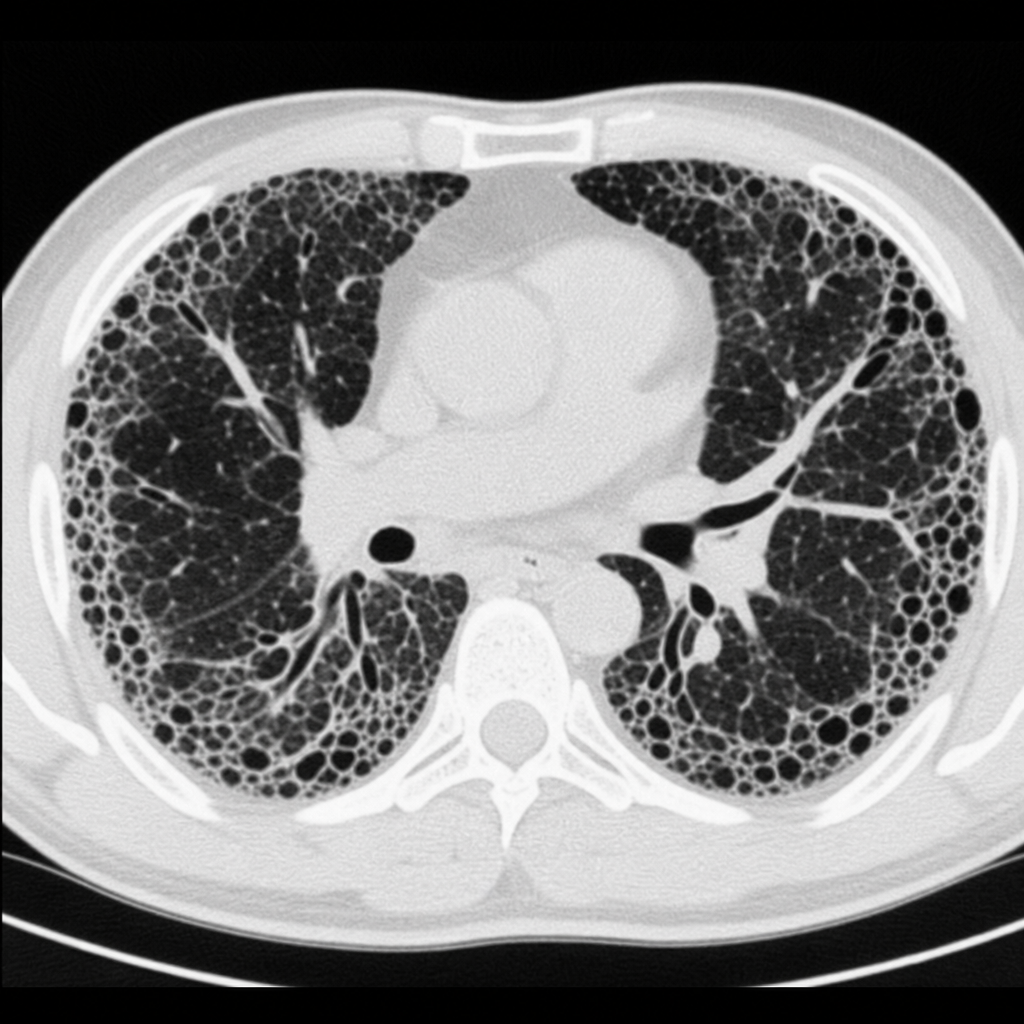
A 19-year-old male college student presents with progressive exertional dyspnea over 6 months. He has a history of childhood radiation therapy to the chest for mediastinal lymphoma. High-resolution CT of the chest shows bilateral interstitial fibrosis with honeycombing and traction bronchiectasis. Pulmonary function testing yields the following results: FVC 3.1 L (predicted 4.8 L), FEV1 2.7 L (predicted 4.0 L), FEV1/FVC 87%, TLC 3.4 L (predicted 6.2 L), DLCO 58% of predicted. Which of the following physiological mechanisms best accounts for the reduced DLCO in this patient?
An investigator develops a new drug that decreases the number of voltage-gated potassium channels in cardiac muscle cell membranes. Which of the following is the most likely effect of this drug on the myocardial action potential?
A 17-year-old girl suddenly grabs her chest and collapses to the ground while playing volleyball at school. The teacher rushes to evaluate the situation and finds that the girl has no pulse and is not breathing. He starts chest compressions. An automated external defibrillator (AED) is brought to the scene within 3 minutes and a shock is delivered. The girl regains consciousness and regular sinus rhythm. She is rushed to the emergency department. The vital signs include: blood pressure 122/77 mm Hg and pulse 65/min. The pulse is regular. An electrocardiogram (ECG) shows a shortened PR interval, a wide QRS complex, a delta wave, and an inverted T wave. Which of the following is the most likely pathology in the conduction system of this patient’s heart?
Want unlimited practice?
Get full access to all questions, explanations, and performance tracking.
Scan to download app