
Preload and afterload concepts — MCQs

A 69-year-old male presents to his primary care provider for a general checkup. The patient currently has no complaints. He has a past medical history of diabetes mellitus type II, hypertension, depression, obesity, and a myocardial infarction seven years ago. The patient's prescribed medications are metoprolol, aspirin, lisinopril, hydrochlorothiazide, fluoxetine, metformin, and insulin. The patient states that he has not been filling his prescriptions regularly and that he can not remember what medications he has been taking. His temperature is 99.5°F (37.5°C), pulse is 96/min, blood pressure is 180/120 mmHg, respirations are 18/min, and oxygen saturation is 97% on room air. Serum: Na+: 139 mEq/L K+: 4.3 mEq/L Cl-: 100 mEq/L HCO3-: 24 mEq/L BUN: 7 mg/dL Glucose: 170 mg/dL Creatinine: 1.2 mg/dL On physical exam which of the following cardiac findings would be expected?
A 59-year-old male presents to the emergency room complaining of substernal chest pain. He reports a three-hour history of dull substernal chest pain that radiates into his left arm and jaw. He has experienced similar chest pain before that was brought on with exertion, but this pain is more severe and occurred with rest. His past medical history includes gout, hypertension, diabetes mellitus, and hyperlipidemia. An EKG demonstrates ST segment depression. Serum troponin is elevated. In addition to aspirin, oxygen, and morphine, he is started on a sublingual medication. What is the main physiologic effect of this medication?
A 67-year-old male with a history of poorly controlled hypertension, COPD, and diabetes presents to his cardiologist for a routine appointment. He reports that he has no current complaints and has not noticed any significant changes in his health. On exam, the cardiologist hears an extra heart sound in late diastole that immediately precedes S1. This heart sound is most associated with which of the following?
A 64-year-old man presents to his physician for a scheduled follow-up visit. He has chronic left-sided heart failure with systolic dysfunction. His current regular medications include captopril and digoxin, which were started after his last episode of symptomatic heart failure approximately 3 months ago. His last episode of heart failure was accompanied by atrial fibrillation, which followed an alcohol binge over a weekend. Since then he stopped drinking. He reports that he has no current symptoms at rest and is able to perform regular physical exercise without limitation. On physical examination, mild bipedal edema is noted. The physician suggested to him that he should discontinue digoxin and continue captopril and scheduled him for the next follow-up visit. Which of the following statements best justifies the suggestion made by the physician?
A 17-year-old previously healthy, athletic male suddenly falls unconscious while playing soccer. His athletic trainer comes to his aid and notes that he is pulseless. He begins performing CPR on the patient until the ambulance arrives but the teenager is pronounced dead when the paramedics arrived. Upon investigation of his primary care physician's office notes, it was found that the child had a recognized murmur that was ruled to be "benign." Which of the following conditions would have increased the intensity of the murmur?
A 72-year-old woman comes to the emergency department because of a 2-week history of worsening shortness of breath, lower extremity swelling, and a 3-kg (6.6-lb) weight gain. Crackles are heard on auscultation of the chest. Cardiac examination shows a dull, low-pitched early diastolic sound at the 5th left intercostal space that becomes louder in the left lateral decubitus position at end-expiration. Which of the following is the most likely cause of these auscultation findings?
Which factor most strongly influences coronary blood flow during exercise?
A 45-year-old man presents with a hereditary condition affecting iron metabolism. The condition is caused by mutations in a gene that normally stimulates hepatic production of hepcidin, a hormone that downregulates iron absorption by inhibiting ferroportin (an iron transporter) on enterocytes. Due to this genetic defect, the patient has developed iron overload. He presents with skin hyperpigmentation, fatigue, joint pain, and diabetes mellitus. Laboratory studies show elevated serum ferritin and transferrin saturation. The patient is also developing early signs of cardiovascular complications from iron deposition. What would be the first cardiac manifestation in this patient?
An investigator is studying muscle contraction in tissue obtained from the thigh muscle of an experimental animal. After injection of radiolabeled ATP, the tissue is stimulated with electrical impulses. Radioassay of these muscle cells is most likely to show greatest activity in which of the following structures?
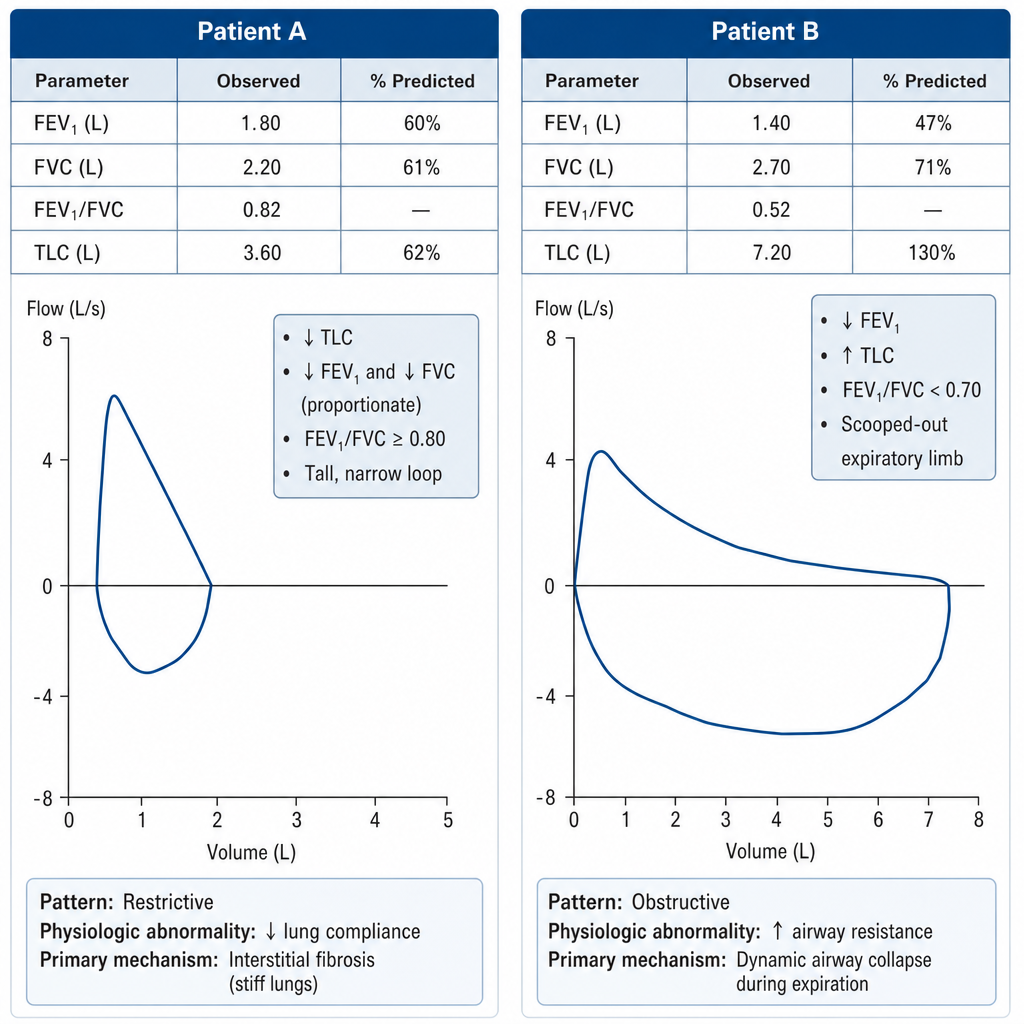
A pulmonologist reviews spirometry tracings from two patients with dyspnea. Patient A's loop shows a reduced total lung capacity, proportionally reduced FEV1 and FVC with an FEV1/FVC ratio of 0.82, and a tall, narrow loop shape. Patient B's loop shows a reduced FEV1, increased TLC, a scooped-out expiratory limb, and an FEV1/FVC ratio of 0.52. Which of the following correctly pairs each patient with the underlying physiological abnormality and its primary mechanism?
Want unlimited practice?
Get full access to all questions, explanations, and performance tracking.
Scan to download app