
Endothelial function and dysfunction — MCQs

An investigator is studying brachial artery reactivity in women with suspected coronary heart disease. The brachial artery diameter is measured via ultrasound before and after intra-arterial injection of acetylcholine. An increase of 7% in the vascular diameter is noted. The release of which of the following is most likely responsible for the observed effect?
A 70-year-old male presents to his primary care provider complaining of decreased sexual function. He reports that over the past several years, he has noted a gradual decline in his ability to sustain an erection. He used to wake up with erections but no longer does. His past medical history is notable for diabetes, hyperlipidemia, and a prior myocardial infarction. He takes metformin, glyburide, aspirin, and atorvastatin. He drinks 2-3 drinks per week and has a 25 pack-year smoking history. He has been happily married for 40 years. He retired from his job as a construction worker 5 years ago and has been enjoying retirement with his wife. His physician recommends starting a medication that is also used in the treatment of pulmonary hypertension. Which of the following is a downstream effect of this medication?
A 61-year-old man with hypertension and hyperlipidemia comes to the physician for a 4-month history of recurrent episodes of retrosternal chest pain, shortness of breath, dizziness, and nausea. The episodes usually start after physical activity and subside within minutes of resting. He has smoked one pack of cigarettes daily for 40 years. He is 176 cm (5 ft 9 in) tall and weighs 95 kg (209 lb); BMI is 30 kg/m2. His blood pressure is 160/100 mm Hg. Coronary angiography shows an atherosclerotic lesion with stenosis of the left anterior descending artery. Compared to normal healthy coronary arteries, increased levels of platelet-derived growth factor (PDGF) are found in this lesion. Which of the following is the most likely effect of this factor?
A 56-year-old male died in a motor vehicle accident. Autopsy reveals extensive atherosclerosis of his left anterior descending artery marked by intimal smooth muscle and collagen proliferation. Which of the following is implicated in recruiting smooth muscle cells from the media to intima in atherosclerotic lesions?
A 45-year-old man presents to the physician with a complaint of recurrent chest pain for the last 2 weeks. He mentions that the pain is not present at rest, but when he walks for some distance, he feels pain like a pressure over the retrosternal region. The pain disappears within a few minutes of stopping the physical activity. He is an otherwise healthy man with no known medical disorder. He does not smoke or have any known dependence. There is no family history of ischemic heart disease or vascular disorder. On physical examination, his vital signs, including blood pressure, are normal. The diagnosis of coronary artery disease due to atherosclerosis is made. Which of the following is known to be an infection associated with this patient’s condition?
A student is experimenting with the effects of nitric oxide in the body. He used a variety of amino acid isolates and measured the resulting nitric oxide levels and the physiological effects on the body. The amino acids function as substrates for nitric oxide synthase. After supplement administration, blood vessels dilated, and the systemic blood pressure decreased. Which of the following amino acids was used in this study?
A 72-year-old woman is brought to the emergency department for right hip pain 1 hour after she fell while walking around in her house. She has been unable to stand or walk since the fall. She has hypertension and gout. Her sister died of multiple myeloma at the age of 55 years. Current medications include amlodipine and febuxostat. She does not smoke cigarettes. She drinks a glass of wine daily. Her temperature is 37.3°C (99.1°F), pulse is 101/min, and blood pressure is 128/86 mm Hg. Examination shows right groin tenderness. Range of motion of the right hip is limited by pain. The remainder of the examination shows no abnormalities. A complete blood count and serum creatinine concentration are within the reference range. An x-ray of the hip shows a linear fracture of the right femoral neck. She is scheduled for surgery. Which of the following is the most likely underlying cause of this patient's fracture?
A 36-year-old man is seen in the emergency department for back pain that has been getting progressively worse over the last 4 days. Upon further questioning, he also notes that he has been having a tingling and burning sensation rising up from his feet to his knees bilaterally. The patient states he is having difficulty urinating and having bowel movements over the last several days. His temperature is 97.4°F (36.3°C), blood pressure is 122/80 mmHg, pulse is 85/min, respirations are 14/min, and oxygen saturation is 98% on room air. Physical exam is notable for weak leg flexion bilaterally along with decreased anal sphincter tone. Which of the following is the best next step in management?
An investigator studying new drug delivery systems administers an aerosol containing 6.7-μm sized particles to a healthy subject via a nonrebreather mask. Which of the following is the most likely route of clearance of the particulate matter in this subject?
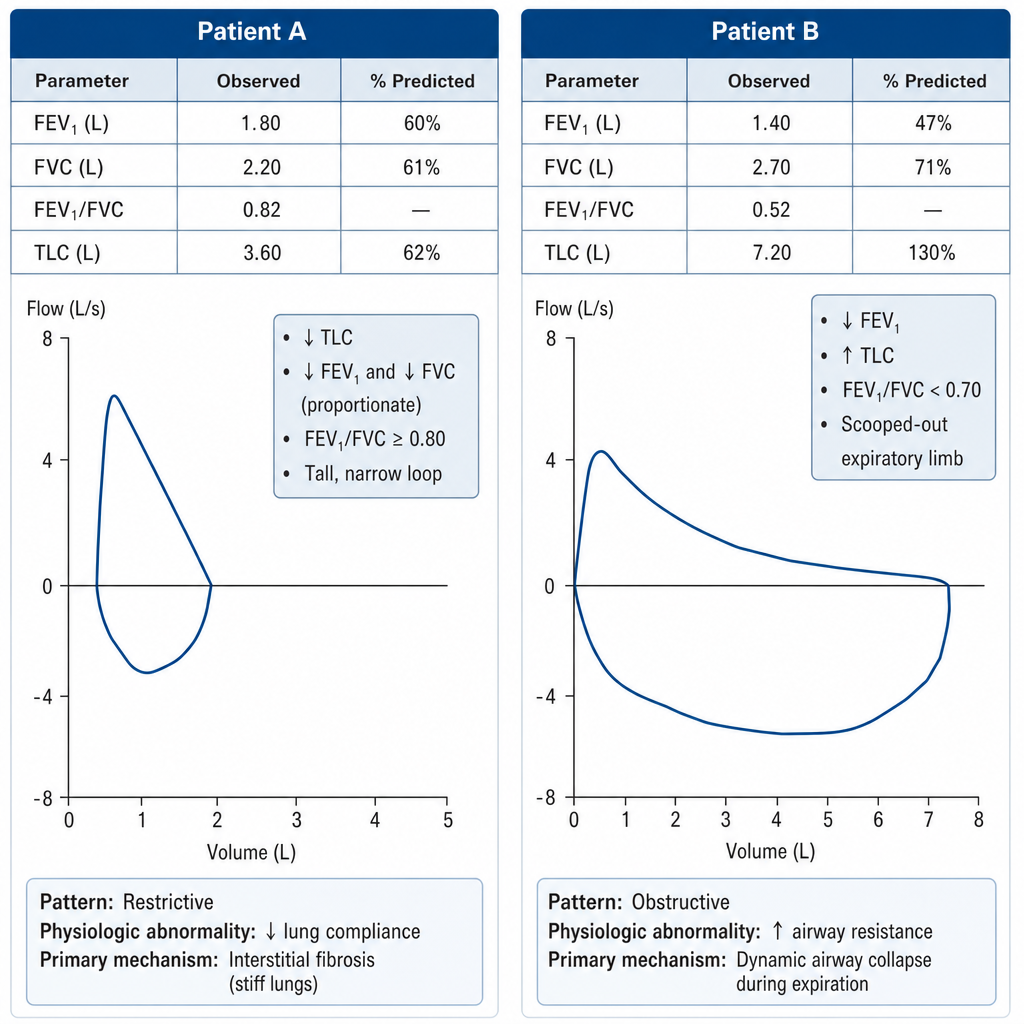
A pulmonologist reviews spirometry tracings from two patients with dyspnea. Patient A's loop shows a reduced total lung capacity, proportionally reduced FEV1 and FVC with an FEV1/FVC ratio of 0.82, and a tall, narrow loop shape. Patient B's loop shows a reduced FEV1, increased TLC, a scooped-out expiratory limb, and an FEV1/FVC ratio of 0.52. Which of the following correctly pairs each patient with the underlying physiological abnormality and its primary mechanism?
Want unlimited practice?
Get full access to all questions, explanations, and performance tracking.
Scan to download app