
Baroreceptor reflexes — MCQs

During an examination of the cranial nerves, a patient shows inability to move their eye laterally past the midline. Which of the following structures in the cavernous sinus is most likely affected?
A 75-year-old man presents to the emergency department after an episode of syncope while walking outside with his wife. His wife states that he suddenly appeared pale and collapsed to the ground. She says he remained unconscious for 1 minute. He says he noticed a fluttering in his chest and excessive sweating before the episode. He has type 2 diabetes mellitus, essential hypertension, and chronic stable angina. He has not started any new medications in the past few months. Vital signs reveal: temperature 37.0°C (98.6°F), blood pressure 135/72 mm Hg, and pulse 72/min. Physical examination is unremarkable. ECG shows an old bifascicular block. Echocardiogram and 24-hour Holter monitoring are normal. Which of the following is the best next step in the evaluation of this patient's condition?
A 33-year-old man presents to the emergency department after an episode of syncope. He states that for the past month ever since starting a new job he has experienced an episode of syncope or near-syncope every morning while he is getting dressed. The patient states that he now gets dressed, shaves, and puts on his tie sitting down to avoid falling when he faints. He has never had this before and is concerned it is stress from his new job as he has been unemployed for the past 5 years. He is wondering if he can get a note for work since he was unable to head in today secondary to his presentation. The patient has no significant past medical history and is otherwise healthy. His temperature is 99.2°F (37.3°C), blood pressure is 122/83 mmHg, pulse is 92/min, respirations are 16/min, and oxygen saturation is 100% on room air. Cardiopulmonary and neurologic exams are within normal limits. An initial ECG and laboratory values are unremarkable as well. Which of the following is the most likely diagnosis?
A 19-year-old man presents to the clinic with a complaint of increasing shortness of breath for the past 2 years. His shortness of breath is associated with mild chest pain and occasional syncopal attacks during strenuous activity. There is no history of significant illness in the past, however, one of his uncles had similar symptoms when he was his age and died while playing basketball a few years later. He denies alcohol use, tobacco consumption, and the use of recreational drugs. On examination, pulse rate is 76/min and is regular and bounding; blood pressure is 130/70 mm Hg. A triple apical impulse is observed on the precordium and a systolic ejection crescendo-decrescendo murmur is audible between the apex and the left sternal border along with a prominent fourth heart sound. The physician then asks the patient to take a deep breath, close his mouth, and pinch his nose and try to breathe out without allowing his cheeks to bulge out. In doing so, the intensity of the murmur increases. Which of the following hemodynamic changes would be observed first during this maneuver?
A 58-year-old man comes to the physician because of intermittent throbbing headaches over the past year. The headaches are worse when he wakes up and are not accompanied by other symptoms. The patient also reports trouble concentrating on daily tasks at work. His wife has been complaining lately about his snoring during sleep, which he attributes to his chronic sinusitis. He has a history of hypertension and an allergy to dust mites. He has smoked a pack of cigarettes daily for 14 years. His pulse is 72/min and blood pressure is 150/95 mm Hg. He is 178 cm (5 ft 10 in) tall and weighs 120 kg (265 lb); BMI is 37.9 kg/m2. Neurological and cutaneous examination shows no abnormalities. Which of the following is the most likely cause of this patient's hypertension?
A 22-year-old man presents with a history of lightheadedness, weakness, and palpitations when he assumes an upright position from a supine position. He is otherwise a healthy man without a history of alcohol or other substance abuse. His supine and standing blood pressures (measured at 3-minute intervals) were 124/82 mm Hg and 102/72 mm Hg, respectively. He was advised to perform a Valsalva maneuver while monitoring blood pressure and heart rate to assess the integrity of his baroreflex control. Which of the following statements is correct?
A 28-year-old female comes to the emergency department complaining of heart palpitations. She has had multiple episodes of these in the past few months. She has found that if she wears tight clothing then sometimes these episodes will stop spontaneously. On presentation to the ED, she feels like her heart is pounding and reports feeling nauseous. She appears mildly diaphoretic. Her blood pressure is 125/75 mmHg, pulse is 180/min, and respirations are 22/min with an O2 saturation of 99% on room air. A neck maneuver is performed and her pulse returns to 90/min with improvement of her symptoms. Stimulation of afferent fibers from which nerve are most responsible for the resolution of her symptoms?
A 25-year-old woman presents to her primary care physician for her yearly physical exam. She has no past medical history and says that she does not currently have any health concerns. On physical exam, she is found to have hyperactive patellar reflexes but says that she has had this finding since she was a child. She asks her physician why this might be the case. Her physician explains that there are certain cells that are responsible for detecting muscle stretch and responding to restore the length of the muscle. Which of the following is most likely a characteristic of these structures?
A 45-year-old man presents to the physician with complaints of burning pain in both feet and lower legs for 3 months. He reports that the pain is especially severe at night. He has a history of diabetes mellitus for the past 5 years, and he frequently skips his oral antidiabetic medications. His temperature is 36.9°C (98.4°F), heart rate is 80/min, respiratory rate is 15/min, and blood pressure is 120/80 mm Hg. His weight is 70 kg (154.3 lb) and height is 165 cm (approx. 5 ft 5 in). The neurologic examination reveals loss of sensations of pain and temperature over the dorsal and ventral sides of the feet and over the distal one-third of both legs. Proprioception is normal; knee jerks and ankle reflexes are also normal. The tone and strength in all muscles are normal. The hemoglobin A1C is 7.8%. Involvement of what type of nerve fibers is the most likely cause of the patient’s symptoms?
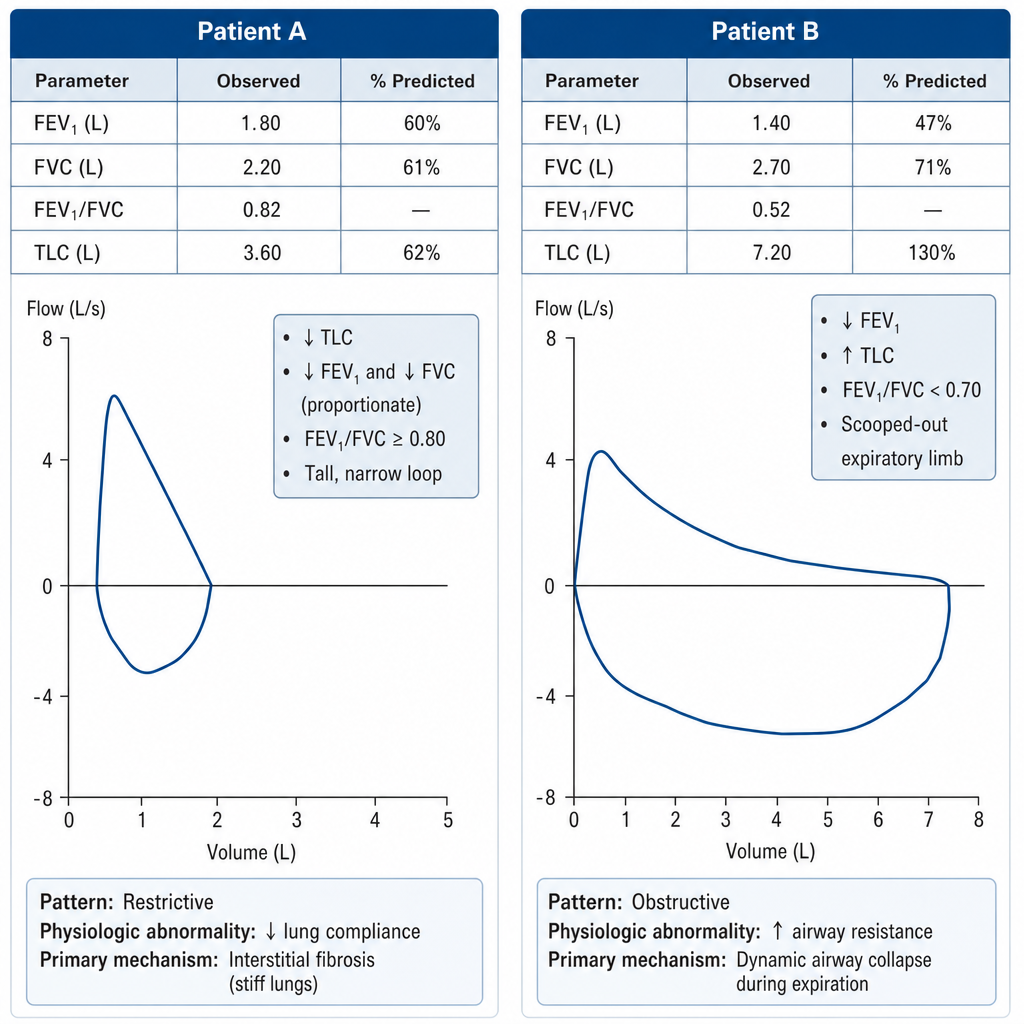
A pulmonologist reviews spirometry tracings from two patients with dyspnea. Patient A's loop shows a reduced total lung capacity, proportionally reduced FEV1 and FVC with an FEV1/FVC ratio of 0.82, and a tall, narrow loop shape. Patient B's loop shows a reduced FEV1, increased TLC, a scooped-out expiratory limb, and an FEV1/FVC ratio of 0.52. Which of the following correctly pairs each patient with the underlying physiological abnormality and its primary mechanism?
Want unlimited practice?
Get full access to all questions, explanations, and performance tracking.
Scan to download app