
Renal regulation of acid-base balance — MCQs

A 61-year-old male is given acetazolamide to treat open-angle glaucoma. Upon diuresis, his urine is found to be highly alkaline. Which of the following accounts for the alkaline nature of this patient’s urine?
A 67-year-old man presents to his primary care physician because of weak urine stream, and increasing difficulty in initiating and stopping urination. He also reports of mild generalized body aches and weakness during the day. The past medical history includes diabetes mellitus type 2 for 35 years and essential hypertension for 19 years. The medication list includes metformin, vildagliptin, and enalapril. The vital signs include: temperature 36.7°C (98.1°F), blood pressure 151/82 mm Hg, and pulse 88/min. The physical examination is remarkable for markedly enlarged, firm prostate without nodules. The laboratory test results are as follows: Serum sodium 142 mEq/L Serum potassium 5.7 mEq/L Serum chloride 115 mEq/L Serum bicarbonate 17 mEq/L Serum creatinine 0.9 mg/dL Arterial pH 7.31 Urine pH 5.3 Urine sodium 59 mEq/L Urine potassium 6.2 mEq/L Urine chloride 65 mEq/L Which of the following most likely explains the patient’s findings?
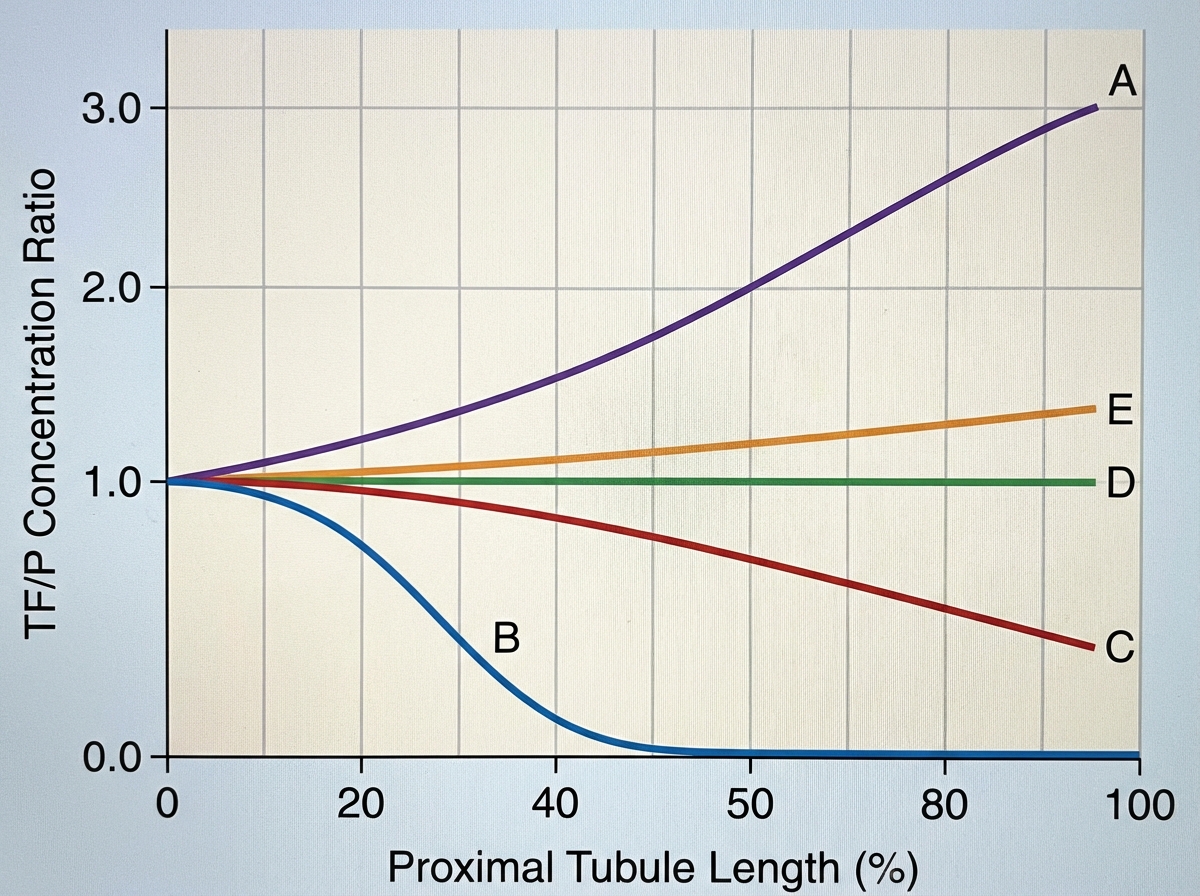
A 72-year-old female is brought to the emergency department after being found unresponsive in her garage with an open bottle of unmarked fluid. She is confused and is unable to answer questions on arrival. Her medical history is significant for Alzheimer disease, but her family says she has no medical comorbidities. Serum analysis of this patient's blood shows a pH of 7.28 with a high anion gap. The electrolyte that is most likely significantly decreased in this patient follows which of the following concentration curves across the proximal tubule of the kidney?
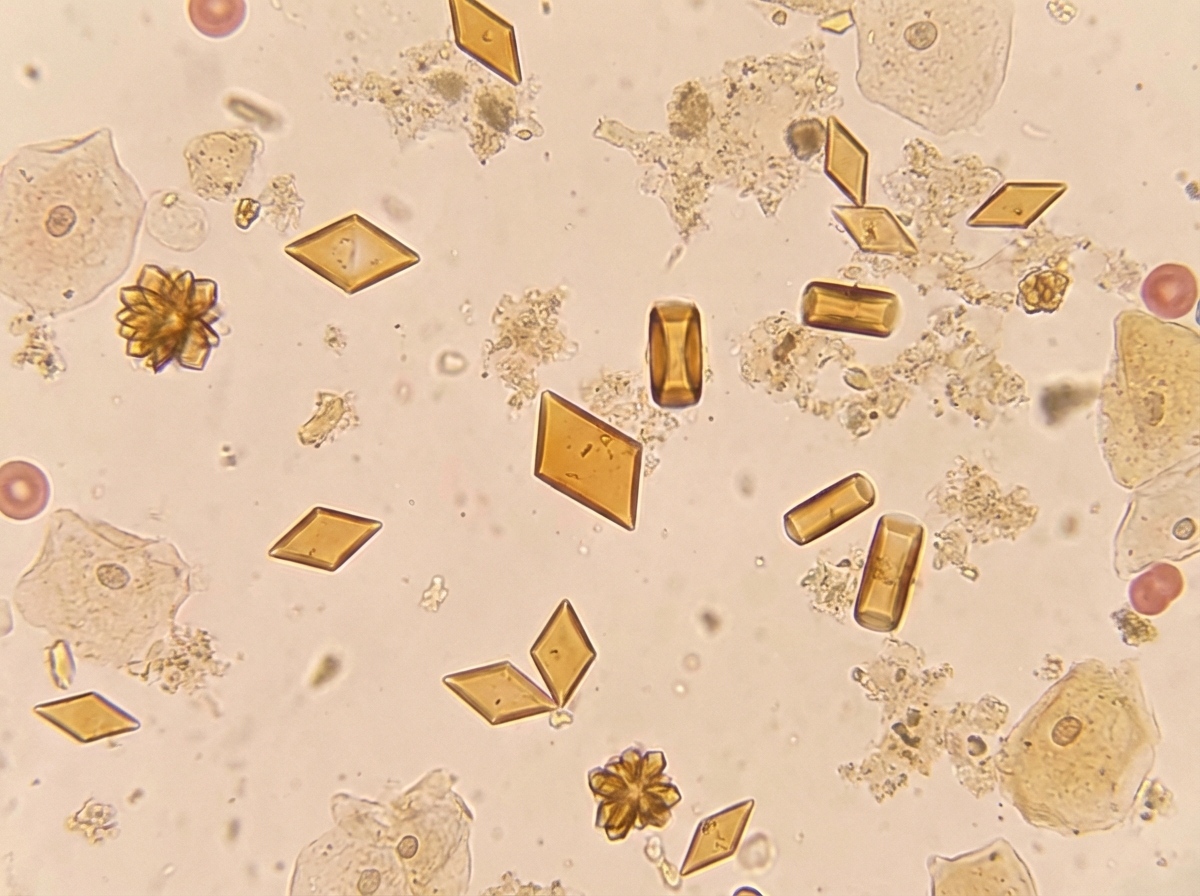
A 45-year-old woman presents with severe, acute-onset colicky abdominal pain and nausea. She also describes bone pain, constipation, headache, decreased vision, and menstrual irregularity. Past medical history is significant for surgical removal of an insulinoma one year ago. Two months ago, she was prescribed fluoxetine for depression but hasn’t found it very helpful. Family history is significant for a rare genetic syndrome. Non-contrast CT, CBC, CMP, and urinalysis are ordered in the diagnostic work-up. Urine sediment is significant for the findings shown in the picture. Which of the following will also be a likely significant finding in the diagnostic workup?
A 70-year-old woman is brought to the emergency department due to worsening lethargy. She lives with her husband who says she has had severe diarrhea for the past few days. Examination shows a blood pressure of 85/60 mm Hg, pulse of 100/min, and temperature of 37.8°C (100.0°F). The patient is stuporous, while her skin appears dry and lacks turgor. Laboratory tests reveal: Serum electrolytes Sodium 144 mEq/L Potassium 3.5 mEq/L Chloride 115 mEq/L Bicarbonate 19 mEq/L Serum pH 7.3 PaO2 80 mm Hg Pco2 38 mm Hg This patient has which of the following acid-base disturbances?
Which mechanism primarily regulates sodium reabsorption in the collecting duct?
A 17-year-old boy is brought to the physician by his father because of a 7-month history of fatigue, recurrent leg cramps, and increased urinary frequency. His pulse is 94/min and blood pressure is 118/85 mm Hg. Physical examination shows dry mucous membranes. Laboratory studies show: Serum Na+ 130 mEq/L K+ 2.8 mEq/L Cl- 92 mEq/L Mg2+ 1.1 mEq/L Ca2+ 10.6 mg/dL Albumin 5.2 g/dL Urine Ca2+ 70 mg/24 h Cl- 375 mEq/24h (N = 110–250) Arterial blood gas analysis on room air shows a pH of 7.55 and an HCO3- concentration of 45 mEq/L. Impaired function of which of the following structures is the most likely cause of this patient's condition?
A 32-year-old woman is admitted to the emergency department for 36 hours of intense left-sided back pain that extends into her left groin. She reports that the pain started a day after a charitable 5 km (3.1 mi) marathon. The past medical history is relevant for multiple complaints of eye dryness and dry mouth. Physical examination is unremarkable, except for intense left-sided costovertebral pain. The results from laboratory tests are shown. Laboratory test Result Serum Na+ 137 Serum Cl- 110 Serum K+ 3.0 Serum creatinine (SCr) 0.82 Arterial blood gas Result pH 7.28 pO2 98 mm Hg pCO2 28.5 mm Hg SaO2% 98% HCO3- 15 mm Hg Which of the following explains this patient’s condition?
A 24-year-old male is brought in by ambulance to the emergency department after he was found unresponsive at home for an unknown length of time. Upon arrival, he is found to be severely altered and unable to answer questions about his medical history. Based on clinical suspicion, a panel of basic blood tests are obtained including an arterial blood gas, which shows a pH of 7.32, a pCO2 of 70, and a bicarbonate level of 30 mEq/L. Which of the following is most likely the primary disturbance leading to the values found in the ABG?
A person is exercising strenuously on a treadmill for 1 hour. An arterial blood gas measurement is then taken. Which of the following are the most likely values?
Want unlimited practice?
Get full access to all questions, explanations, and performance tracking.
Scan to download app