
Area under the curve calculations — MCQs

A 35-year-old woman is started on a new experimental intravenous drug X. In order to make sure that she is able to take this drug safely, the physician in charge of her care calculates the appropriate doses to give to this patient. Data on the properties of drug X from a subject with a similar body composition to the patient is provided below: Weight: 100 kg Dose provided: 1500 mg Serum concentration 15 mg/dL Bioavailability: 1 If the patient has a weight of 60 kg and the target serum concentration is 10 mg/dL, which of the following best represents the loading dose of drug X that should be given to this patient?
A 68-year-old man undergoes successful mechanical prosthetic aortic valve replacement for severe aortic valve stenosis. After the procedure, he is started on an oral medication and instructed that he should take for the rest of his life and that he should avoid consuming large amounts of dark-green, leafy vegetables. Which of the following laboratory parameters should be regularly monitored to guide dosing of this drug?
A scientist is studying the excretion of a novel toxin X by the kidney in order to understand the dynamics of this new substance. He discovers that this new toxin X has a clearance that is half that of inulin in a particular patient. This patient's filtration fraction is 20% and his para-aminohippuric acid (PAH) dynamics are as follows: Urine volume: 100 mL/min Urine PAH concentration: 30 mg/mL Plasma PAH concentration: 5 mg/mL Given these findings, what is the clearance of the novel toxin X?
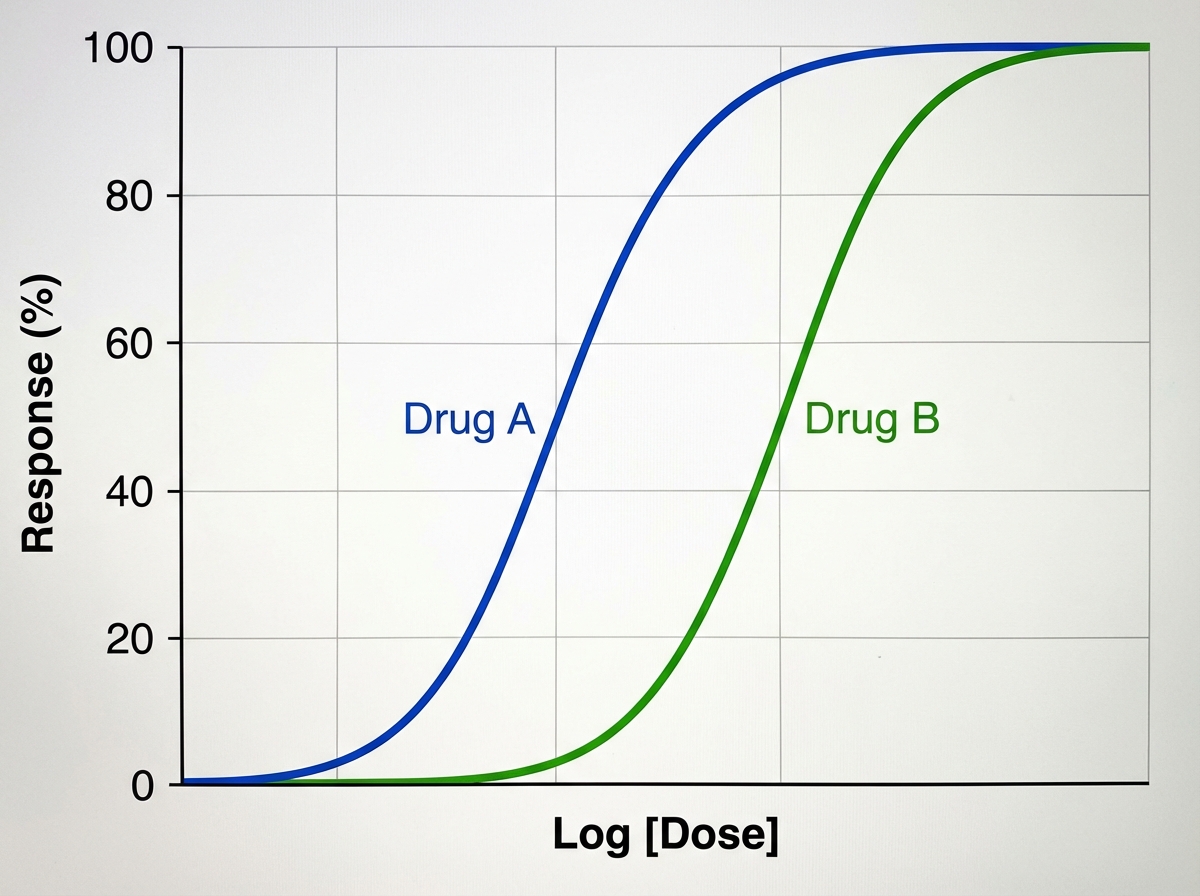
A medical student is reviewing dose-response curves of various experimental drugs. She is specifically interested in the different factors that cause the curve to shift in different directions. From her study, she plots the following graph (see image). She marks the blue curve for drug A, which acts optimally on a receptor. After drawing the second (green) curve for drug B, she discovers that more of drug B is required to produce the same response as drug A, although drug B can still achieve the same maximum effect. Which of the following terms best describes the activity of drug B in comparison to drug A?
You are currently employed as a clinical researcher working on clinical trials of a new drug to be used for the treatment of Parkinson's disease. Currently, you have already determined the safe clinical dose of the drug in a healthy patient. You are in the phase of drug development where the drug is studied in patients with the target disease to determine its efficacy. Which of the following phases is this new drug currently in?
A researcher is investigating the effects of a new antihypertensive medication on renal physiology. She gives a subject a dose of the new medication, and she then collects plasma and urine samples. She finds the following: Hematocrit: 40%; Serum creatinine: 0.0125 mg/mL; Urine creatinine: 1.25 mg/mL. Urinary output is 1 mL/min. Renal blood flow is 1 L/min. Based on the above information and approximating that the creatinine clearance is equal to the GFR, what answer best approximates filtration fraction in this case?
A 5-year-old boy undergoes MRI neuroimaging for the evaluation of worsening headaches and intermittent nausea upon awakening. He receives a bolus of intravenous thiopental for sedation during the procedure. Ten minutes after the MRI, the patient is awake and responsive. Which of the following pharmacological properties is most likely responsible for this patient's rapid recovery from this anesthetic agent?
A 65-year-old man with a history of myocardial infarction is admitted to the hospital for treatment of atrial fibrillation with rapid ventricular response. He is 180 cm (5 ft 11 in) tall and weighs 80 kg (173 lb). He is given an intravenous bolus of 150 mg of amiodarone. After 20 minutes, the amiodarone plasma concentration is 2.5 mcg/mL. Amiodarone distributes in the body within minutes, and its elimination half-life after intravenous administration is 30 days. Which of the following values is closest to the volume of distribution of the administered drug?
An experimental infusable drug, X729, is currently being studied to determine its pharmacokinetics. The drug was found to have a half life of 1.5 hours and is eliminated by first order kinetics. What is the minimum number of hours required to reach a steady state concentration of >90%?
A researcher is investigating the behavior of two novel chemotherapeutic drugs that he believes will be effective against certain forms of lymphoma. In order to evaluate the safety of these drugs, this researcher measures the concentration and rate of elimination of each drug over time. A partial set of the results is provided below. Time 1: Concentration of Drug A: 4 mg/dl Concentration of Drug B: 3 mg/dl Elimination of Drug A: 1 mg/minute Elimination of Drug B: 4 mg/minute Time 2: Concentration of Drug A: 2 mg/dl Concentration of Drug B: 15 mg/dl Elimination of Drug A: 0.5 mg/minute Elimination of Drug B: 4 mg/minute Which of the following statements correctly identifies the most likely relationship between the half-life of these two drugs?
Want unlimited practice?
Get full access to all questions, explanations, and performance tracking.
Scan to download app