
Intravenous anesthetics — MCQs

A 25-year-old female presents to the emergency room with a heart rate of 32 BPM and a blood pressure of 80/40. She was found by emergency medical services with an empty bottle of propranolol that was taken from her grandmother. Her vital signs do not improve despite IV fluids and oxygen. Which of the following is a first line treatment for overdose?
A 38-year-old man presents with sudden onset abdominal pain and undergoes an emergent laparoscopic appendectomy. The procedure is performed quickly, without any complications, and the patient is transferred to the post-operative care unit. A little while later, the patient complains of seeing people in his room and hearing voices talking to him. The patient has no prior medical or psychiatric history and does not take any regular medications. What is the mechanism of action of the anesthetic most likely responsible for this patient’s symptoms?
A 44-year-old male is brought to the emergency department by fire and rescue after he was the unrestrained driver in a motor vehicle accident. His wife notes that the patient’s only past medical history is recent development of severe episodes of headache accompanied by sweating and palpitations. She says that these episodes were diagnosed as atypical panic attacks by the patient’s primary care provider, and the patient was started on sertraline and alprazolam. In the trauma bay, the patient’s temperature is 97.6°F (36.4°C), blood pressure is 81/56 mmHg, pulse is 127/min, and respirations are 14/min. He has a Glascow Coma Score (GCS) of 10. He is extremely tender to palpation in the abdomen with rebound and guarding. His skin is cool and clammy, and he has thready peripheral pulses. The patient's Focused Assessment with Sonography for Trauma (FAST) exam reveals bleeding in the perisplenic space, and he is taken for emergency laparotomy. He is found to have a ruptured spleen, and his spleen is removed. During manipulation of the bowel, the patient’s temperature is 97.8°F (36.6°C), blood pressure is 246/124 mmHg, and pulse is 104/min. The patient is administered intravenous labetalol, but his blood pressure continues to worsen. The patient dies during the surgery. Which of the following medications would most likely have prevented this outcome?
A 26-year-old woman presents with an 8-month history of insomnia and anxiety. She says that she has difficulty sleeping and has feelings of impending doom linked to her difficult financial situation. No significant family history and no current medications. The patient was prescribed an 8-week supply of medication. She follows up 4 weeks later saying that she has increased anxiety and needs a refill. She says that over the past month, due to increasing anxiety levels, she started taking extra doses of her medication to achieve an anxiolytic effect. Which of the following medications was most likely prescribed to this patient?
A 3-year-old boy is brought in by his parents to the emergency department for lethargy and vomiting. The patient was fine until this afternoon, when his parents found him in the garage with an unlabeled open bottle containing an odorless liquid. On exam, the patient is not alert or oriented, but is responsive to touch and pain. The patient is afebrile and pulse is 90/min, blood pressure is 100/60 mmHg, and respirations are 20/min. Which of the following is an antidote for the most likely cause of this patient’s presentation?
A 28-year-old man comes to the emergency department for an injury sustained while doing construction. Physical examination shows a long, deep, irregular laceration on the lateral aspect of the left forearm with exposed fascia. Prior to surgical repair of the injury, a brachial plexus block is performed using a local anesthetic. Shortly after the nerve block is performed, he complains of dizziness and then loses consciousness. His radial pulse is faint and a continuous cardiac monitor shows a heart rate of 24/min. Which of the following is the most likely mechanism of action of the anesthetic that was administered?
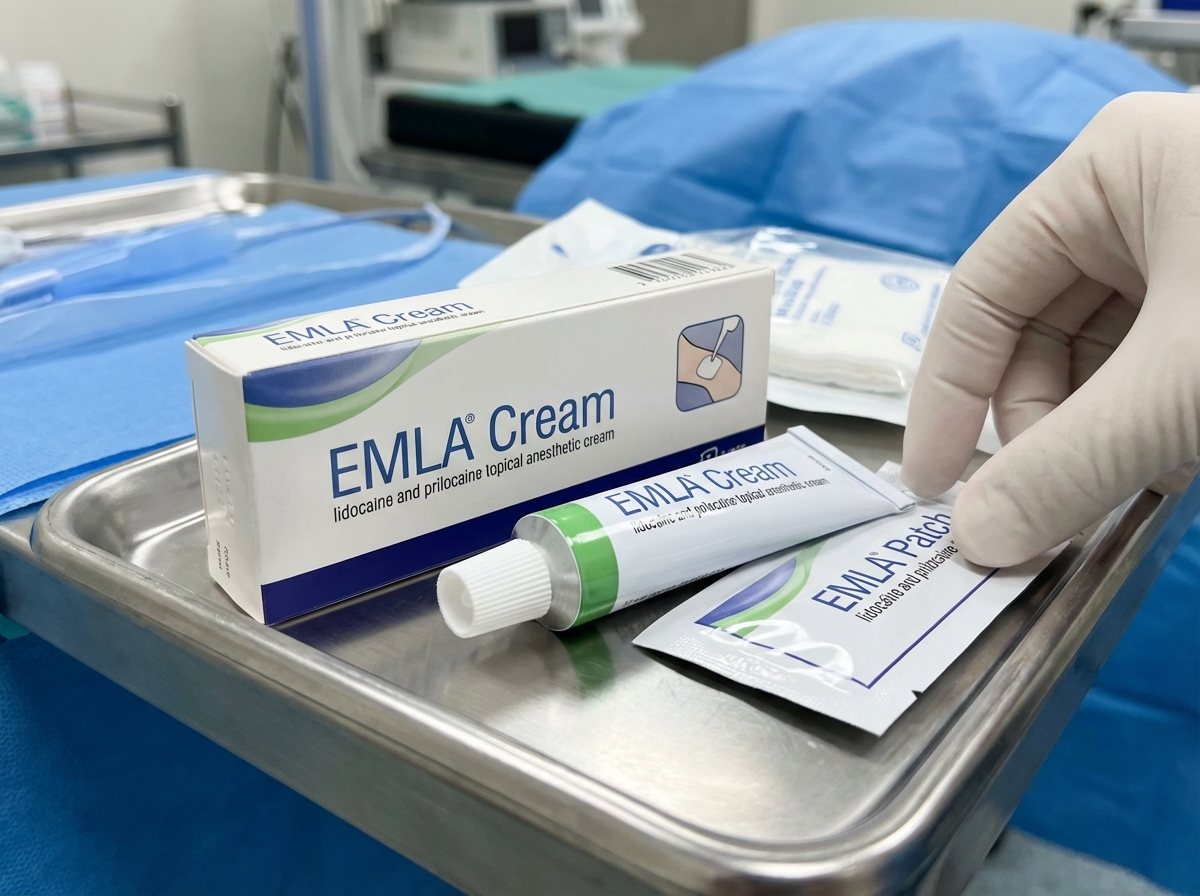
Which of the following statements regarding the patch shown in the figure is correct?
You are a resident on an anesthesiology service and are considering using nitrous oxide to assist in placing a laryngeal mask airway (LMA) in your patient, who is about to undergo a minor surgical procedure. You remember that nitrous oxide has a very high minimal alveolar concentration (MAC) compared to other anesthetics. This means that nitrous oxide has:
A 5-year-old boy undergoes MRI neuroimaging for the evaluation of worsening headaches and intermittent nausea upon awakening. He receives a bolus of intravenous thiopental for sedation during the procedure. Ten minutes after the MRI, the patient is awake and responsive. Which of the following pharmacological properties is most likely responsible for this patient's rapid recovery from this anesthetic agent?
A 42-year-old man is brought in to the emergency department by his daughter. She reports that her father drank heavily for the last 16 years, but he stopped 4 days ago after he decided to quit drinking on his birthday. She also reports that he has been talking about seeing cats running in his room since this morning, although there were no cats. There is no history of any known medical problems or any other substance use. On physical examination, his temperature is 38.4ºC (101.2ºF), heart rate is 116/min, blood pressure is 160/94 mm Hg, and respiratory rate is 22/min. He is severely agitated and is not oriented to his name, time, or place. On physical examination, profuse perspiration and tremors are present. Which of the following best describes the pathophysiologic mechanism underlying his condition?
Want unlimited practice?
Get full access to all questions, explanations, and performance tracking.
Scan to download app