
Beta-adrenergic antagonists — MCQs

A 39-year-old woman is brought to the emergency department 30 minutes after her husband found her unconscious on the living room floor. She does not report having experienced light-headedness, nausea, sweating, or visual disturbance before losing consciousness. Three weeks ago, she was diagnosed with open-angle glaucoma and began treatment with an antiglaucoma drug in the form of eye drops. She last used the eye drops 1 hour ago. Examination shows pupils of normal size that are reactive to light. An ECG shows sinus bradycardia. This patient is most likely undergoing treatment with which of the following drugs?
A 55-year-old man comes to the physician because of episodic retrosternal chest pain and shortness of breath for the past 6 months. His symptoms occur when he takes long walks or climbs stairs but resolve promptly with rest. He has a history of chronic obstructive pulmonary disease, for which he takes ipratropium bromide. His pulse is 81/min and blood pressure is 153/82 mm Hg. Physical examination shows mild expiratory wheezing over both lungs. Additional treatment with a beta blocker is considered. Which of the following agents should be avoided in this patient?
A 55-year-old man comes to the physician because of intermittent palpitations that occur when he is stressed, exercising, or when he drinks alcohol. Physical examination shows an irregularly irregular pulse. An ECG shows irregular QRS complexes without any discrete P waves. Pharmacotherapy with carvedilol is initiated for his condition. Compared to treatment with propranolol, which of the following adverse effects is most likely?
A 50-year-old man with a history of atrial fibrillation presents to his cardiologist’s office for a follow-up visit. He recently started treatment with an anti-arrhythmic drug to prevent future recurrences and reports that he has been feeling well and has no complaints. The physical examination shows that the arrhythmia appears to have resolved; however, there is now mild bradycardia. In addition, the electrocardiogram recording shows a slight prolongation of the PR and QT intervals. Which of the following drugs was most likely used to treat this patient?
A 70-year-old male presents for an annual exam. His past medical history is notable for shortness of breath when he sleeps, and upon exertion. Recently he has experienced dyspnea and lower extremity edema that seems to be worsening. Both of these symptoms have resolved since he was started on several medications and instructed to weigh himself daily. Which of the following is most likely a component of his medical management?
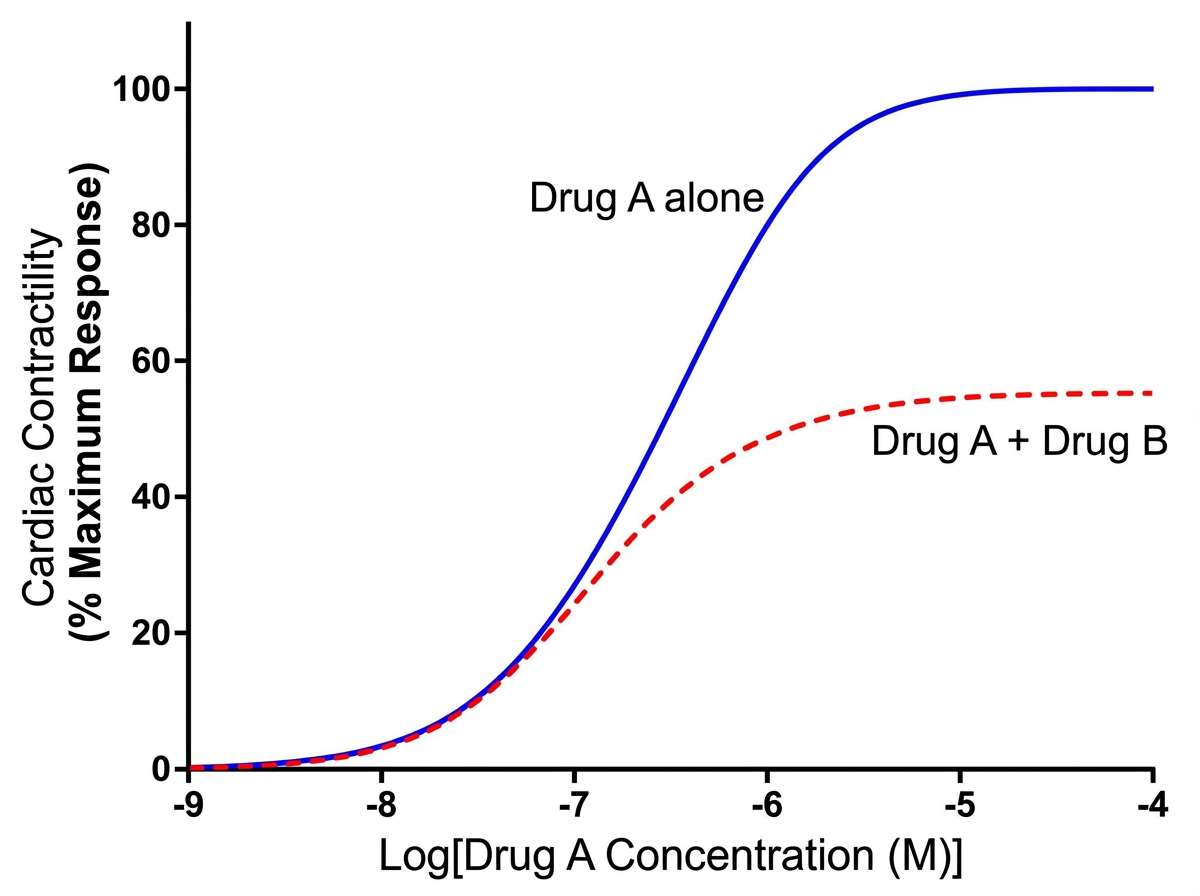
An investigator is studying the effects of different drugs on the contraction of cardiomyocytes. The myocytes are able to achieve maximal contractility with the administration of drug A. The subsequent administration of drug B produces the response depicted in the graph shown. Which of the following drugs is most likely to produce a response similar to that of drug B?
A 77-year-old woman with congestive heart failure is admitted to the hospital for evaluation prior to cardiac transplantation. During her stay at the hospital, the physician prescribes a drug to improve cardiac contractility. The drug works by selectively inhibiting an isoenzyme that is responsible for the degradation of cyclic adenosine monophosphate. Which of the following is the most likely adverse effect of this drug?
Match the following: Column A: a. Beta 1 b. Beta 2 c. Beta 3 Column B: 1. Mirabegron 2. Betaxolol 3. Salbutamol
A 53-year-old man presents to the office for a routine examination. The medical history is significant for diabetes mellitus, for which he is taking metformin. The medical records show blood pressure readings from three separate visits to fall in the 130–160 mm Hg range for systolic and 90–100 mm Hg range for diastolic. Prazosin is prescribed. Which of the following are effects of this drug?
A 73-year-old man presents to his primary care physician with chest pain. He noticed the pain after walking several blocks, and the pain is relieved by sitting. On exam, he has a BP 155/89 mmHg, HR 79 bpm, and T 98.9 F. The physician refers the patient to a cardiologist and offers prescriptions for carvedilol and nitroglycerin. Which of the following describes the mechanism or effects of each of these medications, respectively?
Want unlimited practice?
Get full access to all questions, explanations, and performance tracking.
Scan to download app