
Acetylcholine receptors and function — MCQs

Which receptor type mediates the slow phase of synaptic transmission in autonomic ganglia?
A 32-year-old farmer is brought to the emergency department by his wife. The patient was reportedly anxious, sweaty, and complaining of a headache and chest tightness before losing consciousness on route to the hospital. Which of the following is mechanistically responsible for this patient's symptoms?
A scientist is trying to design a drug to modulate cellular metabolism in the treatment of obesity. Specifically, he is interested in understanding how fats are processed in adipocytes in response to different energy states. His target is a protein within these cells that catalyzes catabolism of an energy source. The products of this reaction are subsequently used in gluconeogenesis or β-oxidation. Which of the following is true of the most likely protein that is being studied by this scientist?
A drug research team has synthesized a novel oral drug that acts as an agonist at multiple adrenergic receptors. When administered in animals, it has been shown to produce urinary retention at therapeutic doses with the absence of other manifestations of adrenergic stimulation. The researchers are interested in understanding signal transduction and molecular mechanisms behind the action of the novel drug. Which of the following receptors would most likely transduce signals across the plasma membrane following the administration of this novel drug?
A 45-year-old unconscious man is brought to the emergency department by a friend who witnessed him collapse. They were working in a greenhouse spraying the vegetables when the man started to complain of blurred vision and nausea. On the way to the hospital, the man lost consciousness and lost bladder continence. The patient’s vital signs are as follows: blood pressure 95/60 mm Hg; heart rate 59/min; respiratory rate 22/min; and temperature 36.0℃ (96.8℉). On examination, he is unconscious with a GCS score of 7. His pupils are contracted and react poorly to light. Lung auscultation reveals diffuse wheezing. Cardiac auscultation is significant for bradycardia. Abdominal auscultation reveals increased bowel sounds. A cardiac monitor shows bradycardia with grade 2 AV-block. Which of the following leads to the cardiac manifestations seen in this patient?
A 72-year-old man with coronary artery disease comes to the physician because of intermittent episodes of substernal chest pain and shortness of breath. The episodes occur only when walking up stairs and resolves after resting for a few minutes. He is a delivery man and is concerned because the chest pain has impacted his ability to work. His pulse is 98/min and blood pressure is 132/77 mm Hg. Physical examination is unremarkable. An ECG shows no abnormalities. A drug that blocks which of the following receptors is most likely to prevent future episodes of chest pain from occurring?
A 48-year-old man is unable to pass urine after undergoing open abdominal surgery. His physical examination and imaging findings suggest that the cause of his urinary retention is non-obstructive and is most probably due to urinary bladder atony. He is prescribed a new selective muscarinic (M3) receptor agonist, which improves his symptoms. Which of the following is most likely involved in the mechanism of action of this new drug?
A 28-year-old female presents to her primary care doctor complaining of new onset blurry vision. She first noticed her vision getting blurry toward the end of the day several days ago. Since then, she reports that her vision has been fine when she wakes up but gets worse throughout the day. She has also noticed that her eyelids have started to droop before she goes to bed. On exam, she has bilateral ptosis that is worse on the right. Administering edrophonium to this patient leads to an immediate improvement in her symptoms. Which of the following is most likely true about this patient’s condition?
A researcher is studying receptors that respond to epinephrine in the body and discovers a particular subset that is expressed in presynaptic adrenergic nerve terminals. She discovers that upon activation, these receptors will lead to decreased sympathetic nervous system activity. She then studies the intracellular second messenger changes that occur when this receptor is activated. She records these changes and begins searching for analogous receptor pathways. Which of the following receptors would cause the most similar set of intracellular second messenger changes?
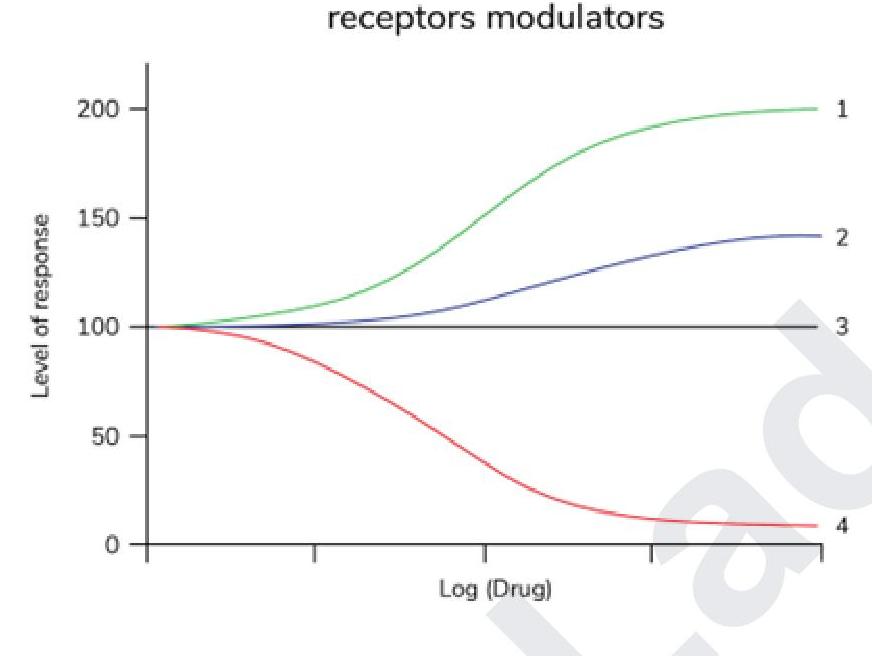
Which of the following statements is correct regarding the given graph?
Want unlimited practice?
Get full access to all questions, explanations, and performance tracking.
Scan to download app