
Influenza antivirals — MCQs

A 45-year-old man comes to the emergency department with fever, nonproductive cough, and difficulty breathing. Three years ago, he underwent lung transplantation. A CT scan of the chest shows diffuse bilateral ground-glass opacities. Pathologic examination of a transbronchial lung biopsy specimen shows several large cells containing intranuclear inclusions with a clear halo. Treatment with ganciclovir fails to improve his symptoms. He is subsequently treated successfully with another medication. This drug does not require activation by viral kinases and also has known in-vitro activity against HIV and HBV. The patient was most likely treated with which of the following drugs?
A 59-year-old female presents to the emergency department after a fall. She reports severe pain in her right hip and an inability to move her right leg. Her past medical history is notable for osteoporosis, rheumatoid arthritis, and has never undergone surgery before. The patient was adopted, and her family history is unknown. She has never smoked and drinks alcohol socially. Her temperature is 98.8°F (37.1°C), blood pressure is 150/90 mmHg, pulse is 110/min, and respirations are 22/min. Her right leg is shortened, abducted, and externally rotated. A radiograph demonstrates a displaced femoral neck fracture. She is admitted and eventually brought to the operating room to undergo right hip arthroplasty. While undergoing induction anesthesia with inhaled sevoflurane, she develops severe muscle contractions. Her temperature is 103.4°F (39.7°C). A medication with which of the following mechanisms of action is indicated in the acute management of this patient’s condition?
A 68-year-old man comes to the physician because of headache, fatigue, and nonproductive cough for 1 week. He appears pale. Pulmonary examination shows no abnormalities. Laboratory studies show a hemoglobin concentration of 9.5 g/dL and an elevated serum lactate dehydrogenase concentration. A peripheral blood smear shows normal red blood cells that are clumped together. Results of cold agglutinin titer testing show a 4-fold elevation above normal. An x-ray of the chest shows diffuse, patchy infiltrates bilaterally. Treatment is begun with an antibiotic that is also used to promote gut motility. Which of the following is the primary mechanism of action of this drug?
A 43-year-old man is brought to the emergency department 45 minutes after his wife found him on the floor sweating profusely. On arrival, he is lethargic and unable to provide a history. He vomited multiple times on the way to the hospital. His temperature is 37.3°C (99.1°F), pulse is 55/min, respirations are 22/min, and blood pressure is 98/65 mm Hg. Pulse oximetry on room air shows an oxygen saturation of 80%. Examination shows profuse diaphoresis and excessive salivation. He withdraws his extremities sluggishly to pain. The pupils are constricted and reactive. Scattered expiratory wheezing and rhonchi are heard throughout both lung fields. Cardiac examination shows no abnormalities. There are fine fasciculations in the lower extremities bilaterally. Muscle strength is reduced and deep tendon reflexes are 1+ bilaterally. His clothes are soaked with urine and feces. Which of the following is the mechanism of action of the most appropriate initial pharmacotherapy?
A 26-year-old nurse presents 12 hours after she accidentally stuck herself with a blood-contaminated needle. She reported the accident appropriately and now seeks post-exposure prophylaxis. She does not have any complaints at the moment of presentation. Her vital signs include: blood pressure 125/80 mm Hg, heart rate 71/min, respiratory rate 15/min, and temperature 36.5℃ (97.7℉). Physical examination is unremarkable. The nurse has prescribed a post-exposure prophylaxis regimen which includes tenofovir, emtricitabine, and raltegravir. How will tenofovir change the maximum reaction rate (Vm) and Michaelis constant (Km) of the viral reverse transcriptase?
A 66-year-old woman with chronic obstructive pulmonary disease is brought to the emergency department because of fever, body aches, malaise, and a dry cough. She has smoked one pack of cigarettes daily for 30 years but quit smoking 1 year ago. She lives with her daughter and her granddaughter, who attends daycare. Her temperature is 38.1°C (101°F). Physical examination shows bilateral conjunctivitis, rhinorrhea, and erythematous tonsils without exudates. Further testing confirms infection with an enveloped orthomyxovirus. Administration of a drug with which of the following mechanisms of action is most appropriate?
A 49-year-old woman presents to her primary care doctor in late December with malaise. She reports worsening fatigue, myalgias, headache, and malaise that started 1 day ago. She works as a lunch lady at an elementary school. Her past medical history is notable for a distal radius fracture after a fall 2 years ago, but she is otherwise healthy and takes no medications. She does not smoke or drink alcohol. She is married and has 3 adult children who are healthy. Her temperature is 102.9°F (39.4°C), blood pressure is 101/61 mmHg, pulse is 112/min, and respirations are 21/min. On exam, she appears lethargic and uncomfortable but is able to answer questions appropriately. Breath sounds are normal bilaterally. She is started on intravenous fluids and a pharmacologic agent for treatment. Which of the following is the most likely mechanism of action of the drug being used to treat this patient?
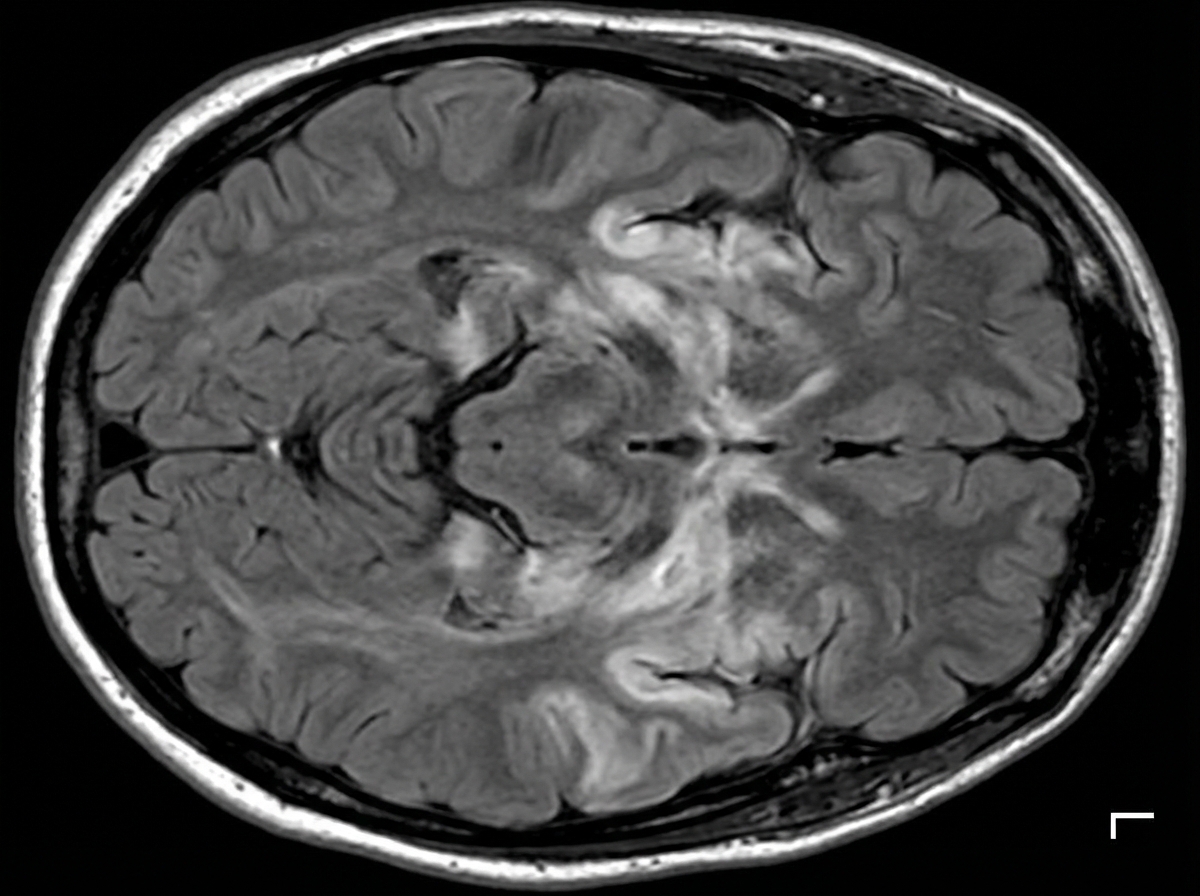
A 27-year-old man is brought to the emergency department by his friends in a confused state. He was doing fine 5 days ago when he started to complain of fever and flu-like symptoms. His fever was low-grade and associated with a headache. For the past 2 days, he has become increasingly irritable, confused, and was getting angry at trivial things. Past medical history is unremarkable. He is a college student and is physically active. He smokes cigarettes occasionally. He drinks alcohol socially. He is sexually active with his girlfriend and they use condoms inconsistently. Physical examination reveals: blood pressure 120/80 mm Hg, heart rate 108/min, respiratory rate 10/min, and temperature 37.4°C (99.4°F). He is confused and disoriented. Pupils are 3 mm in diameter and respond to light sluggishly. He is moving all his limbs spontaneously. His neck is supple. MRI of the brain is shown in the picture. Cerebrospinal fluid (CSF) reveals an opening pressure of 16 cm of H20, a total leukocyte count of 112/mm3 with 85% lymphocytes, the protein of 42 mg/dL, and glucose of 58 mg/dL. What is the best treatment for this condition?
A 22-year-old man presents to the emergency department with a fever and a sore throat. He has had these symptoms for the past 2 weeks and has felt progressively more fatigued. His temperature is 102°F (38.9°C), blood pressure is 120/68 mmHg, pulse is 100/min, respirations are 17/min, and oxygen saturation is 98% on room air. Physical exam is notable for tonsillar exudates, posterior cervical lymphadenopathy, and splenomegaly. Which of the following is the most appropriate next step in management for this patient?
A 53-year-old woman comes to the physician in February because of a 1-day history of fever, chills, headache, and dry cough. She also reports malaise and generalized muscle aches. She works as a teacher at a local high school, where there was recently an outbreak of influenza. She has a history of intermittent asthma, for which she takes albuterol as needed. She declined the influenza vaccine offered in the fall because her sister told her that a friend developed a flulike illness after receiving the vaccine. She is worried about possibly becoming ill and cannot afford to miss work. Her temperature is 37.9°C (100.3°F), heart rate is 58/min, and her respirations are 12/min. Physical examination is unremarkable. Her hemoglobin concentration is 14.5 g/dL, leukocyte count is 9,400/mm3, and platelet count is 280,000/mm3. In addition to analgesia, which of the following is the most appropriate next step in management?
Want unlimited practice?
Get full access to all questions, explanations, and performance tracking.
Scan to download app