
Hepatitis B antivirals — MCQs

A 25-year-old sexually active male presents to an internal medicine physician for a routine health check up after having several unprotected sexual encounters. After appropriate testing the physician discusses with the patient that he is HIV+ and must be started on anti-retroviral treatment. Which of the following medications prescribed acts on the gp41 subunit of the HIV envelope glycoprotein?
A 30-year-old woman presents with generalized fatigue, joint pain, and decreased appetite. She says that symptoms onset a year ago and have not improved. The patient’s husband says he has recently noticed that her eyes and skin are yellowish. The patient denies any history of smoking or alcohol use, but she admits to using different kinds of intravenous illicit drugs during her college years. The patient is afebrile and vital signs are within normal limits. Physical examination is unremarkable, except for moderate scleral icterus. A polymerase chain reaction (PCR) of a blood sample is positive for a viral infection that reveals a positive-sense RNA virus, that is small, enveloped, and single-stranded. The patient is started on a drug that resembles a purine RNA nucleotide. She agrees not to get pregnant before or during the use of this medication. Which of the following is the drug that was most likely given to this patient?
A 39-year-old male presents to the emergency department with fever, jaundice, and abdominal pain. The patient is a known intravenous drug-user. Serologic testing reveals an ALT of 1040 units/L, AST of 810 units/L, and titer evidence of infection with an enveloped, negative sense, single-stranded, closed circular RNA virus. Which of the following infections must also be present in this patient for him to develop his current disease?
A 28-year-old man comes to the physician for a pre-employment examination. He has no history of serious illness and takes no medications. A screening blood test is performed in which peptides are added to the sample to stimulate in vitro production of interferon-gamma, which is then measured using an enzyme-linked immunosorbent assay. This test is most likely to be helpful in diagnosing infection with which of the following pathogens?
A 27-year-old woman who recently emigrated from Brazil comes to the physician because of fever, fatigue, decreased appetite, and mild abdominal discomfort. She has not seen a physician in several years and her immunization status is unknown. She drinks 2 alcoholic beverages on the weekends and does not use illicit drugs. She is sexually active with several male partners and uses condoms inconsistently. Her temperature is 38°C (99.8°F). Physical examination shows right upper quadrant tenderness and scleral icterus. Serology confirms acute infection with a virus that has partially double-stranded, circular DNA. Which of the following is most likely involved in the replication cycle of this virus?
A 52-year-old woman comes to the physician because of abdominal discomfort, anorexia, and mild fatigue. She has systemic lupus erythematosus and takes hydroxychloroquine. She does not drink alcohol or use illicit drugs. Physical examination shows no abnormalities. Laboratory studies show: Alanine aminotransferase 455 U/L Aspartate aminotransferase 205 U/L Hepatitis B surface antigen positive Hepatitis B surface antibody negative Hepatitis B envelope antigen positive Hepatitis B core antigen IgG antibody positive Which of the following is the most appropriate pharmacotherapy for this patient?
A 26-year-old nurse presents 12 hours after she accidentally stuck herself with a blood-contaminated needle. She reported the accident appropriately and now seeks post-exposure prophylaxis. She does not have any complaints at the moment of presentation. Her vital signs include: blood pressure 125/80 mm Hg, heart rate 71/min, respiratory rate 15/min, and temperature 36.5℃ (97.7℉). Physical examination is unremarkable. The nurse has prescribed a post-exposure prophylaxis regimen which includes tenofovir, emtricitabine, and raltegravir. How will tenofovir change the maximum reaction rate (Vm) and Michaelis constant (Km) of the viral reverse transcriptase?
A 20-year-old man who is a biology major presents to his physician for a simple check-up. He is informed that he hasn't received a hepatitis B vaccine. When the first injection is applied, the medical professional informs him that he will need to come back 2 more times on assigned days, since the vaccine is given in 3 doses. Which of the following antibodies is produced first in the college student as a result of the first vaccination?
A 45-year-old man presents for follow-up to monitor his chronic hepatitis C treatment. The patient was infected with hepatitis C genotype 1, one year ago. He has been managed on a combination of pegylated interferon-alpha and ribavirin, but a sustained viral response has not been achieved. Past medical history is significant for non-alcoholic fatty liver disease for the last 5 years. Which of the following, if added to the patient’s current treatment regimen, would most likely benefit this patient?
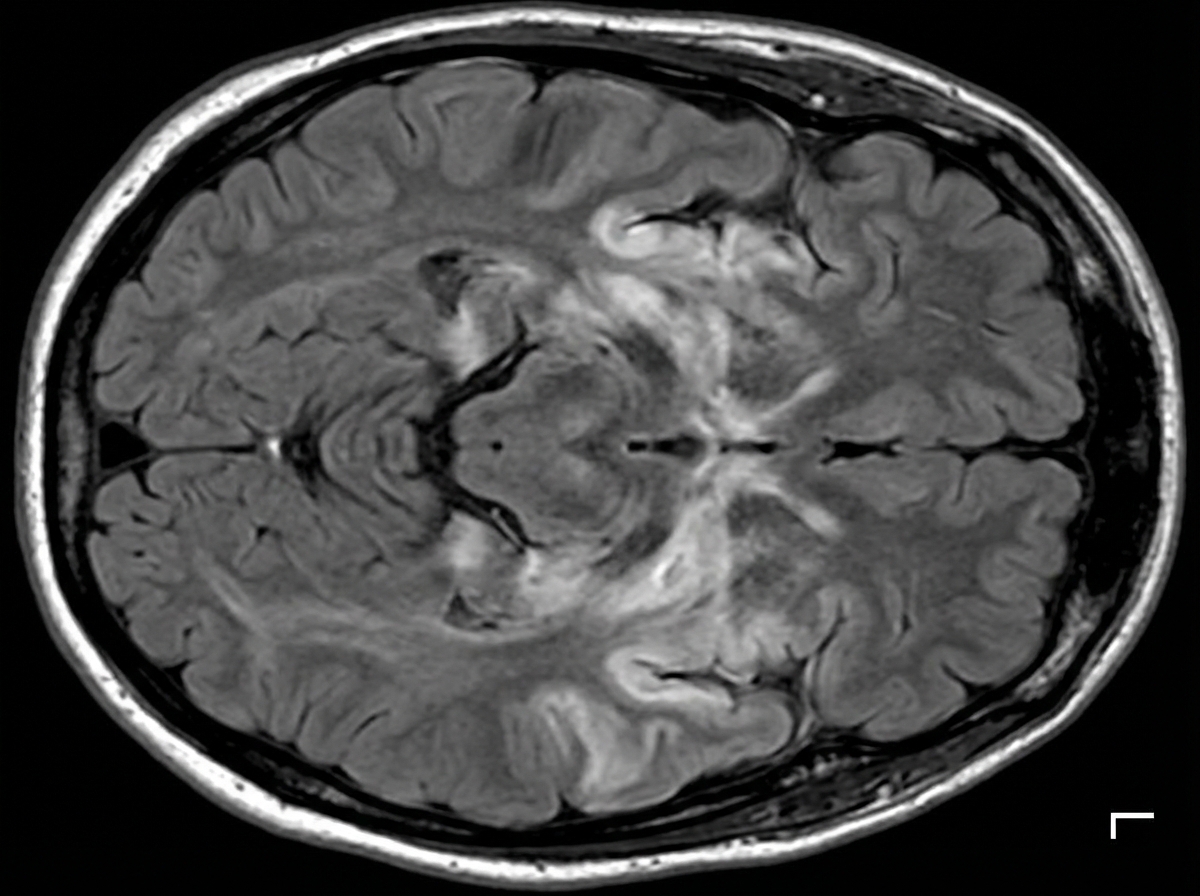
A 27-year-old man is brought to the emergency department by his friends in a confused state. He was doing fine 5 days ago when he started to complain of fever and flu-like symptoms. His fever was low-grade and associated with a headache. For the past 2 days, he has become increasingly irritable, confused, and was getting angry at trivial things. Past medical history is unremarkable. He is a college student and is physically active. He smokes cigarettes occasionally. He drinks alcohol socially. He is sexually active with his girlfriend and they use condoms inconsistently. Physical examination reveals: blood pressure 120/80 mm Hg, heart rate 108/min, respiratory rate 10/min, and temperature 37.4°C (99.4°F). He is confused and disoriented. Pupils are 3 mm in diameter and respond to light sluggishly. He is moving all his limbs spontaneously. His neck is supple. MRI of the brain is shown in the picture. Cerebrospinal fluid (CSF) reveals an opening pressure of 16 cm of H20, a total leukocyte count of 112/mm3 with 85% lymphocytes, the protein of 42 mg/dL, and glucose of 58 mg/dL. What is the best treatment for this condition?
Want unlimited practice?
Get full access to all questions, explanations, and performance tracking.
Scan to download app