
Vitamin D deficiency and rickets — MCQs

A 67-year-old male presents to his primary care physician complaining of left hip pain for the past six months. He denies any trauma or recent falls. He is accompanied by his wife who reports that he has experienced progressive hearing loss over the same time period. The patient has also noticed that he is no longer able to fit into his favorite hat even though it previously fit well. A radiograph of the patient’s pelvis is shown. Which of the following laboratory abnormalities is most likely to be found in this patient?
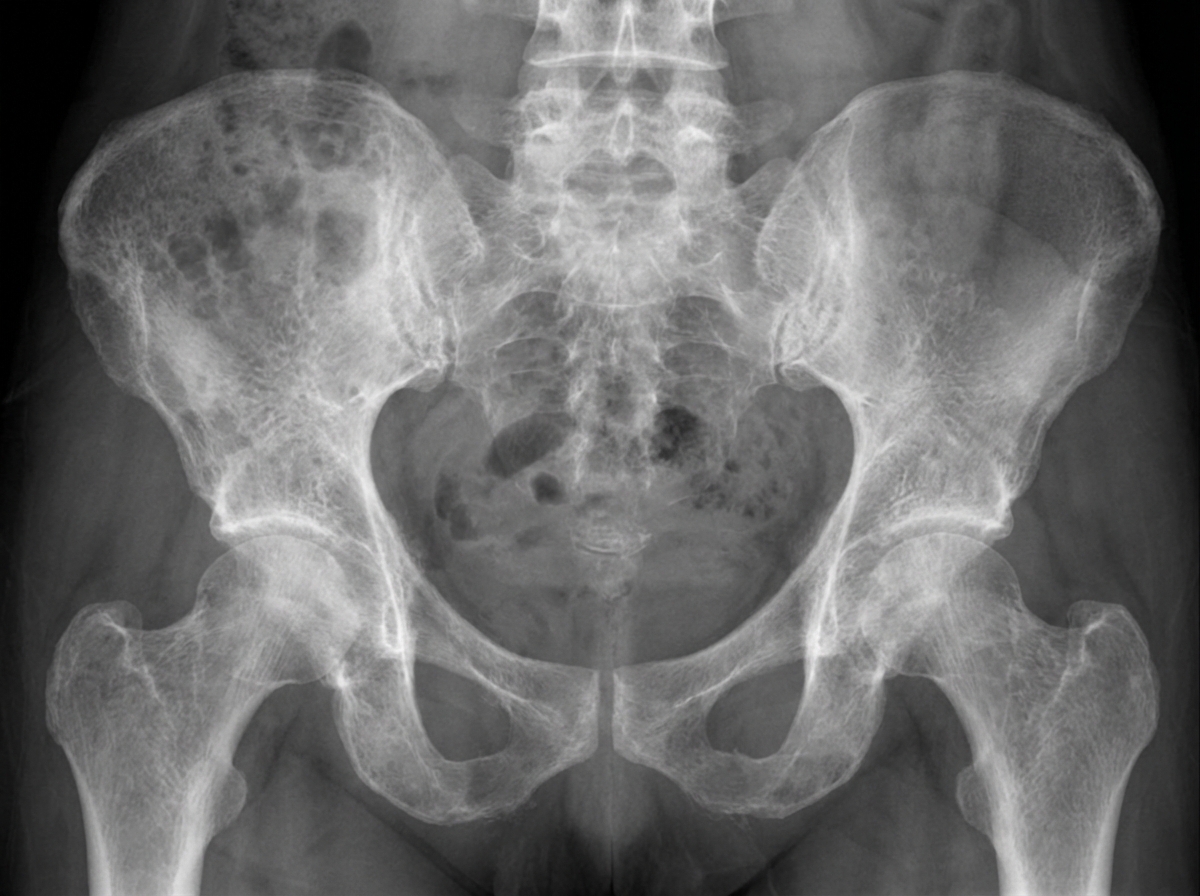
A 70-year-old woman presents to the office for a yearly physical. She states she has recently started experiencing pain in her legs and her back. Last year, she experienced a fracture of her left arm while trying to lift groceries. The patient states that she does not consume any dairy and does not go outside often because of the pain in her legs and back. Of note, she takes carbamazepine for seizures. On exam, her vitals are within normal limits. You suspect the patient might have osteomalacia. Testing for which of the following is the next best step to confirm your suspicion?
A 57-year-old man presents the urgent care clinic with a one-week history of diffuse bone pain and generalized weakness. He was diagnosed with end-stage renal disease 6 months ago and is currently on dialysis. His wife, who is accompanying him today, adds that he is not compliant with his medicines. He has been diabetic for the last 10 years and hypertensive for the last 7 years. He has smoked 4–5 cigarettes per day for 30 years but does not drink alcohol. His family history is insignificant. On examination, the patient has a waddling gait. Hypotonia of all the limbs is evident on neurologic examination. Diffuse bone tenderness is remarkable. X-ray of his legs reveal osteopenia and osseous resorption. The final step of activation of the deficient vitamin in this patient occurs by which of the following enzymes?
A 6-year-old boy is brought to the physician for a well-child examination. His mother has noticed he frequently falls while running. He was born at term and pregnancy was uncomplicated. He has a seizure disorder treated with phenytoin. He is at the 20th percentile for height and at 30th percentile for weight. Vital signs are within normal limits. Examination shows decreased muscle strength in the lower extremities. There is a deep groove below the costal margins bilaterally. An x-ray of the lower extremities is shown. Which of the following is the most likely cause of these findings?
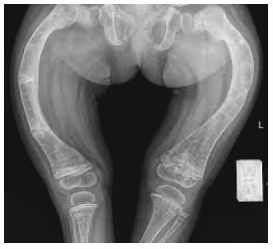
A 67-year-old Caucasian female presents to her primary care physician after a screening DEXA scan reveals a T-score of -3.0. Laboratory work-up reveals normal serum calcium, phosphate, vitamin D, and PTH levels. She smokes 1-2 cigarettes per day. Which of the following measures would have reduced this patient's risk of developing osteoporosis?
A 6-month-old girl is brought to the physician for a well-child examination. She was born at 37 weeks' gestation. Pregnancy and the neonatal period were uncomplicated. The infant was exclusively breastfed and received vitamin D supplementation. She can sit unsupported and can transfer objects from one hand to the other. She babbles and is uncomfortable around strangers. She is at 40th percentile for length and at 35th percentile for weight. Vital signs are within normal limits. Physical examination shows no abnormalities. In addition to continuing breastfeeding, which of the following is the most appropriate recommendation at this time?
A 28-year-old gravida 1 para 1 woman is being seen in the hospital for breast tenderness. She reports that both breasts are swollen and tender. She is also having difficulty getting her newborn to latch. The patient gave birth 4 days ago by uncomplicated vaginal delivery. During her pregnancy, the patient developed gestational diabetes but was otherwise healthy. She took folate and insulin. She attended all her pre-natal appointments. Upon examination, the patient has a low grade fever, but all other vital signs are stable. Bilateral breasts appear engorged and are tender to palpation. There is no erythema, warmth, or induration. A lactation nurse is brought in to assist the patient and her newborn with more effective breastfeeding positions. The patient says a neighbor told her that breastmilk actually lacks in nutrients, and she asks what the best option is for the health of her newborn. Which of the following components is breastmilk a poor source of?
A 3-month-old African American boy presents to his pediatrician’s office for his routine well visit. He was born full-term from an uncomplicated vaginal delivery. He is exclusively breastfeeding and not receiving any medications or supplements. Today, his parents report no issues or concerns with their child. He is lifting his head for brief periods and smiling. He has received only 2 hepatitis B vaccines. Which of the following is the correct advice for this patient’s parents?
A 35-year-old female presents to her primary care physician complaining of right upper quadrant pain over the last 6 months. Pain is worst after eating and feels like intermittent squeezing. She also admits to lighter colored stools and a feeling of itchiness on her skin. Physical exam demonstrates a positive Murphy's sign. The vitamin level least likely to be affected by this condition is associated with which of the following deficiency syndromes?
A child presents with rachitic changes in the limbs that are not responding to Vitamin D supplementation. Investigations reveal the following results: - Calcium: $9.5 \mathrm{mg} / \mathrm{dl}$ - Phosphorus: $1.6 \mathrm{mg} / \mathrm{dl}$ - Alkaline phosphatase (ALP): 814 IU - Serum PTH: $24.2 \mathrm{pg} / \mathrm{ml}$ - Serum electrolytes, creatinine, and blood gases: Normal. What is the most likely diagnosis?
Want unlimited practice?
Get full access to all questions, explanations, and performance tracking.
Scan to download app