
Neonatal meningitis — MCQs

A 7-year-old boy is brought to the emergency department because of high-grade fever and lethargy for 4 days. He has had a severe headache for 3 days and 2 episodes of non-bilious vomiting. He has sickle cell disease. His only medication is hydroxyurea. His mother has refused vaccinations and antibiotics in the past because of their possible side effects. He appears ill. His temperature is 40.1°C (104.2°F), pulse is 131/min, and blood pressure is 92/50 mm Hg. Examination shows nuchal rigidity. Kernig and Brudzinski signs are present. A lumbar puncture is performed. Analysis of the cerebrospinal fluid (CSF) shows a decreased glucose concentration, increased protein concentration, and numerous segmented neutrophils. A Gram stain of the CSF shows gram-negative coccobacilli. This patient is at greatest risk for which of the following complications?
A previously healthy 10-day-old infant is brought to the emergency department by his mother because of episodes of weakness and spasms for the past 12 hours. His mother states that he has also had difficulty feeding and a weak suck. He has not had fever, cough, diarrhea, or vomiting. He was born at 39 weeks' gestation via uncomplicated vaginal delivery at home. Pregnancy was uncomplicated. The mother refused antenatal vaccines out of concern they would cause side effects. She is worried his symptoms may be from some raw honey his older sister maybe inadvertently fed him 5 days ago. He appears irritable. His temperature is 37.1°C (98.8°F). Examination shows generalized muscle stiffness and twitches. His fontanelles are soft and flat. The remainder of the examination shows no abnormalities. Which of the following is the most likely causal organism?
An infant boy of unknown age and medical history is dropped off in the emergency department. The infant appears lethargic and has a large protruding tongue. Although the infant exhibits signs of neglect, he is in no apparent distress. The heart rate is 70/min, the respiratory rate is 30/min, and the temperature is 35.7°C (96.2°F). Which of the following is the most likely cause of the patient’s physical exam findings?
You are treating a neonate with meningitis using ampicillin and a second antibiotic, X, that is known to cause ototoxicity. What is the mechanism of antibiotic X?
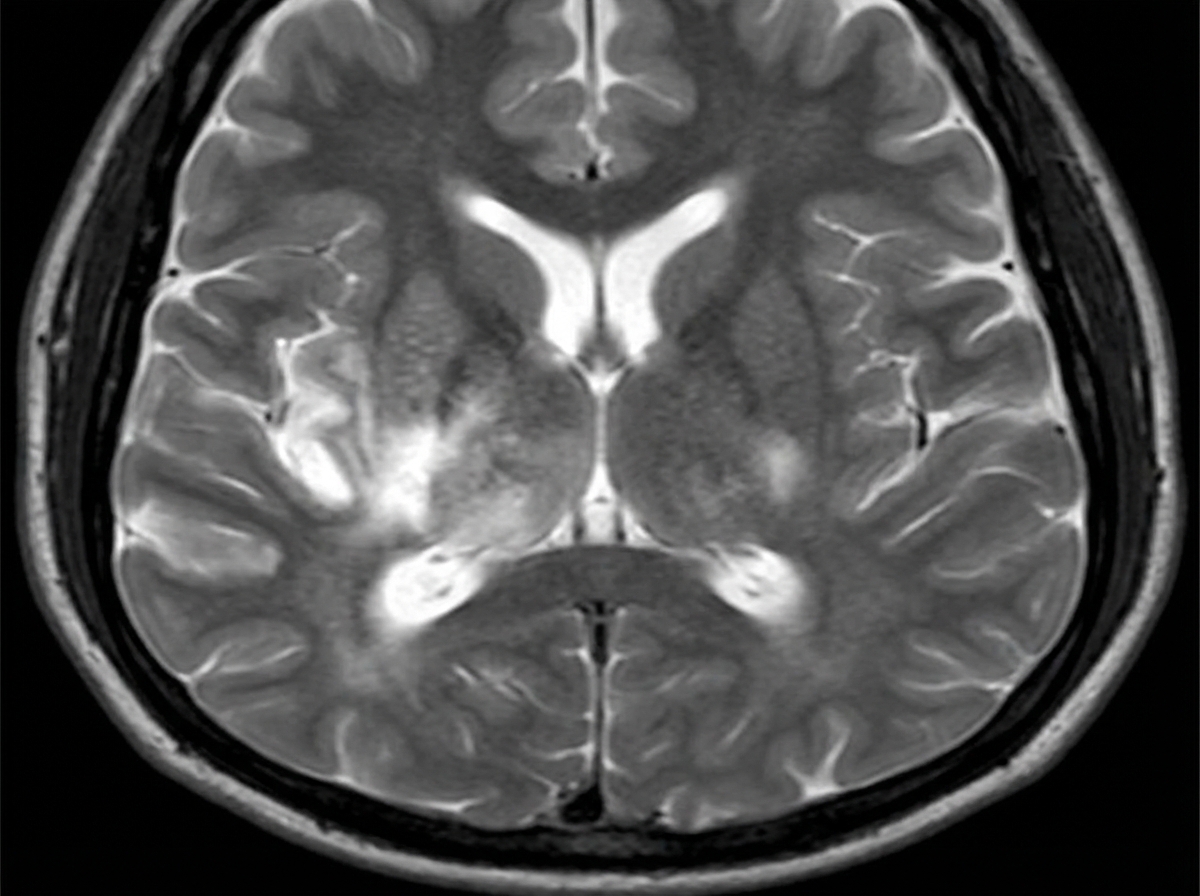
A 24-year-old man is brought to the emergency department after he is found sluggish, drowsy, feverish, and complaining about a headache. His past medical history is unremarkable. His vital signs include: blood pressure 120/60 mm Hg, heart rate 70/min, respiratory rate 17/min, and body temperature 39.0°C (102.2°F). On physical examination, the patient is dysphasic and incapable of following commands. Gait ataxia is present. No meningeal signs or photophobia are present. A noncontrast CT of the head is unremarkable. A T2 MRI is performed and is shown in the image. A lumbar puncture (LP) is subsequently performed. Which of the following CSF findings would you most likely expect to find in this patient?
A 10-year-old boy is brought to the emergency department by his parents because of a dull persistent headache beginning that morning. He has nausea and has vomited twice. During the past four days, the patient has had left-sided ear pain and fever, but his parents did not seek medical attention. He is from Thailand and is visiting his relatives in the United States for the summer. There is no personal or family history of serious illness. He is at the 45th percentile for height and 40th percentile for weight. He appears irritable. His temperature is 38.5°C (101.3°F), pulse is 110/min, and blood pressure is 98/58 mm Hg. The pupils are equal and reactive to light. Lateral gaze of the left eye is limited. The left tympanic membrane is erythematous with purulent discharge. There is no nuchal rigidity. Which of the following is the most appropriate next step in management?
A mother delivers in a rural area under the guidance of a skilled care attendant. Which of the following statements is incorrect regarding the care provided by the skilled care attendant at birth?
An 8-day-old male infant presents to the pediatrician with a high-grade fever and poor feeding pattern with regurgitation of milk after each feeding. On examination the infant showed abnormal movements, hypertonia, and exaggerated DTRs. The mother explains that during her pregnancy, she has tried to eat only unprocessed foods and unpasteurized dairy so that her baby would not be exposed to any preservatives or unhealthy chemicals. Which of the following characteristics describes the causative agent that caused this illness in the infant?
Three days after delivery, a 1100-g (2-lb 7-oz) newborn has a tonic seizure that lasts for 25 seconds. She has become increasingly lethargic over the past 18 hours. She was born at 31 weeks' gestation. Antenatal period was complicated by chorioamnionitis. Apgar scores were 3 and 6 at 1 and 5 minutes, respectively. She appears ill. Her pulse is 123/min, respirations are 50/min and irregular, and blood pressure is 60/30 mm Hg. Examination shows a tense anterior fontanelle. The pupils are equal and react sluggishly to light. Examination shows slow, conjugate back and forth movements of the eyes. Muscle tone is decreased in all extremities. The lungs are clear to auscultation. Which of the following is the most likely diagnosis?
A 2860-g (6-lb 3-oz) male newborn is born at term to a primigravid woman via spontaneous vaginal delivery. The mother has had no routine prenatal care. She reports that there is no family history of serious illness. The initial examination of the newborn shows bowing of the legs and respiratory distress upon palpation of the chest. The skin and joints are hyperextensible. X-rays of the chest and skull show multiple rib fractures and small, irregular bones along the cranial sutures. The patient is at increased risk of which of the following complications?
Want unlimited practice?
Get full access to all questions, explanations, and performance tracking.
Scan to download app