
Nutritional assessment tools — MCQs

A 21-year-old woman is admitted to the hospital for severe malnutrition with a BMI of 15 kg/m2. Past medical history is significant for chronic anorexia nervosa. During the course of her stay, she is treated with parenteral fluids and nutrition management. On the 4th day, her status changes. Her blood pressure is 110/75 mm Hg, heart rate is 120/min, respiratory rate is 25/min, and temperature is 37.0°C (98.6°F). On physical exam, her heart is tachycardic with a regular rhythm and her lungs are clear to auscultation bilaterally. She appears confused, disoriented, and agitated. Strength in her lower extremities is 4/5. What is the next step in management?
During the selection of subjects for a study on infantile vitamin deficiencies, a child is examined by the lead investigator. She is at the 75th percentile for head circumference and the 80th percentile for length and weight. She can lift her chest and shoulders up when in a prone position, but cannot roll over from a prone position. Her eyes follow objects past the midline. She coos and makes gurgling sounds. When the investigator strokes the sole of her foot, her big toe curls upward and there is fanning of her other toes. She makes a stepping motion when she is held upright and her feet are in contact with the examination table. Which of the following additional skills or behaviors would be expected in a healthy patient of this developmental age?
A concerned mother presents to clinic stating that her 14-year-old son has not gone through his growth spurt. She states that, although shorter, he had been growing at the same rate as his peers until the past year. There is no evidence of delayed puberty in the mother, but the father's history is unknown. The patient has no complaints. On physical exam, the patient is a healthy-appearing 14-year-old boy whose height is below the third percentile and whose weight is at the 50th percentile. His bone age is determined to be 11 years. A laboratory workup, including thyroid stimulating hormone (TSH), is unremarkable. What is the most likely diagnosis?
A 4-day-old male newborn is brought to the physician for a well-child examination. His mother is concerned that he is losing weight. He was born at 40 weeks' gestation and weighed 2980g (6-lb 9-oz); he currently weighs 2830g (6-lb 4-oz). Pregnancy was uncomplicated. He passed stool and urine 8 and 10 hours after delivery. He has been exclusively breast fed since birth and feeds 11–12 times daily. His mother says she changes 5–6 heavy diapers daily. Examination shows an open and firm anterior fontanelle. Mucous membranes are moist. Capillary refill time is less than 2 seconds. Cardiopulmonary examination shows no abnormalities. Which of the following is the most appropriate next best step in management?
A homeless woman presents with shortness of breath on exertion and pedal edema. Cardiac workup performed shows evidence of dilated cardiomyopathy and increased cardiac output. She also has decreased sensation over both extremities bilaterally. Which vitamin deficiency most likely caused these symptoms?
A 1-minute-old newborn is being examined by the pediatric nurse. The nurse auscultates the heart and determines that the heart rate is 89/min. The respirations are spontaneous and regular. The chest and abdomen are both pink while the tips of the fingers and toes are blue. When the newborn’s foot is slapped the face grimaces and he cries loud and strong. When the arms are extended by the nurse they flex back quickly. What is this patient’s Apgar score?
A 21-year-old Syrian refugee, who arrived in the US 2 weeks ago after living in refugee camps in Jordan and Turkey for 2 years, presents with decreased night vision, severe dry eyes unresponsive to eye drops, and a corneal ulcer. She reports limiting her food intake to ensure her 3-year-old son's nutrition. Her BMI is 18.1 kg/m2. Examination reveals lethargy, dry mucous membranes, decreased skin turgor, and dry, thickened conjunctiva. This patient's symptoms are most consistent with a deficiency in a vitamin that contributes to which of the following processes?
An 18-month-old boy is brought to the physician by his mother because of concern that he has not yet begun to walk. He was born at term and exclusively breastfed until 15 months of age. His mother says he has been well, apart from an episode of high fever and seizure 4 months ago for which she did not seek medical attention. He has an older brother who is currently receiving medical treatment for failure to thrive. His parents have no history of serious illness; they are of normal height. His last vaccine was at the age of 4 months. He is at the 20th percentile for length, 10th percentile for weight, and 50th percentile for head circumference. Physical examination shows dry mucous membranes and erosion of the enamel on the lingual surface of the incisors and carious molars. He has frontal bossing. His wrists are widened, his legs seem bent, and there is beading of the ribs. Which of the following is the most likely underlying cause of this patient's delay in walking?
A laborer's younger child is brought to the OPD with a swollen belly and dull face. He has been fed rice water (rice milk) in his diet mostly. On investigations, the child is found to have low serum protein and low albumin. What is the probable diagnosis?
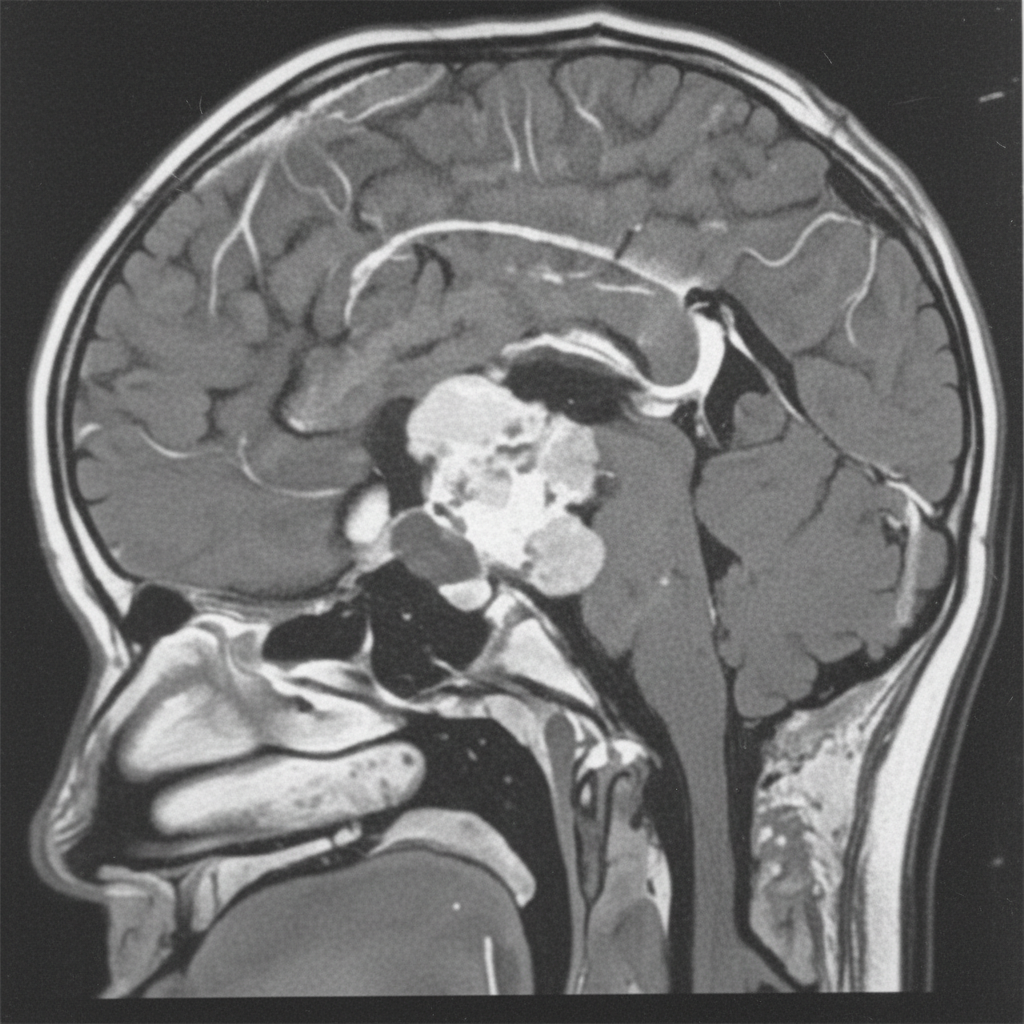
A 12-year-old boy presents with symptoms of headaches, visual disturbances, and growth retardation. An MRI scan is performed, and the image provided shows a cystic mass with both solid and calcified components in the suprasellar region, extending into the third ventricle. Based on the clinical presentation and MRI findings, what is the most likely diagnosis?
Want unlimited practice?
Get full access to all questions, explanations, and performance tracking.
Scan to download app