
Normal growth patterns — MCQs

An investigator for a nationally representative health survey is evaluating the heights and weights of men and women aged 18–74 years in the United States. The investigator finds that for each sex, the distribution of heights is well-fitted by a normal distribution. The distribution of weight is not normally distributed. Results are shown: Mean Standard deviation Height (inches), men 69 0.1 Height (inches), women 64 0.1 Weight (pounds), men 182 1.0 Weight (pounds), women 154 1.0 Based on these results, which of the following statements is most likely to be correct?
A 1-year-old male presents to his pediatrician for a well-child visit. Through a history from the mother and physical examination, the pediatrician learns that the baby babbles non-specifically, takes several steps independently, and picks up his cereal using two fingers. His weight is currently 22 lbs (birth-weight 6 lbs, 9 oz), and his height is 30 inches (birth length 18 inches). Are there any aspects of this child's development that are delayed?
A 2-month-old is brought to the physician for a well-child examination. She was born at 39 weeks gestation via spontaneous vaginal delivery and is exclusively breastfed. She weighed 3,400 g (7 lb 8 oz) at birth. At the physician's office, she appears well. Her pulse is 136/min, the respirations are 41/min, and the blood pressure is 82/45 mm Hg. She weighs 5,200 g (11 lb 8 oz) and measures 57.5 cm (22.6 in) in length. The remainder of the physical examination is normal. Which of the following developmental milestones has this patient most likely met?
A child presents to his pediatrician’s clinic for a routine well visit. He can bend down and stand back up without assistance and walk backward but is not able to run or walk upstairs. He can stack 2 blocks and put the blocks in a cup. He can bring over a book when asked, and he will say “mama” and “dada” to call for his parents, as well as 'book', 'milk', and 'truck'. How old is this child if he is developmentally appropriate for his age?
A 6-year-old boy is brought in by his mother for a well-visit. She reports that he is going to start kindergarten soon. She is worried that he doesn't like to play outside with the other kids on the block. When asked, the patient says "I like video games more than running. My big brother plays with me." His mother states that his teachers reported that he did well in pre-school and participated in group games. The patient is normally a good listener but has become more stubborn about wanting to "do things by himself," like getting dressed in the morning. The patient has no chronic medical conditions. He is allergic to peanuts. He takes no medications but has an epinephrine auto-injector for his allergy. His brother has asthma and his paternal grandfather died at age 56 of a myocardial infarction. The patient's blood pressure is 110/70 mmHg and pulse is 105/min. He is in the 50th percentile for height and weight. On physical examination, a grade II systolic murmur is heard. When the patient stands up, the murmur decreases. Capillary refill is less than 2 seconds. Which of the following is the most likely next step in management?
A 4-year-old boy is brought to the pediatrician by his mother for a routine medical examination. His medical history is relevant for delayed gross motor milestones. The mother is concerned about a growth delay because both of his brothers were twice his size at this age. Physical examination reveals a well-groomed and healthy boy with a prominent forehead and short stature, in addition to shortened upper and lower extremities with a normal vertebral column. The patient’s vitals reveal: temperature 36.5°C (97.6°F); pulse 60/min; and respiratory rate 17/min and a normal intelligence quotient (IQ). A mutation in which of the following genes is the most likely cause underlying the patient’s condition?
An 18-month-old boy is brought to the physician by his mother because of concern that he has not yet begun to walk. He was born at term and exclusively breastfed until 15 months of age. His mother says he has been well, apart from an episode of high fever and seizure 4 months ago for which she did not seek medical attention. He has an older brother who is currently receiving medical treatment for failure to thrive. His parents have no history of serious illness; they are of normal height. His last vaccine was at the age of 4 months. He is at the 20th percentile for length, 10th percentile for weight, and 50th percentile for head circumference. Physical examination shows dry mucous membranes and erosion of the enamel on the lingual surface of the incisors and carious molars. He has frontal bossing. His wrists are widened, his legs seem bent, and there is beading of the ribs. Which of the following is the most likely underlying cause of this patient's delay in walking?
A 6-month-old girl is brought to the physician because of drooling and excessive crying for 3 days. She calms down when cuddled or with a pacifier in her mouth. She feeds well and has no vomiting or diarrhea. She was breastfed exclusively for 5 months. She is given no medications and was born at 39 weeks gestation via spontaneous vaginal delivery. She is up to date on all vaccines and is meeting all developmental milestones. At the clinic, her weight is 7.3 kg (16 lb 1 oz) and her height is 65.8 cm (25.9 in) in length. She appears irritable. Her pulse is 124/min, the respirations are 32/min, the blood pressure is 92/63 mm Hg, and the temperature is 36.8°C (98.2°F). On physical examination, she has no conjunctivitis, cervical lymphadenopathy, or pharyngeal erythema. Which element of the physical examination is most likely to be present in this patient?
A laborer's younger child is brought to the OPD with a swollen belly and dull face. He has been fed rice water (rice milk) in his diet mostly. On investigations, the child is found to have low serum protein and low albumin. What is the probable diagnosis?
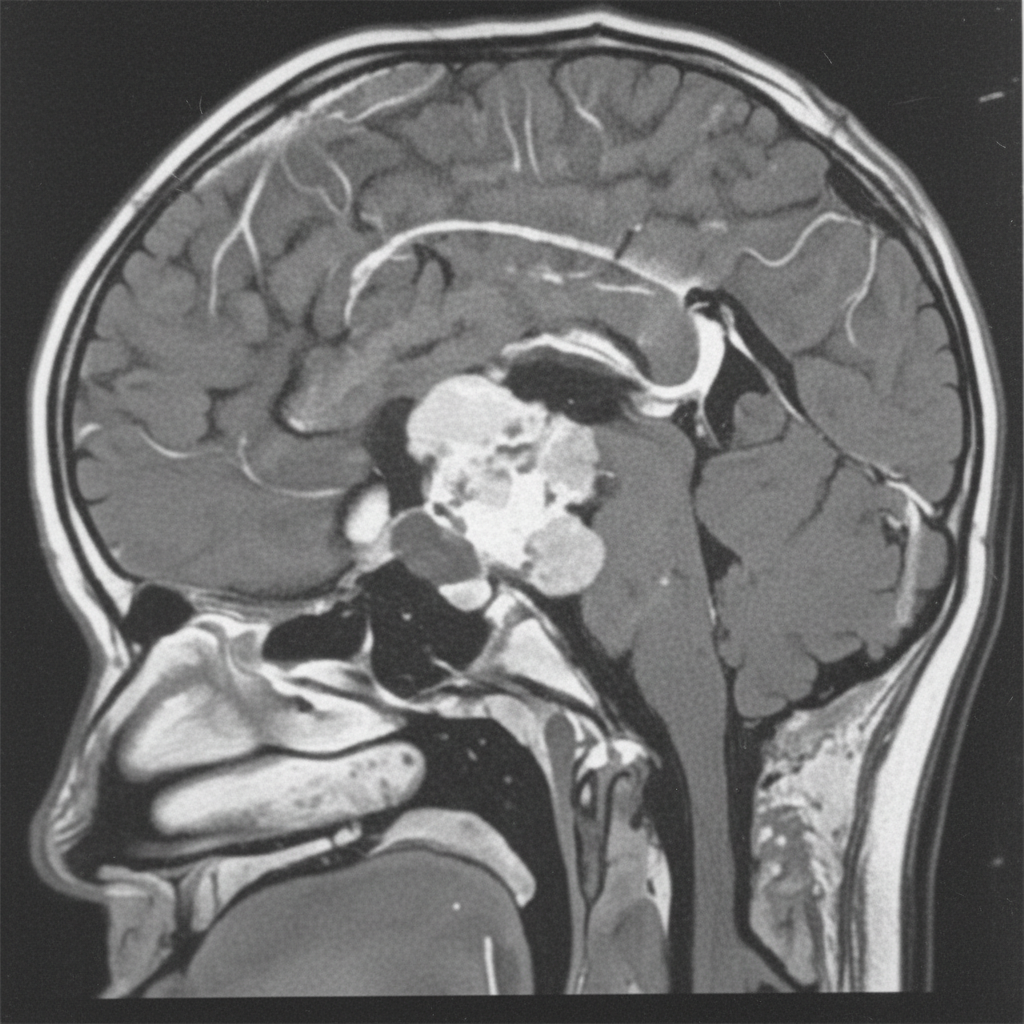
A 12-year-old boy presents with symptoms of headaches, visual disturbances, and growth retardation. An MRI scan is performed, and the image provided shows a cystic mass with both solid and calcified components in the suprasellar region, extending into the third ventricle. Based on the clinical presentation and MRI findings, what is the most likely diagnosis?
Want unlimited practice?
Get full access to all questions, explanations, and performance tracking.
Scan to download app