
Genetic counseling principles — MCQs

A 25-year-old man with a genetic disorder presents for genetic counseling because he is concerned about the risk that any children he has will have the same disease as himself. Specifically, since childhood he has had difficulty breathing requiring bronchodilators, inhaled corticosteroids, and chest physiotherapy. He has also had diarrhea and malabsorption requiring enzyme replacement therapy. If his wife comes from a population where 1 in 10,000 people are affected by this same disorder, which of the following best represents the likelihood a child would be affected as well?
A healthy 30-year-old woman comes to the physician with her husband for preconception counseling. Her husband is healthy but she is concerned because her brother was recently diagnosed with a genetic liver condition for which he takes penicillamine. Her father-in-law has liver cirrhosis and a tremor. The results of genetic testing show that both the patient and her husband are carriers of a mutation in the ATP7B gene. Which of the following is the chance that this patient’s offspring will eventually develop the hereditary condition?
A 28-year-old woman dies shortly after receiving a blood transfusion. Autopsy reveals widespread intravascular hemolysis and acute renal failure. Investigation reveals that she received type A blood, but her medical record indicates she was type O. In a malpractice lawsuit, which of the following elements must be proven?
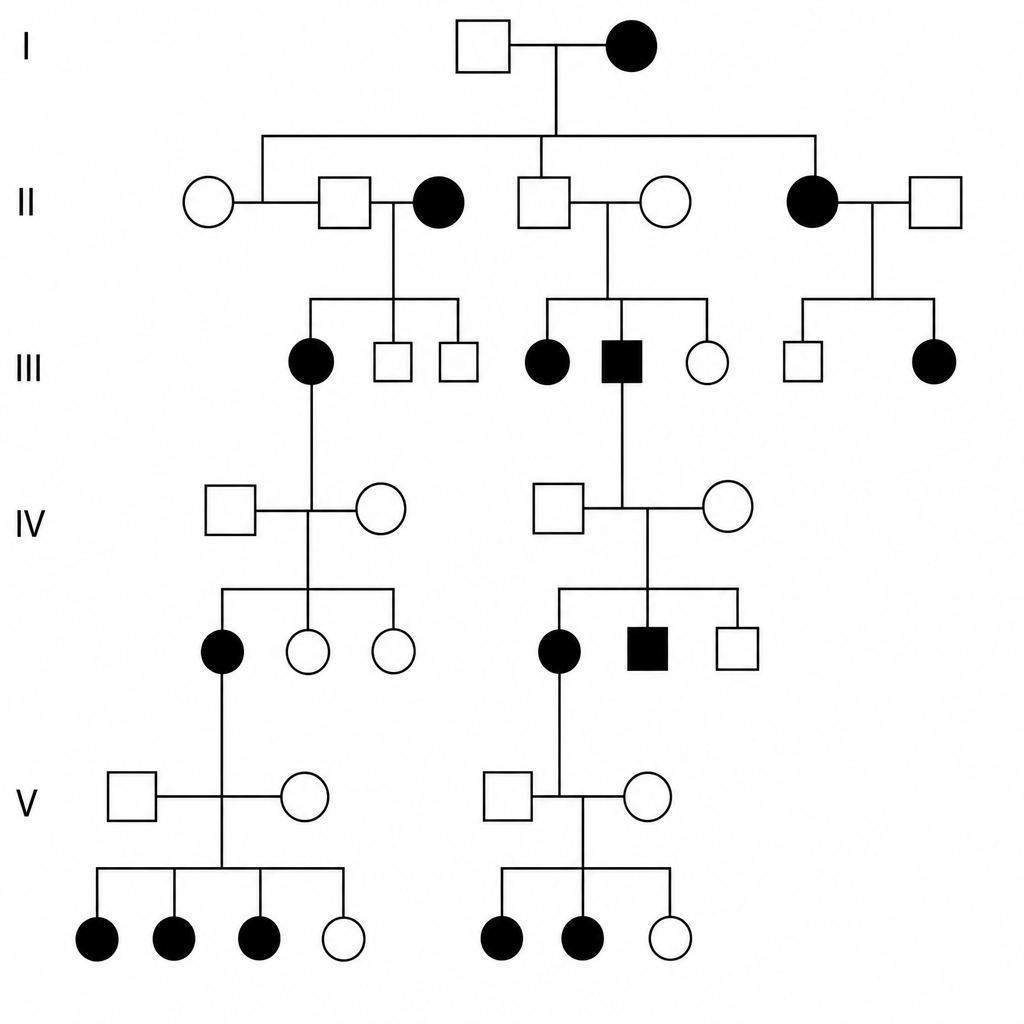
Given the pattern of inheritance shown in the pedigree, where might you find the disease gene in question?
An 87-year-old man with glioblastoma multiforme is informed that the size and location of the tumor make operative resection impossible, and he has a prognosis of between 3-6 months. The patient then asks whether it would be possible to get a prescription for lethal medications so that he would be able to end his life if his situation deteriorated further. The physician says that he is unable to prescribe such drugs because assisted suicide is not legal in their state. Refusing to help a patient commit suicide is most consistent with which of the following ethical principles?
A 35-year-old woman gravida 2, para 1, comes to the physician for her first prenatal visit. Pregnancy and delivery of her first child were uncomplicated. She is not sure about the date of her last menstrual period. Pelvic examination shows a uterus consistent in size with a 10-week gestation. An ultrasound examination confirms the gestational age and shows one fetus with no indication of multiple gestations. During counseling on pregnancy risks and possible screening and diagnostic tests, the patient states she would like to undergo screening for Down syndrome. She would prefer immediate and secure screening with a low risk to herself and the fetus. Which of the following is the most appropriate next step in management at this time?
A 31-year-old man and his wife were referred to a genetic counselor. They are concerned about the chance that their children are likely to inherit certain conditions that run in their families. The wife's father and grandfather are both healthy, but her grandfather cannot see the color red. The husband is unaware if any member of his family has the same condition. The geneticist provides some details about genetic diseases and inheritance patterns, then orders lab tests to analyze the gene mutations carried by both partners. Which of the following are the correct terms regarding the genotype and phenotype of males affected by the condition described?
A 16-year-old boy is brought to his primary care physician for evaluation of visual loss and is found to have lens subluxation. In addition, he is found to have mild scoliosis that is currently being monitored. Physical exam reveals a tall and thin boy with long extremities. Notably, his fingers and toes are extended and his thumb and little finger can easily encircle his wrist. On this visit, the boy asks his physician about a friend who has a very similar physical appearance because his friend was recently diagnosed with a pheochromocytoma. He is worried that he will also get a tumor but is reassured that he is not at increased risk for any endocrine tumors. Which of the following genetic principles most likely explains why this patient and his friend have a similar physical appearance and yet only one is at increased risk of tumors?
An investigator studying viral mutation isolates a virus strain from the gastric contents of an infant with gastroenteritis. This virus has a nonenveloped RNA genome with 11 segments and an icosahedral symmetrical capsid. The investigator finds that if 2 strains of this virus coinfect a single host cell, some of the resulting viral progeny have genome segments derived from both parental viruses. The observed phenomenon is most likely also seen in which of the following viral families?
A homeless 45-year-old man presents to the emergency room in December complaining of malaise, body aches, chills, and fever. He reports that his symptoms started 4 days ago. His myalgias and chills have begun to resolve, but now he is starting to develop a dry cough, dyspnea, and a sore throat. He does not have a primary care provider and has not had any vaccinations in over 2 decades. He receives medical care from the emergency room whenever he is feeling ill. His temperature is 103°F (39.4°C), blood pressure is 130/70 mmHg, pulse is 115/min, and respirations are 22/min. On exam, he appears fatigued with mildly increased work of breathing. A chest radiograph is negative. A nasopharyngeal viral culture is positive for an orthomyxovirus. Upon further review of the patient’s medical record, he was diagnosed with the same condition 1 year ago in November. Which of the following mechanisms is responsible for pandemics of this patient’s disease?
Want unlimited practice?
Get full access to all questions, explanations, and performance tracking.
Scan to download app