
Preventive strategies — MCQs

A 21-year-old G3P2 woman presents to her obstetrician at 6 weeks gestation for routine prenatal care. Her past medical history includes obesity and gestational diabetes. She has had two spontaneous vaginal deliveries at term. One infant was macrosomic with hypoglycemia, but otherwise, she has had no complications. Her physician informs her that she must start taking a multivitamin with folic acid daily. The defect that folic acid supplementation protects against arises in tissue that is derived from which germ cell layer?
A 24-year-old woman visits her physician to seek preconception advice. She is recently married and plans to have a child soon. Menses occur at regular 28-day intervals and last 5 days. She has sexual intercourse only with her husband and, at this time, they consistently use condoms for birth control. The patient consumes a well-balanced diet with moderate intake of meat and dairy products. She has no history of serious illness and takes no medications currently. She does not smoke or drink alcohol. The patient’s history reveals no birth defects or severe genetic abnormalities in the family. Physical examination shows no abnormalities. Pelvic examination indicates a normal vagina, cervix, uterus, and adnexa. To decrease the likelihood of fetal neural-tube defects in her future pregnancy, which of the following is the most appropriate recommendation for initiation of folic acid supplementation?
A 26-year-old gravida 3 para 1 is admitted to labor and delivery with uterine contractions. She is at 37 weeks gestation with no primary care provider or prenatal care. She gives birth to a boy after an uncomplicated vaginal delivery with APGAR scores of 7 at 1 minute and 8 at 5 minutes. His weight is 2.2 kg (4.4 lb) and the length is 48 cm (1.6 ft). The infant has weak extremities and poor reflexes. The physical examination reveals microcephaly, palpebral fissures, thin lips, and a smooth philtrum. A systolic murmur is heard on auscultation. Identification of which of the following factors early in the pregnancy could prevent this condition?
A 37-year-old woman comes for a follow-up prenatal visit at 18 weeks' gestation. At 12 weeks' gestation, ultrasonography showed increased nuchal translucency and pregnancy-associated plasma protein A (PAPP-A) was decreased by 2 standard deviations. Chorionic villus sampling showed a 47, XX, +21 karyotype. During this visit, ultrasonography shows a hypoplastic nasal bone, shortened femur length, shortened middle phalanges of the fifth digits with clinodactyly. A quadruple marker test would most likely show which of the following sets of findings? $$$ α-Fetoprotein (AFP) %%% Estriol %%% β-Human chorionic gonadotropin (HCG) %%% Inhibin A $$$
A 27-year-old G0P0 female presents to her OB/GYN for a preconception visit to seek advice before becoming pregnant. A detailed history reveals no prior medical or surgical history, and she appears to be in good health currently. Her vaccination history is up-to-date. She denies tobacco or recreational drug use and admits to drinking 2 glasses of wine per week. She states that she is looking to start trying to become pregnant within the next month, hopefully by the end of January. Which of the following is NOT recommended as a next step for this patient's preconception care?
A 30-year-old female with a history of epilepsy becomes pregnant. Her epilepsy has been well controlled by taking a medication that inhibits GABA transaminase and blocks voltage-gated sodium and calcium channels. Her obstetrician informs her that her epilepsy medication has been shown to have teratogenic effects. Of the following, which teratogenic effect is this woman's medication most likely to cause?
A 12-month-old boy presents for a routine checkup. The patient immigrated from the Philippines with his parents a few months ago. No prior immunization records are available. The patient’s mother claims that he had a series of shots at 6 months of age which gave him a severe allergic reaction with swelling of the tongue and the face. She also remembers that he had the same reaction when she introduced solid foods to his diet, including carrots, eggs, and bananas. Which of the following vaccinations are not recommended for this patient?
A 26-year-old G1P0 mother is in the delivery room in labor. Her unborn fetus is known to have a patent urachus. Which of the following abnormalities would you expect to observe in the infant?
A 13-month-old girl is brought to the physician because of a pruritic rash for 2 days. The girl's mother says she noticed a few isolated skin lesions on her trunk two days ago that appear to be itching. The girl received her routine immunizations 18 days ago. Her mother has been giving her ibuprofen for her symptoms. The patient has no known sick contacts. She is at the 71st percentile for height and the 64th percentile for weight. She is in no acute distress. Her temperature is 38.1°C (100.6°F), pulse is 120/min, and respirations are 26/min. Examination shows a few maculopapular and pustular lesions distributed over the face and trunk. There are some excoriation marks and crusted lesions as well. Which of the following is the most likely explanation for these findings?
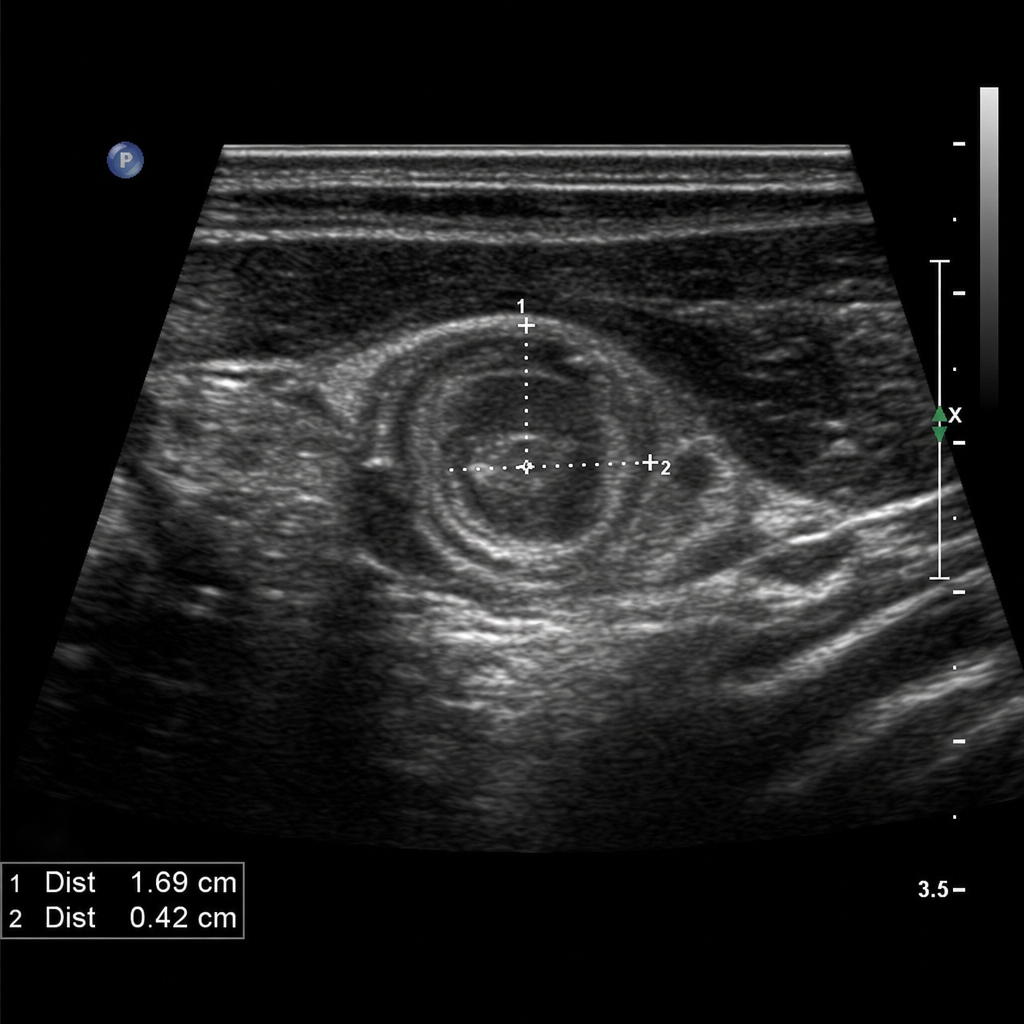
A 4-week-old male infant is brought to the emergency department with a 3-day history of progressive non-bilious, forceful vomiting after every feeding. He appears hungry and roots immediately after vomiting. On examination, weight is 3.1 kg (birth weight 3.4 kg), he is mildly lethargic, his anterior fontanelle is slightly sunken, and a small olive-shaped mass is palpable in the epigastrium. An abdominal ultrasound confirms the suspected diagnosis. Laboratory values show: Na 132 mEq/L, K 3.0 mEq/L, Cl 88 mEq/L, HCO3 30 mEq/L, pH 7.50. Which of the following represents the most appropriate sequence of management steps?
Want unlimited practice?
Get full access to all questions, explanations, and performance tracking.
Scan to download app