
Leukemias in children — MCQs

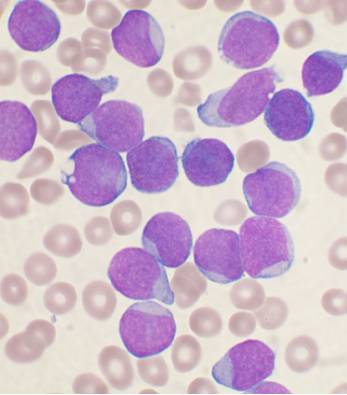
A 7-year-old boy presents to the ER with progressive dysphagia over the course of 3 months and a new onset fever for the past 24 hours. The temperature in the ER was 39.5°C (103.1°F). There are white exudates present on enlarged tonsils (Grade 2). Routine blood work reveals a WBC count of 89,000/mm3, with the automatic differential yielding a high (> 90%) percentage of lymphocytes. A peripheral blood smear is ordered, demonstrating the findings in the accompanying image. The peripheral smear is submitted to pathology for review. After initial assessment, the following results are found on cytologic assessment of the cells: TdT: positive CALLA (CD 10): positive Which of the following cell markers are most likely to be positive as well?
A 66-year-old man comes to the physician for a 3-month history of fatigue. He has hypertension and hyperlipidemia. He had a transient ischemic attack 3 years ago. He drinks 3 beers a day, and sometimes a couple more on social occasions. He currently takes aspirin, simvastatin, hydrochlorothiazide, and metoprolol. His temperature is 37.1°C (98.8°F), pulse is 78, respirations are 19/min, and oxygen saturation on room air is 97%. He is in no distress but shows marked pallor and has multiple pinpoint, red, nonblanching spots on his extremities. On palpation, his spleen is significantly enlarged. Laboratory studies show a hemoglobin of 8.0 g/dL, a leukocyte count of 80,000/mm3, and a platelet count of 34,000/mm3. A blood smear shows immature cells with large, prominent nucleoli and pink, elongated, needle-shaped cytoplasmic inclusions. Which of the following is the most likely diagnosis?
A 64-year-old woman comes to the physician for her routine health maintenance examination. She feels well. She had cervical cancer and received radiotherapy 8 years ago. Her vital signs are within normal limits. On percussion, the spleen size is 15 cm. Otherwise, the physical examination shows no abnormalities. The laboratory test results are as follows: Hemoglobin 10 g/dL Mean corpuscular volume 88 μm3 Leukocyte count 65,000/mm3 Platelet count 500,000/mm3 Two images of the peripheral blood smear are shown on the image. Which of the following is the most appropriate next step in management?
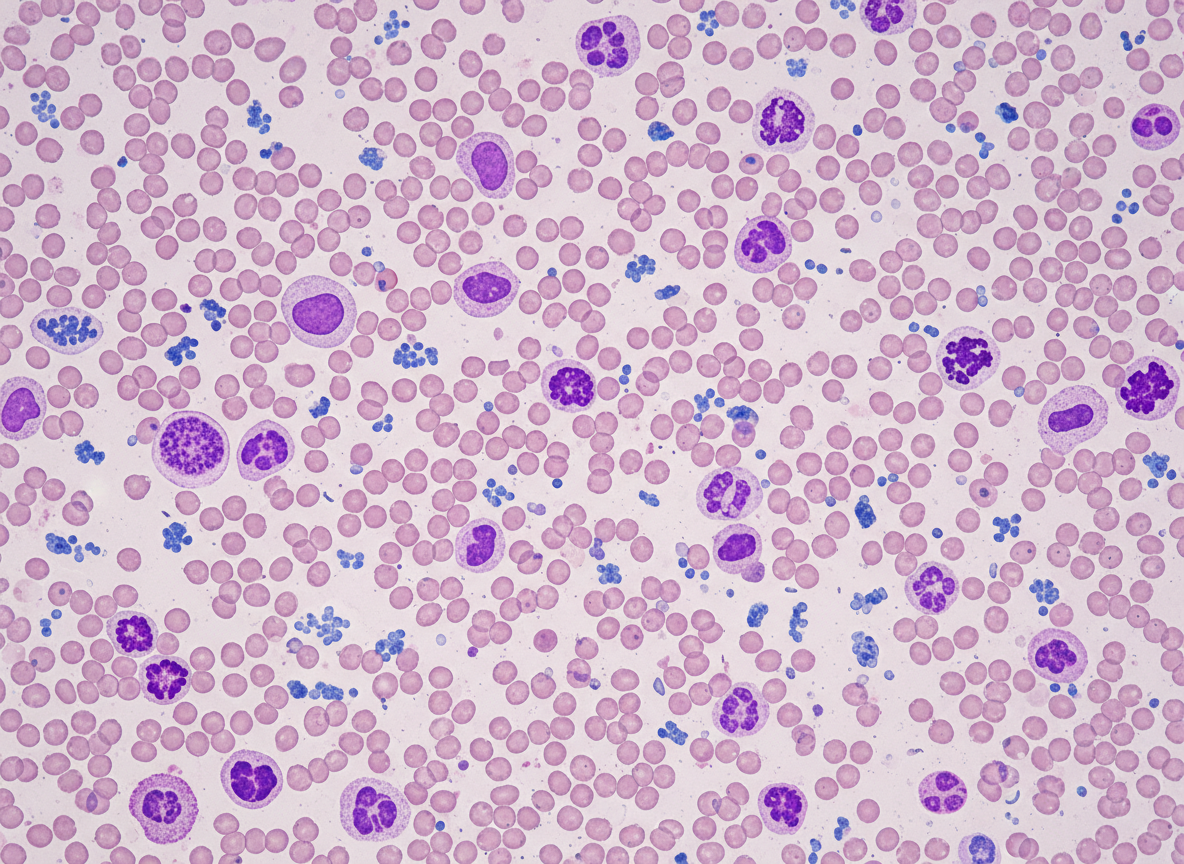
A 59-year-old woman comes to the physician because of a 2-month history of fatigue and abdominal discomfort. Over the past 6 months, she has had a 5.4-kg (12-lb) weight loss. She takes no medications. Her temperature is 37.8°C (100°F), pulse is 70/min, respirations are 13/min, and blood pressure is 125/80 mm Hg. Cardiopulmonary examination shows no abnormalities. The spleen is palpated 3 cm below the left costal margin. Laboratory studies show: Hemoglobin 9.4 g/dL Mean corpuscular volume 86 μm3 Leukocyte count 58,000/mm3 Segmented neutrophils 54% Bands 8% Lymphocytes 7% Myelocytes 5% Metamyelocytes 10% Promyelocytes 4% Blasts 5% Monocytes 1% Eosinophils 4% Basophils 2% Platelet count 850,000/mm3 Serum Creatinine 0.9 mg/dL LDH 501 U/L Bone marrow biopsy shows hyperplastic myelopoiesis with granulocytosis. Which of the following is the most appropriate next step in management?
A 4-year-old girl is brought to the physician because of a 3-week history of generalized fatigue and easy bruising. During the past week, she has also had fever and severe leg pain that wakes her up at night. Her temperature is 38.3°C (100.9°F), pulse is 120/min, and respirations are 30/min. Examination shows cervical and axillary lymphadenopathy. The abdomen is soft and nontender; the liver is palpated 3 cm below the right costal margin, and the spleen is palpated 2 cm below the left costal margin. Laboratory studies show: Hemoglobin 10.1 g/dL Leukocyte count 63,000/mm3 Platelet count 27,000/mm3 A bone marrow aspirate predominantly shows immature cells that stain positive for CD10, CD19, and TdT. Which of the following is the most likely diagnosis?
An 8-year-old girl is brought to the clinic by her parents for fever and easy bruising. Her parents report that the child has been bruising easily ever since an upper respiratory infection 3 months ago. For example, a bump into the table resulted in a large bruise on the side of her hip for a week. Three days ago, her mother noticed that the child felt warm and subsequently measured a temperature of 101.8°F (38.8°C) that did not respond to acetaminophen. The patient denies any chills, cough, rhinorrhea, pharyngitis, sick contacts, headache, or urinary symptoms. A physical examination demonstrates a nontender, firm, and rubbery node along her left neck and splenomegaly. Laboratory findings are shown below: Leukocyte count and differential: Leukocyte count: 19,000/mm³ Neutrophils: 39% Bands: 12% Eosinophils: 2% Basophils: 0.5% Lymphocytes: 40% Monocytes: 6.5% Hemoglobin: 9.7 g/dL Platelet count: 100,000/mm³ Mean corpuscular hemoglobin concentration: 30% Mean corpuscular volume: 76 μm³ Reticulocyte count: 0.7% What cytogenetic abnormality would be most likely in this patient?
A 5-year-old boy is brought to the physician by his parents because of a 6-week history of increased tiredness, irritability, and worsening leg pain. His parents report that he has been reluctant to walk recently because of the pain in his legs. Examination shows conjunctival pallor and diffuse petechiae. There are palpable, nontender posterior cervical and axillary lymph nodes. His hemoglobin concentration is 8.9 g/dL, leukocyte count is 45,750/mm3, and platelet count is 25,000/mm3. A bone marrow aspiration shows numerous immature cells that stain positive for CD10, CD19, and terminal deoxynucleotidyl transferase (TdT). Which of the following translocations is associated with a favorable prognosis for this patient's condition?
A 70-year-old retired police officer is being evaluated for fatigue. A peripheral smear shows extremely elevated numbers of immature myeloid cells, which are positive for myeloperoxidase and a translocation t(15,17). Which of the following statements is true regarding his condition?
A 12-year-old boy is brought in by his mother for a routine checkup. The patient’s mother says he is frequently fatigued and looks pale. She also claims that he has recently become “much quieter” than normal and is no longer interested in playing baseball with his friends. The patient’s mother believes it may just be “growing pains.” The patient has no significant medical history. He is the 90th percentile for height and weight and has been meeting all developmental milestones. The patient is afebrile, and his vital signs are within normal limits. Physical examination reveals several small bruises on the patient’s right arm and on both thighs. Laboratory findings are significant for the following: Sodium 140 mEq/L Potassium 4.2 mEq/L Chloride 101 mEq/L Bicarbonate 27 mEq/L BUN 16 mg/dL Creatinine 1.2 mg/dL Glucose (fasting) 111 mg/dL WBC 3,400/mm3 RBC 4.20 x 10⁶/mm3 Hematocrit 22% Hemoglobin 7.1 g/dL Platelet count 109,000/mm3 A peripheral blood smear reveals myeloblasts. Which of the following is the next best step in the management of this patient?
A 7-year-old girl is brought to the physician by her mother because of a 2-week history of generalized fatigue, intermittent fever, and progressively worsening shortness of breath. Physical examination shows pallor, jugular venous distention, and nontender cervical and axillary lymphadenopathy. Inspiratory stridor is heard on auscultation of the chest. The liver is palpated 3 cm below the right costal margin. Her hemoglobin concentration is 9.5 g/dL, leukocyte count is 66,000/mm³, and platelet count is 102,000/mm³. An x-ray of the chest shows a mediastinal mass. A bone marrow aspirate predominantly shows leukocytes and presence of 35% lymphoblasts. Which of the following additional findings is most likely in this patient?
Want unlimited practice?
Get full access to all questions, explanations, and performance tracking.
Scan to download app