
Liver pathology (hepatitis, cirrhosis) — MCQs

A 57-year-old man comes to the physician for a follow-up visit. Serum studies show: AST 134 U/L ALT 152 U/L Hepatitis B surface antigen Positive A photomicrograph of the microscopic findings of a liver biopsy is shown. These biopsy findings are most characteristic of which of the following types of inflammatory reactions?
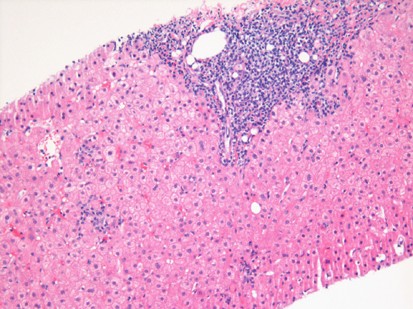
A 38-year-old woman comes to the physician because of a 3-month history of moderate abdominal pain that is unresponsive to medication. She has a history of two spontaneous abortions at 11 and 12 weeks' gestation. Ultrasound examination of the abdomen shows normal liver parenchyma, a dilated portal vein, and splenic enlargement. Upper endoscopy shows dilated submucosal veins in the lower esophagus. Further evaluation of this patient is most likely to show which of the following findings?
A 57-year-old man presents with fever and yellow discoloration of the skin for the past 4 days. He denies any recent weight loss or changes in urine or stool color. His past medical history is unremarkable. He admits to drinking about 130 g/day of alcohol and says he has been doing so for the past 25 years. His wife who is accompanying him during this visit adds that once her husband drank 15 cans of beer at a funeral. The patient also reports a 10-pack-year smoking history. His vital signs include: pulse 98/min, respiratory rate 13/min, temperature 38.2°C (100.8°F) and blood pressure 120/90 mm Hg. On physical examination, the patient appears jaundiced and is ill-appearing. Sclera is icteric. Abdominal examination reveals tenderness to palpation in the right upper quadrant with no rebound or guarding. Percussion reveals significant hepatomegaly extending 3 cm below the right costal margin. Laboratory studies are significant for the following: Sodium 135 mEq/L Potassium 3.5 mEq/L ALT 240 U/L AST 500 U/L A liver biopsy is obtained but the results are pending. Which of the following would most likely be seen in this patient's biopsy?
A 58-year-old man with a history of alcoholism is hospitalized with acute onset nausea and hematemesis. On admission, his vitals are as follows: blood pressure 110/70 mm Hg, heart rate 88/min, respiratory rate 16/min, and temperature 37.8℃ (100.0℉). Physical examination shows jaundice, palmar erythema, widespread spider angiomata, abdominal ascites, and visibly distended superficial epigastric veins. Abdominal ultrasound demonstrates portal vein obstruction caused by liver cirrhosis. Where in the liver would you find the earliest sign of fibrous deposition in this patient?
A 58-year-old man with liver cirrhosis presents to his primary care physician complaining of increased abdominal girth and early satiety. He drinks 2–4 glasses of wine with dinner and recalls having had abnormal liver enzymes in the past. Vital signs include a temperature of 37.1°C (98.7°F), blood pressure of 110/70 mm Hg, and a pulse of 75/min. Physical examination reveals telangiectasias, mild splenomegaly, palpable firm liver, and shifting dullness. Liver function is shown: Total bilirubin 3 mg/dL Aspartate aminotransferase (AST) 150 U/L Alanine aminotransferase (ALT) 70 U/L Total albumin 2.5 g/dL Abdominal ultrasonography confirms the presence of ascites. Diagnostic paracentesis is performed and its results are shown: Polymorphonuclear cell count 10 cells/mm Ascitic protein 1 g/dL Which of the following best represents the mechanism of ascites in this patient?
A 33-year-old female comes to her primary care physician with complaints of fatigue and nausea. She has also noticed that her skin tone is darker than it used to be. On exam, the physician notes that the woman appears to be jaundiced and obtains liver enzymes which demonstrate an elevated AST and ALT. Further testing subsequently confirms the diagnosis of hepatitis B (HBV). The woman is extremely concerned about transmitting this disease to her loved ones and ask how HBV is transmitted. By which of the following routes can HBV be spread? (I) blood, (II) sexual contact, (III) maternal-fetal, and/or (IV) breast milk?
A 25-year-old man presents to the office for a 3-day history of fever and fatigue. Upon further questioning, he says that he also had constant muscular pain, headaches, and fever during these days. He adds additional information by giving a history of regular unprotected sexual relationship with multiple partners. He is a non-smoker and drinks alcohol occasionally. The heart rate is 102/min, respiratory rate is 18/min, temperature is 38.0°C (100.4°F), and blood pressure is 120/80 mm Hg. On physical examination, he is icteric and hepatosplenomegaly is evident with diffuse muscular and abdominal tenderness particularly in the right upper quadrant. The serologic markers show the following pattern: Anti-HAV IgM negative HBsAg positive Anti-HBs negative IgM anti-HBc positive Anti-HCV negative Anti-HDV negative What is the most likely diagnosis?
Two weeks after returning from vacation in Mexico, a 21-year-old man comes to the emergency department because of malaise, nausea, vomiting, fever, and abdominal pain. He has no history of serious illness and takes no medications. Physical examination shows scleral icterus and right upper quadrant tenderness. The liver is palpated 1.5 cm below the right costal margin. A biopsy specimen of this patient's liver would most likely show which of the following findings?
A 37-year-old man presents to an urgent care clinic with complaints of speech problems and yellowing of his eyes for a week. He admits to using illicit intravenous drugs. His vital signs include: blood pressure 110/60 mm Hg, pulse rate 78/min, and respiratory rate 22/min. On examination, the patient appears jaundiced, and his speech is slurred. His liver enzymes and viral markers are as follows: Aspartate aminotransferase 6,700 IU/L Alanine aminotransferase 5,000 IU/L HBsAg Negative Anti-HBs Negative Anti-HCV Ab Positive HCV RNA Positive If this patient develops chronic hepatitis C infection, he is at risk of developing a secondary dermatological condition. A biopsy of this skin condition would most likely show which of the following findings?
A 59-year-old woman comes to the physician because of progressively worsening coordination and involuntary movements in her left hand for the past 6 months. Her husband also reports that she has been withdrawn and apathetic during this period. She is oriented to time, place, and person. Examination shows a bimanual, rhythmic, low-frequency tremor that is more prominent in the left hand. There is normal range of motion in the arms and legs; active movements are very slow. Muscle strength is normal, and there is increased resistance to passive flexion and extension in the limbs. She walks with a shuffling gait and takes small steps. Which of the following is the most likely underlying cause of this patient's symptoms?
Want unlimited practice?
Get full access to all questions, explanations, and performance tracking.
Scan to download app