
Head and neck pathology — MCQs

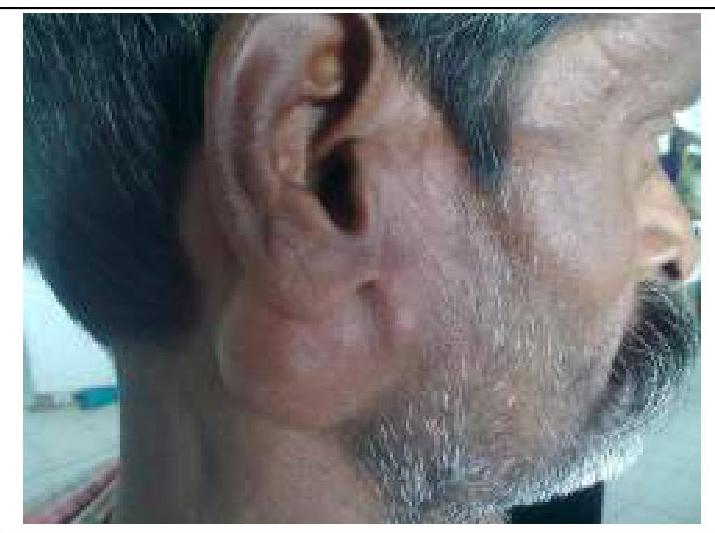
A 26-year-old woman presents to the medicine clinic with swelling around the right side of her chin and neck (Image A). She reports pain when moving her jaw and chewing. Her symptoms developed two days after receiving an uncomplicated tonsillectomy. She has been followed by a general medical physician since birth and has received all of her standard health maintenance procedures. Vital signs are stable with the exception of a temperature of 38.4 degrees Celcius. The area in question on the right side is exquisitely tender. The remainder of her exam is benign. What is the most likely diagnosis?
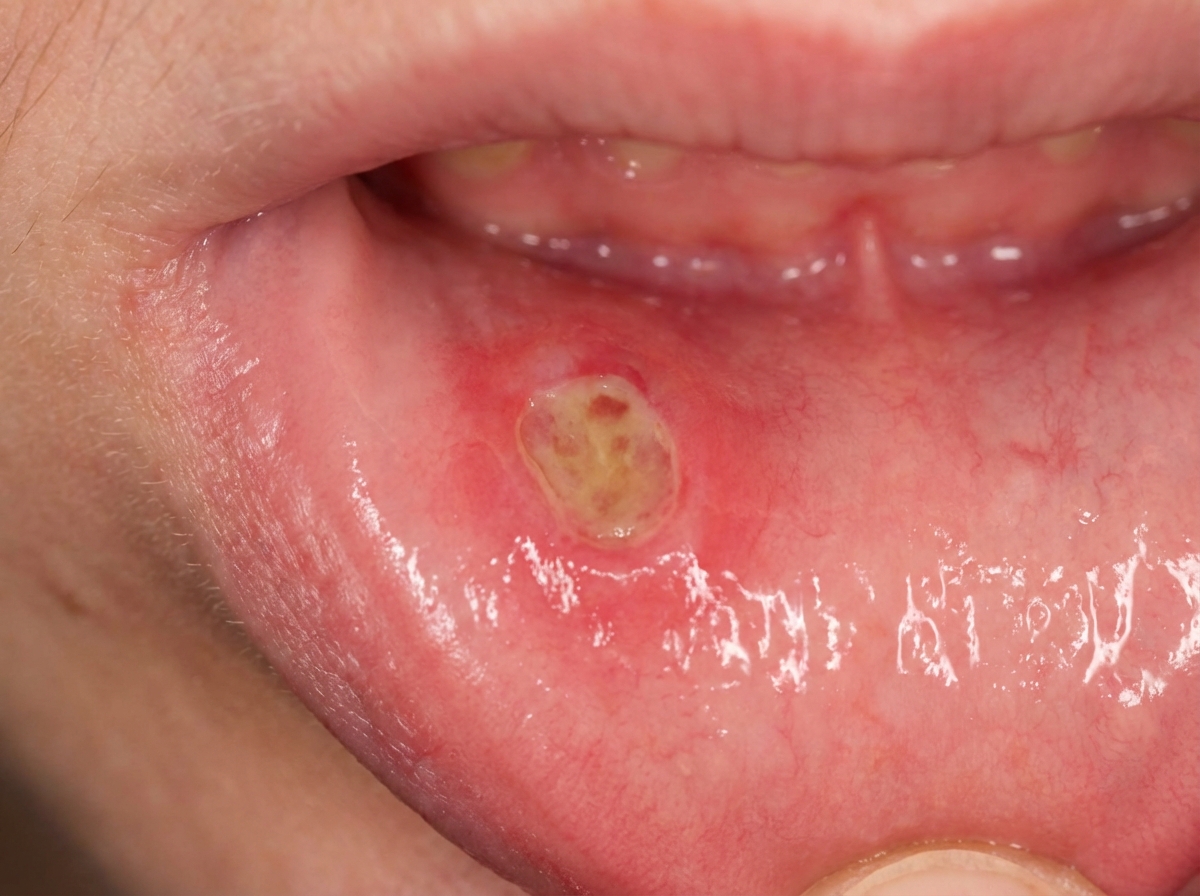
A 23-year-old woman presents with a painful lesion in her mouth. She denies tooth pain, bleeding from the gums, nausea, vomiting, diarrhea, or previous episodes similar to this in the past. She states that her last normal menstrual period was 12 days ago, and she has not been sexually active since starting medical school 2 years ago. On physical examination, the patient has good dentition with no signs of infection with the exception of a solitary ulcerated lesion on the oral mucosa. The nonvesicular lesion has a clean gray-white base and is surrounded by erythema. Which of the following is correct concerning the most likely etiology of the oral lesion in this patient?
An 11-year-old boy who recently emigrated from Nigeria is brought to the physician for evaluation of jaw swelling. He has no history of serious illness and takes no medications. Examination shows a 5-cm solid mass located above the right mandible and significant cervical lymphadenopathy. A biopsy specimen of the mass shows sheets of lymphocytes with interspersed tingible body macrophages. Serology for Epstein-Barr virus is positive. Which of the following chromosomal translocations is most likely present in cells obtained from the tissue mass?
A 30-year-old boxer seeks evaluation by his physician after he noticed swelling at the angle of his jaw a few days ago. He recalls a recent boxing match when he was punched in his face. He says that his jaw is very painful. On examination, a firm mass is palpated, measuring 4 x 4 cm. An ultrasound was performed, which shows a thin, encapsulated, well-circumscribed, predominantly solid mass with occasional cystic areas. The mass is surgically excised, after which he develops a hoarse voice for a few days, but recovers within 1 week. The histopathologic evaluation of the surgical specimen reports a pseudocapsule with a hypocellular stromal component consisting of a myxoid background and cartilage arranged in clusters and a hypercellular epithelial component with cells arranged in sheets and trabeculae. From which of the following structures did the mass most likely arise?
A 63-year-old man presents to his primary care physician because he has been having headaches and hearing loss. In addition, he says that he has been having difficulty opening his jaw to eat and recurrent middle ear infections. Physical exam reveals enlarged neck lymph nodes and a mass in the nasopharynx. Biopsy of the mass reveals undifferentiated squamous epithelial cells. The organism that is most likely associated with this patient's disease is also associated with which of the following disorders?
A 5-year-old boy is brought into your office by his mother. His father recently passed away, and his mother states she just lost her job. She has been unable to buy food regularly, and they have had to eat boiled and preserved vegetables. His mother denies that the boy has any prior medical conditions, but the patient states that his gums bleed when he brushes his teeth. On exam, the patient's vital signs are normal, but he appears malnourished. There is gum hypertrophy present on exam along with small, curled hairs over his head. CBC is significant for a Hgb of 9.5 g/dL with an MCV of 85. PT, aPTT, and bleeding time are all normal. What is the most likely cause?
A 16-year-old boy is brought to the physician by his mother because of a 4-day history of painful lesions in his mouth. During the past year, he has twice had similar lesions that resolved without treatment after approximately 10 days. He has never had any genital or anal lesions. His mother reports that he has been very stressed over the past month because he is approaching his senior year at high school. He is otherwise healthy and takes no medications. He appears thin. His temperature is 37.6°C (99.7°F). A photograph of his oral cavity is shown. The remainder of the examination shows no abnormalities. Which of the following is the most likely diagnosis?
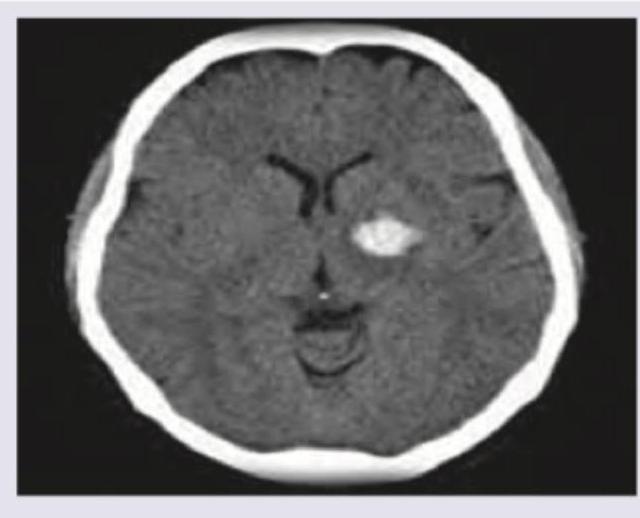
A 53-year-old man is brought to the emergency department for confusion. He was in his usual state of health until about 3 hours ago when he tried to use his sandwich to turn off the TV. He also complained to his wife that he had a severe headache. Past medical history is notable for hypertension, which has been difficult to control on multiple medications. His temperature is 36.7°C (98°F), the pulse is 70/min, and the blood pressure is 206/132 mm Hg. On physical exam he is alert and oriented only to himself, repeating over and over that his head hurts. The physical exam is otherwise unremarkable and his neurologic exam is nonfocal. The noncontrast CT scan of the patient's head is shown and reveals an acute intraparenchymal hemorrhage in the basal ganglia. Which of the following diagnostic tests would be most helpful in determining the underlying cause of this patient's hemorrhage?
A 20-year-old man presents with a painless neck mass that has gradually increased in size. The mass is anteromedial to the right sternocleidomastoid muscle and has been present for 3 years. The mass increased in size and became more tender following an upper respiratory infection. An ultrasound of the neck identifies a single, round cystic mass with uniform, low echogenicity, and no internal septations. A contrast-enhanced CT scan of the neck shows a homogeneous mass with low attenuation centrally and with smooth rim enhancement. Which of the following is the most likely diagnosis?
A 15-year-old girl comes to the physician because of a sore throat and subjective fevers for the past 2 weeks. She has been feeling lethargic and is unable to attend school. She has a history of multiple episodes of streptococcal pharyngitis treated with amoxicillin. She immigrated with her family to the United States from China 10 years ago. She appears thin. Her temperature is 37.8°C (100°F), pulse is 97/min, and blood pressure is 90/60 mm Hg. Examination shows pharyngeal erythema and enlarged tonsils with exudates and palatal petechiae. There is cervical lymphadenopathy. The spleen is palpated 2 cm below the left costal margin. Her hemoglobin concentration is 12 g/dL, leukocyte count is 14,100/mm3 with 54% lymphocytes (12% atypical lymphocytes), and platelet count is 280,000/mm3. A heterophile agglutination test is positive. The underlying cause of this patient's symptoms is most likely to increase the risk of which of the following conditions?
Want unlimited practice?
Get full access to all questions, explanations, and performance tracking.
Scan to download app