
Gallbladder and biliary tract disorders — MCQs

A 65-year-old man presents to his primary care physician for fatigue. The patient states that he has not been sleeping well and requests sleep medication to help him with his fatigue. He recently changed his diet to try to increase his energy and has been on a vegetarian diet for the past several months. The patient has no significant past medical history. He smokes 1 pack of cigarettes per day and drinks 5 alcoholic beverages per day. The patient has lost 12 pounds since his last visit 1 month ago. Physical exam demonstrates a tired man. He appears thin, and his skin and sclera are icteric. Abdominal ultrasound is notable for a thin-walled and enlarged gallbladder. A urine sample is collected and is noted to be amber in color. Which of the following is the most likely diagnosis?
A previously healthy 37-year-old woman, gravida 3, para 2, at 29 weeks' gestation comes to the physician because of colicky postprandial abdominal pain. Her vital signs are within normal limits. Physical examination shows a uterus consistent in size with a 29-week gestation. Ultrasonography of the abdomen shows multiple 5-mm hyperechoic masses within the gallbladder lumen. Which of the following processes is most likely involved in the pathogenesis of this patient's condition?
A 42-year-old woman is brought to the emergency department because of intermittent sharp right upper quadrant abdominal pain and nausea for the past 10 hours. She has vomited 3 times. There is no associated fever, chills, diarrhea, or urinary symptoms. She has 2 children who both attend high school. She appears uncomfortable. She is 165 cm (5 ft 5 in) tall and weighs 86 kg (190 lb). Her BMI is 32 kg/m2. Her temperature is 37.0°C (98.6°F), pulse is 100/min, and blood pressure is 140/90 mm Hg. She has mild scleral icterus. On physical examination, her abdomen is soft and nondistended, with tenderness to palpation of the right upper quadrant without guarding or rebound. Bowel sounds are normal. Laboratory studies show the following: Blood Hemoglobin count 14 g/dL Leukocyte count 9,000 mm3 Platelet count 160,000 mm3 Serum Alkaline phosphatase 238 U/L Aspartate aminotransferase 60 U/L Bilirubin Total 2.8 mg/dL Direct 2.1 mg/dL Which of the following is the most appropriate next step in diagnosis?
A 45-year-old woman comes to the emergency department complaining of abdominal pain for the past day. The pain is situated in the right upper quadrant, colicky, 8/10, and radiates to the tip of the right shoulder with no aggravating or relieving factors. The pain is associated with nausea but no vomiting. She tried to take over-the-counter antacids which relieved her pain to a certain extent, but not entirely. She does not smoke cigarettes or drink alcohol. She has no past medical illness. Her father died of pancreatic cancer at the age of 75, and her mother has diabetes controlled with medications. Temperature is 38°C (100.4°F), blood pressure is 125/89 mm Hg, pulse is 104/min, respiratory rate is 20/min, and BMI is 29 kg/m2. On abdominal examination, her abdomen is tender to shallow and deep palpation of the right upper quadrant. Laboratory test Complete blood count Hemoglobin 13 g/dL WBC 15,500/mm3 Platelets 145,000/mm3 Basic metabolic panel Serum Na+ 137 mEq/L Serum K+ 3.6 mEq/L Serum Cl- 95 mEq/L Serum HCO3- 25 mEq/L BUN 10 mg/dL Serum creatinine 0.8 mg/dL Liver function test Total bilirubin 1.3 mg/dL AST 52 U/L ALT 60 U/L Ultrasonography of the abdomen shows normal findings. What is the best next step in management of this patient?
An otherwise healthy 56-year-old woman comes to the physician because of a 3-year history of intermittent upper abdominal pain. She has had no nausea, vomiting, or change in weight. Physical examination shows no abnormalities. Laboratory studies are within normal limits. Abdominal ultrasonography shows a hyperechogenic rim-like calcification of the gallbladder wall. The finding in this patient's ultrasonography increases the risk of which of the following conditions?
A 41-year-old G3P3 woman presents with acute on chronic right upper quadrant abdominal pain. She says that her current symptoms acutely onset 8 hours ago after eating a large meal and have not improved. She describes the pain as severe, sharp and cramping in character, and localized to the right upper quadrant. She also describes feeling nauseous. The patient says she has had similar less severe episodes intermittently for the past 2 years, usually precipitated by the intake of fatty foods. She denies any history of fever or jaundice. Vital signs are stable. Physical examination is unremarkable, and laboratory findings show normal liver function tests and normal serum bilirubin and serum amylase levels. Ultrasonography of the abdomen reveals multiple stones in the gallbladder. The patient is managed symptomatically for this episode, and after a few months, undergoes elective cholecystectomy, which reveals multiple stones in her gallbladder as shown in the figure (see image). Which of the following best describes these gallstones?
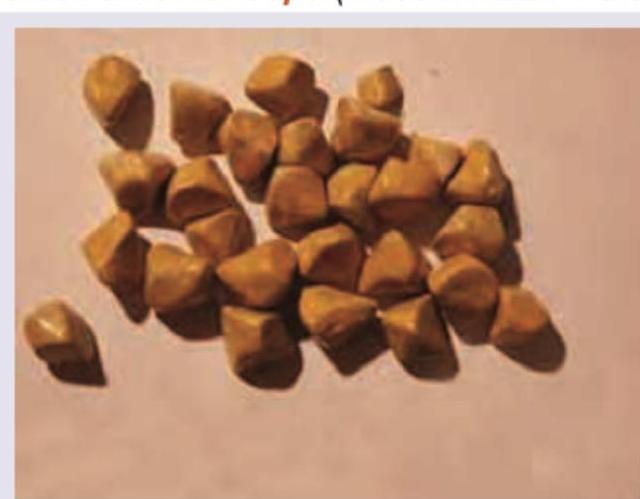
A 57-year-old man is brought to the emergency department because of a 2-day history of fever and right upper quadrant abdominal pain. Examination shows jaundice. Ultrasonography of the abdomen shows cholelithiasis and marked dilation of the biliary duct. An ERCP is performed and reveals pus with multiple brown concrements draining from the common bile duct. Which of the following is the most likely underlying cause of the patient's findings?
A 45-year-old woman comes to the emergency department because of right upper abdominal pain and nausea that have become progressively worse since eating a large meal 8 hours ago. She has had intermittent pain similar to this before, but it has never lasted this long. She has a history of hypertension and type 2 diabetes mellitus. She does not smoke or drink alcohol. Current medications include metformin and enalapril. Her temperature is 38.5°C (101.3°F), pulse is 90/min, and blood pressure is 130/80 mm Hg. The abdomen is soft, and bowel sounds are normal. The patient has sudden inspiratory arrest during right upper quadrant palpation. Laboratory studies show a leukocyte count of 13,000/mm3. Serum alkaline phosphatase, total bilirubin, amylase, and aspartate aminotransferase levels are within the reference ranges. Imaging is most likely to show which of the following findings?
A 66-year-old woman comes to the physician because of a 1-week history of pruritic blister formation. Physical examination shows multiple 1–3 cm bullae on the palms, soles, lower legs, and inguinal folds. Gentle rubbing of the skin does not result in sloughing of the epidermis. Immunofluorescence studies of a perilesional skin biopsy specimen are most likely to show deposition of antibodies in which of the following areas?
A 7-year-old boy is brought to the emergency department by his parents. He is complaining of left-sided knee pain which has progressively increased in severity over the past 2 days. It started when he was playing football with his brothers but he does not recall falling or getting any injury. Past medical history is significant for prolonged bleeding and easy bruising. His maternal uncle has similar problems. Physical exam reveals swollen and painful left knee. His laboratory investigations reveal: Hemoglobin 11.8 g/dL WBC count 7,000/mL Platelets 250,000/mL INR 0.9 aPTT 62 sec, fully corrected with a mixing study Which of the following disorders have the same mode of inheritance as this patient’s disease?
Want unlimited practice?
Get full access to all questions, explanations, and performance tracking.
Scan to download app