
Congenital renal anomalies — MCQs

A newborn infant is resuscitated and transferred to the neonatal intensive care unit. The infant has notable limb deformities as well as low-set ears and a flattened nose. He was born at 34 weeks gestation to a healthy mother who received regular obstetric follow-up. Resuscitation was notable for difficulty maintaining oxygenation in the newborn. Despite appropriate interventions, the infant is still struggling to maintain adequate oxygenation. Which of the following is most likely the cause of this patient's symptoms?
A 41-year-old man presents to the emergency department because of brownish discoloration of his urine for the last several days. The review of symptoms includes complaints of increasing abdominal girth, early satiety, and difficulty breathing on exertion. The past medical history includes essential hypertension for 19 years. The medication list includes lisinopril and hydrochlorothiazide. He had a right inguinal hernia repair when he was a teenager. He smokes 20–30 cigarettes daily for the last 21 years, and drinks alcohol socially. His father died of a hemorrhagic stroke at the age of 69 years. The vital signs include: temperature 37.0°C (98.6°F), blood pressure 131/88 mm Hg, and pulse 82/min. The physical examination is positive for a palpable right upper quadrant mass. The abdominal ultrasound shows multiple bilateral kidney cysts and hepatic cysts. Which of the following is the most likely diagnosis?
A 27-year-old female in her 20th week of pregnancy presents for a routine fetal ultrasound screening. An abnormality of the right fetal kidney is detected. It is determined that the right ureteropelvic junction has failed to recanalize. Which of the following findings is most likely to be seen on fetal ultrasound:
A 14-year-old girl comes to the physician for exertional leg pain. The pain began last week when she started jogging to lose weight. She is at the 5th percentile for height and 80th percentile for weight. Physical examination shows a broad neck with bilateral excess skin folds that extend to the shoulders, as well as a low-set hairline and ears. There is an increased carrying angle when she fully extends her arms at her sides. Pulses are palpable in all extremities; lower leg pulses are delayed. Which of the following additional findings is most likely in this patient?
A female infant is born with a mutation in PKD1 on chromosome 16. An abdominal ultrasound performed shortly after birth would most likely reveal which of the following?
A 49-year-old man presents to your clinic with “low back pain”. When asked to point to the area that bothers him the most, he motions to both his left and right flank. He describes the pain as deep, dull, and aching for the past few months. His pain does not change significantly with movement or lifting heavy objects. He noted dark colored urine this morning. He has a history of hypertension managed with hydrochlorothiazide; however, he avoids seeing the doctor whenever possible. He drinks 3-4 beers on the weekends but does not smoke. His father died of a sudden onset brain bleed, and his mother has diabetes. In clinic, his temperature is 99°F (37.2°C), blood pressure is 150/110 mmHg, pulse is 95/min, and respirations are 12/min. Bilateral irregular masses are noted on deep palpation of the abdomen. The patient has full range of motion in his back and has no tenderness of the spine or paraspinal muscles. Urine dipstick in clinic is notable for 3+ blood. Which chromosome is most likely affected by a mutation in this patient?
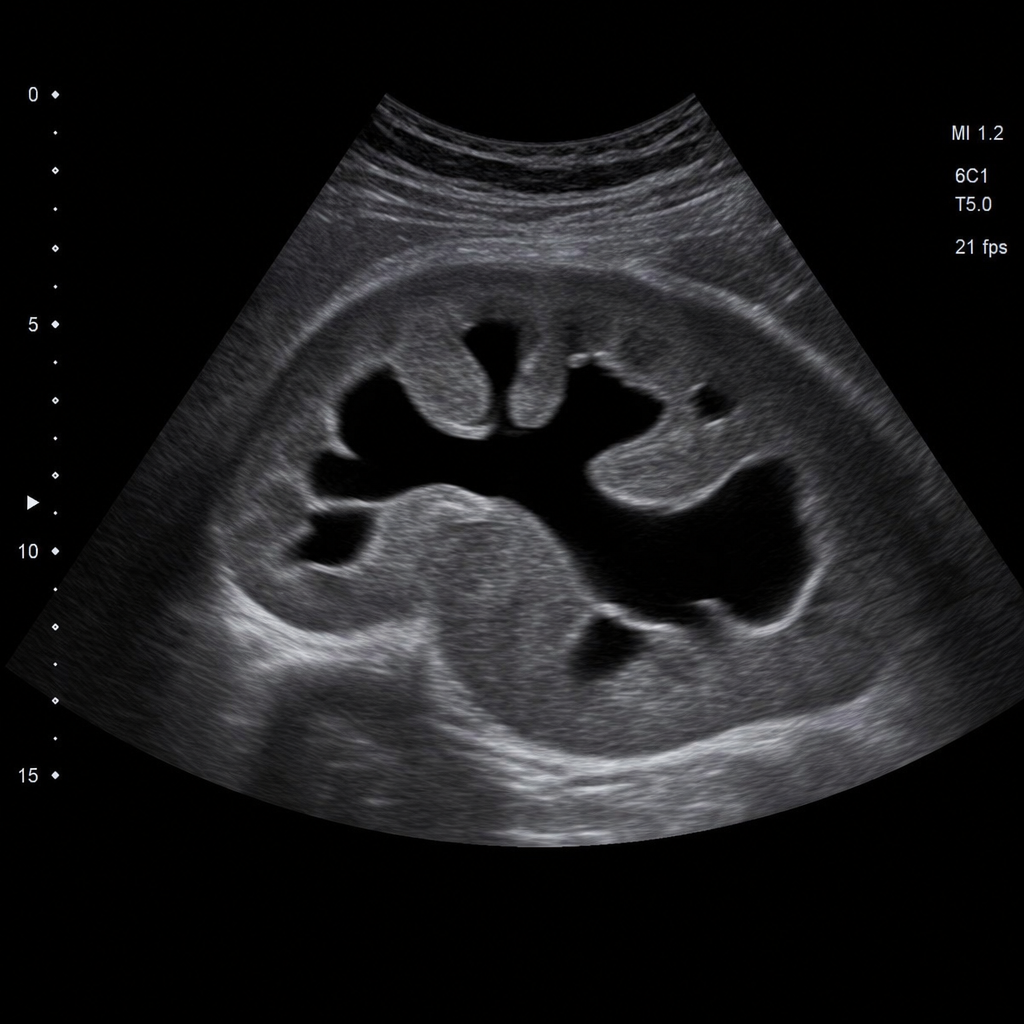
An 87-year-old man comes to the physician because of progressive involuntary urine dribbling over the past two years. He has to use the restroom more frequently than he used to and feels like he cannot fully empty his bladder. Physical examination shows a palpable suprapubic mass. An ultrasound image of the left kidney is shown. Which of the following is the most likely explanation of this patient's imaging findings?
A 4-year-old male is accompanied by his mother to the pediatrician. His mother reports that over the past two weeks, the child has had intermittent low grade fevers and has been more lethargic than usual. The child’s past medical history is notable for myelomeningocele complicated by lower extremity weakness as well as bowel and bladder dysfunction. He has been hospitalized multiple times at an outside facility for recurrent urinary tract infections. The child is in the 15th percentile for both height and weight. His temperature is 100.7°F (38.2°C), blood pressure is 115/70 mmHg, pulse is 115/min, and respirations are 20/min. Physical examination is notable for costovertebral angle tenderness that is worse on the right. Which of the following would most likely be found on biopsy of this patient’s kidney?
A child presents with rachitic changes in the limbs that are not responding to Vitamin D supplementation. Investigations reveal the following results: - Calcium: $9.5 \mathrm{mg} / \mathrm{dl}$ - Phosphorus: $1.6 \mathrm{mg} / \mathrm{dl}$ - Alkaline phosphatase (ALP): 814 IU - Serum PTH: $24.2 \mathrm{pg} / \mathrm{ml}$ - Serum electrolytes, creatinine, and blood gases: Normal. What is the most likely diagnosis?
A 6-year-old girl comes with her parents to the physician's office to initiate care with a new physician. The patient was recently adopted and her parents do not know her birth history; however, she has had some issues with fatigue. They were told by the adoption agency that the patient has required blood transfusions for "low blood count" in the past but they are not aware of the reason for these transfusions. Her temperature is 37.8°C (99.8°F), blood pressure is 110/84 mmHg, and pulse is 95/min. Physical examination is notable for conjunctival pallor, pale skin, and mild splenomegaly. A complete blood count is taken in the office with the following results: Hemoglobin: 6.8 g/dL Leukocyte count: 5,000/mm^3 Platelet count: 190,000/mm^3 Peripheral smear shows spherocytes and further analysis reveals rigid red blood cells. The most likely cause of this patient's symptoms has which of the following modes of inheritance?
Want unlimited practice?
Get full access to all questions, explanations, and performance tracking.
Scan to download app