
Lung tumors (primary and metastatic) — MCQs

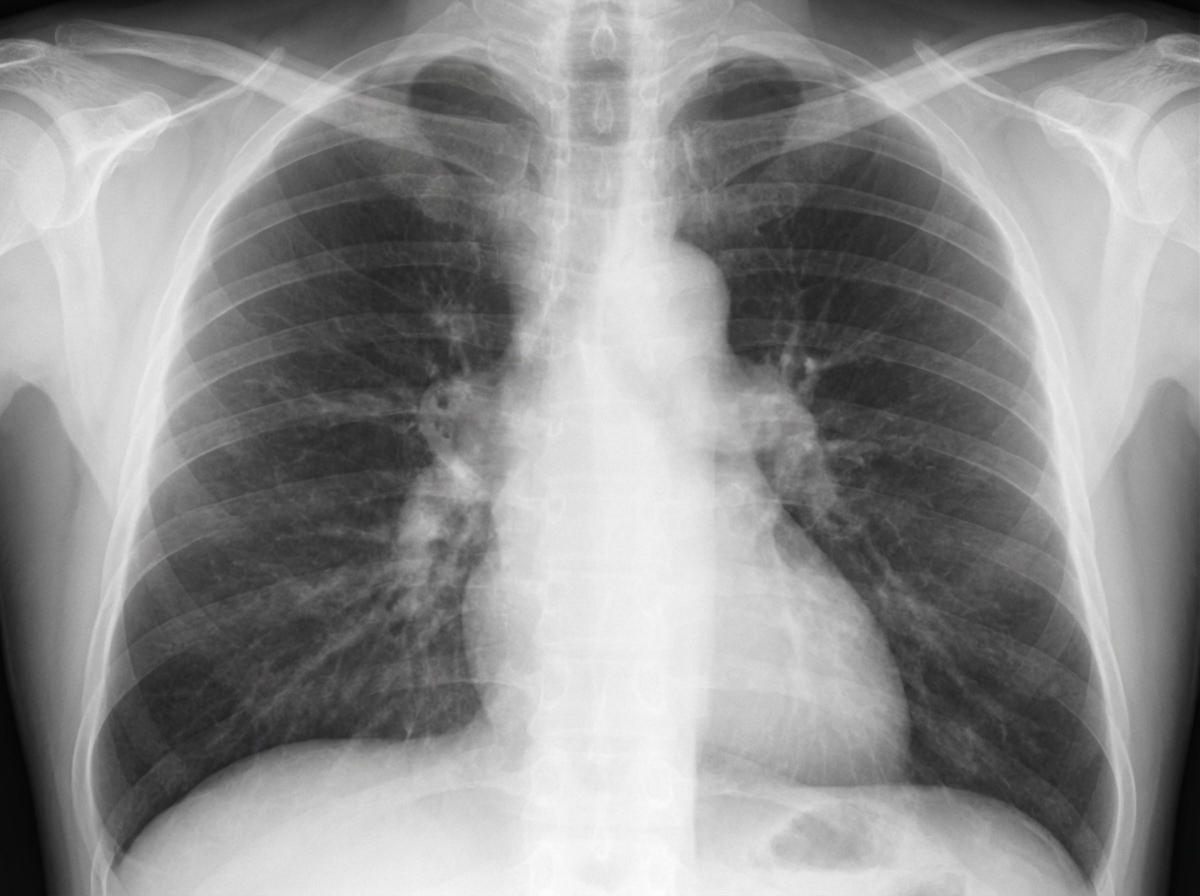
A 61-year-old man presents to the urgent care clinic complaining of cough and unintentional weight loss over the past 3 months. He works as a computer engineer, and he informs you that he has been having to meet several deadlines recently and has been under significant stress. His medical history is significant for gout, hypertension, hypercholesterolemia, diabetes mellitus type 2, and pulmonary histoplasmosis 10 years ago. He currently smokes 2 packs of cigarettes/day, drinks a 6-pack of beer/day, and he endorses a past history of cocaine use back in the early 2000s but currently denies any drug use. The vital signs include: temperature 36.7°C (98.0°F), blood pressure 126/74 mm Hg, heart rate 87/min, and respiratory rate 18/min. His physical examination shows minimal bibasilar rales, but otherwise clear lungs on auscultation, grade 2/6 holosystolic murmur, and a benign abdominal physical examination. However, on routine lab testing, you notice that his sodium is 127 mEq/L. His chest X-ray is shown in the picture. Which of the following is the most likely underlying diagnosis?
A 61-year-old man comes to the physician because of a 2-month history of a cough productive of clear mucoid sputum. He has smoked one pack of cigarettes daily for 33 years. Physical examination shows no abnormalities. Chest x-ray shows a 2-cm solid nodule in the periphery of the lower left lobe. A bronchial biopsy of the mass shows numerous mucin-filled epithelial cells lining the alveolar basement membrane. The cells have prominent nucleoli, coarse chromatin, and some cells have multiple nuclei. Which of the following is the most likely diagnosis?
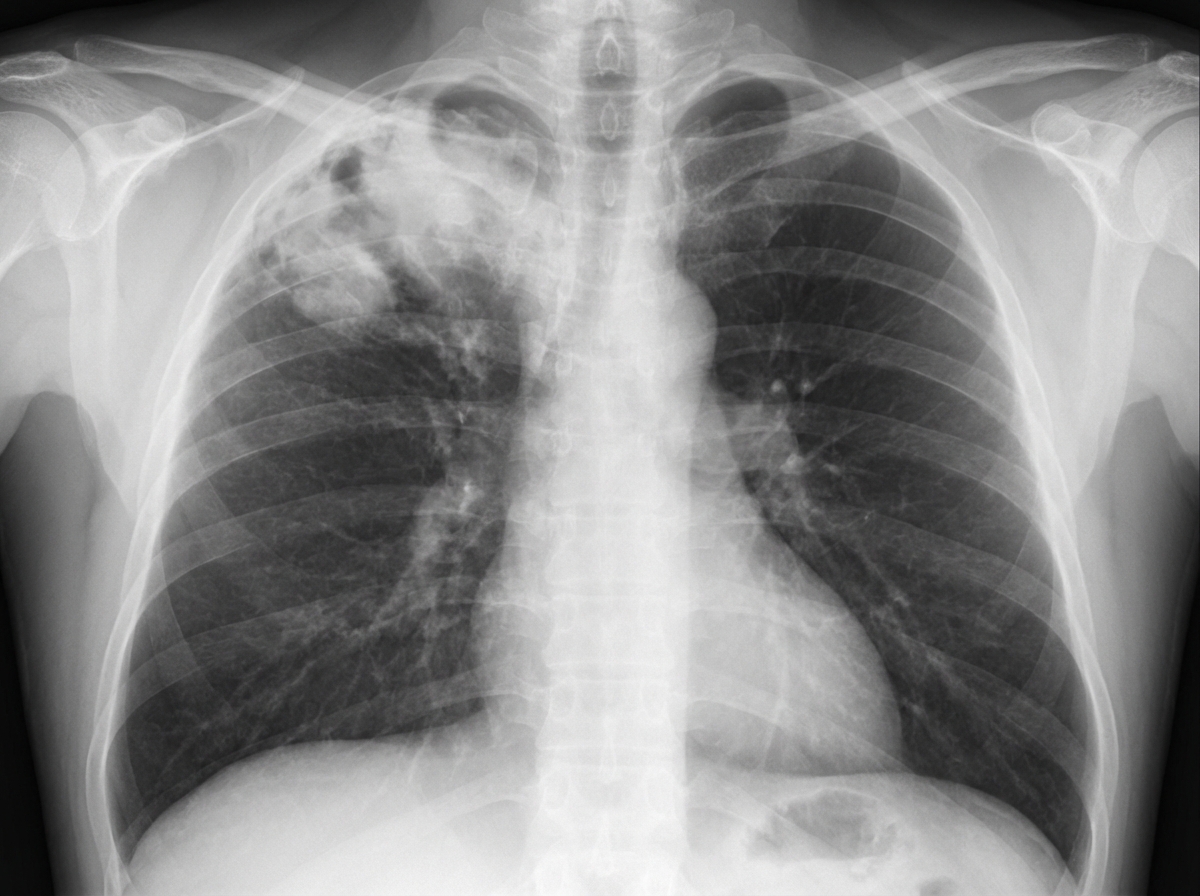
A 68-year-old male is diagnosed with squamous cell carcinoma in the upper lobe of his right lung. A chest radiograph can be seen in image A. Which of the following would you most expect to find in this patient?
A 65-year-old man with a 40-pack-year smoking history presents with hemoptysis and a persistent cough. Chest CT shows a 3.5 cm centrally located mass in the right main bronchus. Positron emission tomography confirms a malignant nodule. Bronchoscopy with transbronchial biopsy is performed and a specimen sample of the nodule is sent for frozen section analysis. The tissue sample is most likely to show which of the following tumor types?
A 63-year-old male is accompanied by his wife to his primary care doctor complaining of shortness of breath. He reports a seven-month history of progressively worsening dyspnea and a dry non-productive cough. He has also lost 15 pounds over the same time despite no change in diet. Additionally, over the past week, his wife has noticed that the patient appears confused and disoriented. His past medical history is notable for stable angina, hypertension, hyperlipidemia, and diabetes mellitus. He currently takes aspirin, metoprolol, lisinopril, atorvastatin, metformin, and glyburide. He has smoked 1 pack of cigarettes per day for 30 years and previously worked as a mechanic at a shipyard. Physical examination reveals no wheezes, rales, or rhonchi with slightly decreased aeration in the left lower lung field. Mucus membranes are moist with normal skin turgor and capillary refill. Laboratory analysis reveals the following: Na 121 mEq/L K 3.4 mEq/L Cl 96 mEq/L HCO3 23 mEq/L Cr 1.1 mg/dl BUN 17 mg/dl A biopsy of the responsible lesions will most likely demonstrate which of the following findings?
A 72-year-old man presents to the physician with blood in his sputum for 3 days. He also mentions that he has had a cough for the last 3 months but thought that it was because of the winter season. He also has often experienced fatigue recently. His temperature is 37.0°C (98.6°F), the respiratory rate is 15/min, the pulse is 67/min, and the blood pressure is 122/98 mm Hg. Auscultation of his chest reveals normal heart sounds but localized rhonchi over the right infrascapular region. A detailed diagnostic evaluation including a complete blood count and other serum biochemistry, chest radiogram, computed tomography of chest and abdomen, magnetic resonance imaging of the brain, bone scan, and pulmonary function tests are ordered, which confirm a diagnosis of limited-disease small cell lung cancer of 2.5 cm (1 in) in diameter, located in the lower lobe of the right lung, with the involvement of ipsilateral hilar lymph nodes and intrapulmonary lymph nodes. The mediastinal, subcarinal, scalene or supraclavicular lymph nodes are not involved, and there is no distant metastasis. There is no additional comorbidity and his performance status is good. The patient does not have any contraindication to any chemotherapeutic agents or radiotherapy. Which of the following is the best treatment option for this patient?
An 82-year-old man is brought to the emergency department after he was found down by his daughter. On presentation, he is alert and oriented with no obvious signs of trauma. He says that he felt lightheaded shortly before passing out and that he has been feeling extremely fatigued over the last few weeks. He has a known diagnosis of colorectal adenocarcinoma and had it surgically removed 2 months ago; however, recently he has been feeling increasingly short of breath. He has a 60-pack-year smoking history and drinks 2-3 beers a night. He worked as an insulation technician and shipyard laborer for 40 years prior to retiring at age 65. Radiographs reveal approximately a dozen new nodules scattered throughout his lungs bilaterally. Biopsy of these lesions would most likely reveal which of the following?
A 75-year-old gentleman is brought to the ED with confusion that started earlier this morning. His family notes that he was complaining of feeling weak last night and also had a slight tremor at the time. He is afebrile and he has no known chronic medical conditions. Physical exam reveals a cooperative but confused gentleman. His mucous membranes are moist, he has no focal neurological deficits, and his skin turgor is within normal limits. His lab results are notable for: Serum Na+: 123 mEq/L Plasma osmolality: 268 mOsm/kg Urine osmolality: 349 mOsm/kg Urine Na+: 47 mEq/L Which of the following malignancies is most likely to be responsible for this patient's presentation?
A 34-year-old man comes to the physician because of a 3-week history of left testicular swelling. He has no pain. He underwent a left inguinal hernia repair as a child. He takes no medications. He appears healthy. His vital signs are within normal limits. Examination shows an enlarged, nontender left testicle. When the patient is asked to cough, there is no bulge present in the scrotum. When a light is held behind the scrotum, it does not shine through. There is no inguinal lymphadenopathy. Laboratory studies show: Hemoglobin 14.5 g/dL Leukocyte count 8,800/mm3 Platelet count 345,000/mm3 Serum Glucose 88 mg/dL Creatinine 0.8 mg/dL Total bilirubin 0.7 mg/dL Alkaline phosphatase 35 U/L AST 15 U/L ALT 14 U/L Lactate dehydrogenase 60 U/L β-Human chorionic gonadotropin 80 mIU/mL (N < 5) α-Fetoprotein 6 ng/mL (N < 10) Which of the following is the most likely diagnosis?
A 57-year-old man is brought to the emergency department by his wife 20 minutes after having had a seizure. He has had recurrent headaches and dizziness for the past 2 weeks. An MRI of the brain shows multiple, round, well-demarcated lesions in the brain parenchyma at the junction between gray and white matter. This patient's brain lesions are most likely comprised of cells that originate from which of the following organs?
Want unlimited practice?
Get full access to all questions, explanations, and performance tracking.
Scan to download app