
Acute respiratory distress syndrome — MCQs

A previously healthy 35-year-old woman is brought into the emergency department after being found unresponsive by her husband. Her husband finds an empty bottle of diazepam tablets in her pocket. She is stuporous. At the hospital, her blood pressure is 90/40 mm Hg, the pulse is 58/min, and the respirations are 6/min. The examination of the pupils shows normal size and reactivity to light. Deep tendon reflexes are 1+ bilaterally. Babinski sign is absent. All 4 extremities are hypotonic. The patient is intubated and taken to the critical care unit for mechanical ventilation and treatment. Regarding the prevention of pneumonia in this patient, which of the following strategies is most likely to achieve this goal?
A 63-year-old man with alpha-1-antitrypsin deficiency is brought to the emergency department 1 hour after his daughter found him unresponsive. Despite appropriate care, the patient dies. At autopsy, examination of the lungs shows enlargement of the airspaces in the respiratory bronchioles and alveoli. Enzymatic activity of which of the following cells is the most likely cause of these findings?
A 63-year-old man is brought to the emergency department, 30 minutes after being involved in a high-speed motor vehicle collision. He is obtunded on arrival. He is intubated and mechanical ventilation is begun. The ventilator is set at a FiO2 of 60%, tidal volume of 440 mL, and positive end-expiratory pressure of 4 cm H2O. On the third day of intubation, his temperature is 37.3°C (99.1°F), pulse is 91/min, and blood pressure is 103/60 mm Hg. There are decreased breath sounds over the left lung base. Cardiac examination shows no abnormalities. The abdomen is soft and not distended. Arterial blood gas analysis shows: pH 7.49 pCO2 29 mm Hg pO2 73 mm Hg HCO3- 20 mEq/L O2 saturation 89% Monitoring shows a sudden increase in the plateau airway pressure. An x-ray of the chest shows deepening of the costophrenic angle on the left side. Which of the following is the most appropriate next step in management?
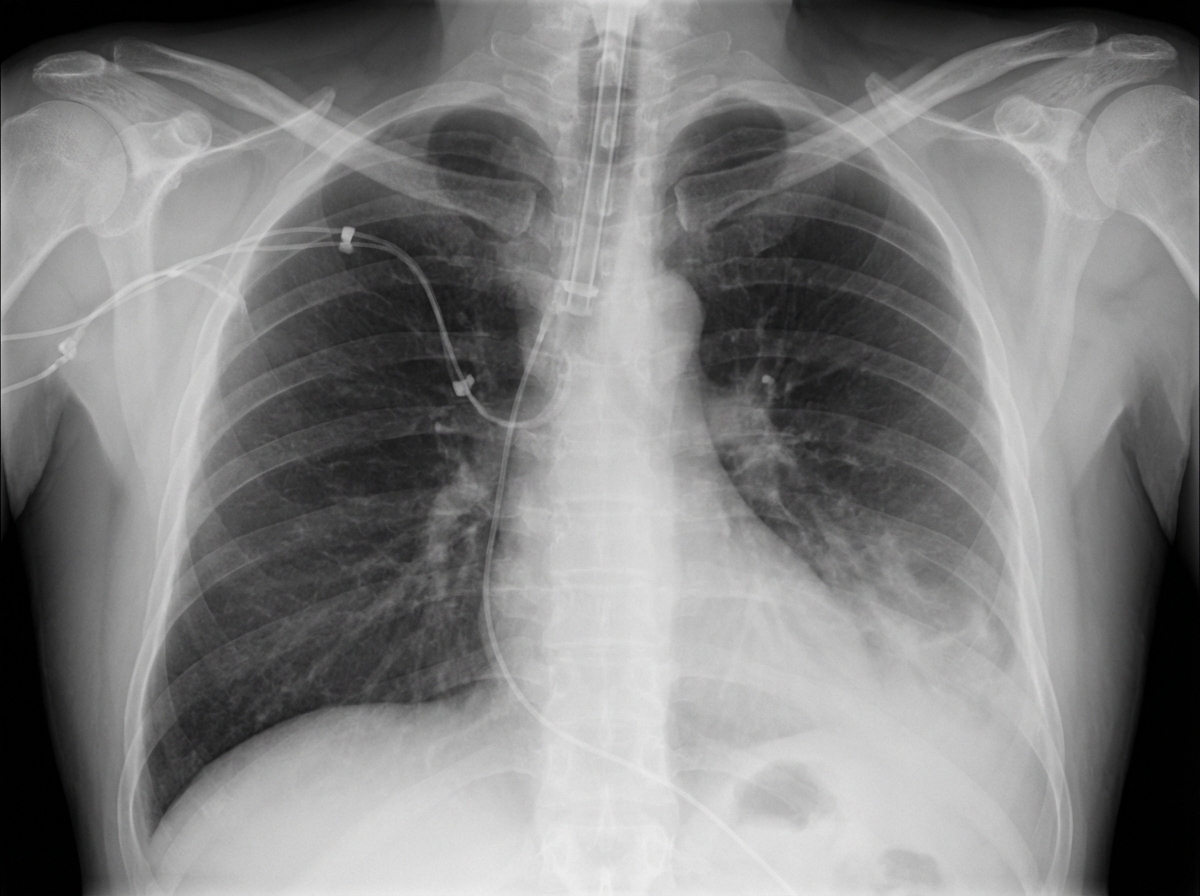
A 72-year-old man with coronary artery disease comes to the emergency department because of chest pain and shortness of breath for the past 3 hours. Troponin levels are elevated and an ECG shows ST-elevations in the precordial leads. Revascularization with percutaneous coronary intervention is performed, and a stent is successfully placed in the left anterior descending artery. Two days later, he complains of worsening shortness of breath. Pulse oximetry on 3L of nasal cannula shows an oxygen saturation of 89%. An x-ray of the chest shows distended pulmonary veins, small horizontal lines at the lung bases, and blunting of the costophrenic angles bilaterally. Which of the following findings would be most likely on a ventilation-perfusion scan of this patient?
A neonate suffering from neonatal respiratory distress syndrome is given supplemental oxygen. Which of the following is a possible consequence of oxygen therapy in this patient?
An 83-year-old man is being seen in the hospital for confusion. The patient was admitted 4 days ago for pneumonia. He has been improving on ceftriaxone and azithromycin. Then 2 nights ago he had an episode of confusion. He was unsure where he was and attempted to leave. He was calmed down by nurses with redirection. He had a chest radiograph that was stable from admission, a normal EKG, and a normal urinalysis. This morning he was alert and oriented. Then this evening he became confused and agitated again. The patient has a history of benign prostatic hyperplasia, severe dementia, and osteoarthritis. He takes tamsulosin in addition to the newly started antibiotics. Upon physical examination, the patient is alert but orientated only to name. He tries to get up, falls back onto the bed, and grabs his right knee. He states, “I need to get to work. My boss is waiting, but my knee hurts.” He tries to walk again, threatens the nurse who stops him, and throws a plate at the wall. In addition to reorientation, which of the following is the next best step in management?
A 2500-g (5-lb 8-oz) female newborn delivered at 37 weeks' gestation develops rapid breathing, grunting, and subcostal retractions shortly after birth. Despite appropriate lifesaving measures, the newborn dies 2 hours later. Autopsy shows bilateral renal agenesis. Which of the following is the most likely underlying cause of this newborn's respiratory distress?
A 52-year-old woman presents to the emergency room complaining of chest pain. She reports a 4-hour history of dull substernal pain radiating to her jaw. Her history is notable for hypertension, diabetes mellitus, and alcohol abuse. She has a 30 pack-year smoking history and takes lisinopril and metformin but has an allergy to aspirin. Her temperature is 99.1°F (37.3°C), blood pressure is 150/90 mmHg, pulse is 120/min, and respirations are 22/min. Physical examination reveals a diaphoretic and distressed woman. An electrocardiogram reveals ST elevations in leads I, aVL, and V5-6. She is admitted with plans for immediate transport to the catheterization lab for stent placement. What is the mechanism of the next medication that should be given to this patient?
A 35-year-old woman who was recently ill with an upper respiratory infection presents to the emergency department with weakness in her lower limbs and difficulty breathing. Her symptoms began with a burning sensation in her toes along with numbness. She claims that the weakness has been getting worse over the last few days and now involving her arms and face. Currently, she is unable to get up from the chair without some assistance. Her temperature is 37.0°C (98.6°F), the blood pressure is 145/89 mm Hg, the heart rate is 99/min, the respiratory rate is 12/min, and the oxygen saturation is 95% on room air. On physical examination, she has diminished breath sounds on auscultation of bilateral lung fields with noticeably poor inspiratory effort. Palpation of the lower abdomen reveals a palpable bladder. Strength is 3 out of 5 symmetrically in the lower extremities bilaterally. The sensation is intact. What is the most likely diagnosis?
A 42-year-old man is referred for an endocrinology consult because of decreased triiodothyronine (T3) hormone levels. He presented to the emergency department 1 week prior to this consultation with pneumonia and was admitted to a medicine service for management of his infection. He has since recovered from his infection after intravenous antibiotic administration. He currently has no symptoms and denies feeling cold or lethargic. A panel of laboratory tests are obtained with the following results: Thyroid-stimulating hormone: 4.7 µU/mL Thyroxine (T4): 6 µg/dL Triiodothyronine (T3): 68 ng/dL Which of the following additional findings would most likely also be seen in this patient?
Want unlimited practice?
Get full access to all questions, explanations, and performance tracking.
Scan to download app