
Metastatic CNS tumors — MCQs

A 57-year-old man is brought to the emergency department by his wife 20 minutes after having had a seizure. He has had recurrent headaches and dizziness for the past 2 weeks. An MRI of the brain shows multiple, round, well-demarcated lesions in the brain parenchyma at the junction between gray and white matter. This patient's brain lesions are most likely comprised of cells that originate from which of the following organs?
A previously healthy 50-year-old woman is brought to the emergency department 30 minutes after she was observed having a seizure. On arrival, she is conscious and reports that she feels drowsy. An MRI of the brain shows a 4-cm, round, sharply demarcated mass. She undergoes resection of the mass. A photomicrograph of a section of the resected specimen is shown. This patient's mass is most likely derived from which of the following?
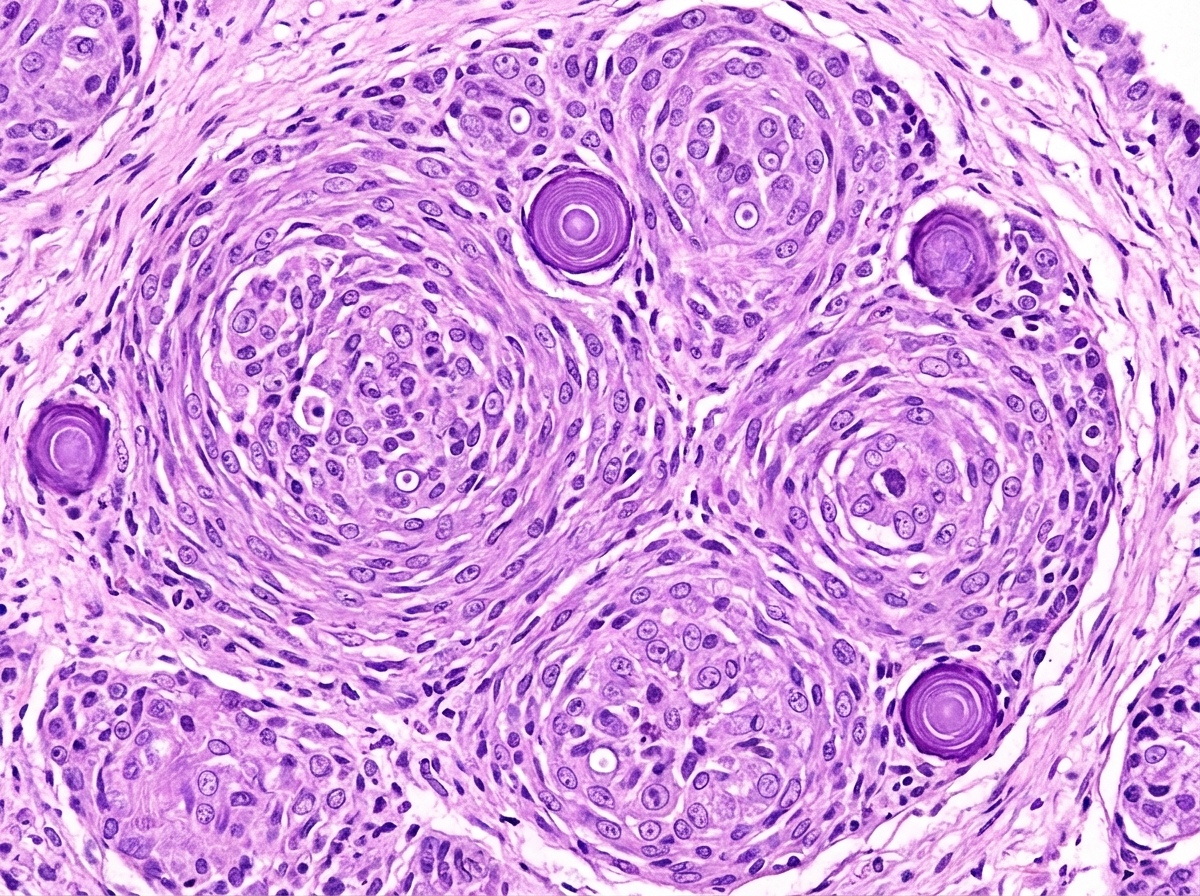
A 39-year-old African American woman is admitted to the hospital following a seizure with a severe post-ictal headache. She was diagnosed with breast cancer 1 year ago when she presented with a hard, rock-like, immobile mass with irregular borders accompanied by changes in the breast skin, including erythema and dimpling. She had ipsilateral mobile axillary lymphadenopathy at that time. A biopsy confirmed the diagnosis of stage 2B invasive breast cancer. Her mother died at 42 years of age due to the same type of breast cancer. A CT scan done during this admission reveals multiple metastatic lesions in the brain and liver, along with the involvement of supra- and infra-clavicular lymph nodes. Which of the following molecular profile most likely characterizes this patient?
A 22-year-old man comes to the physician because of headaches and blurry vision for the past 6 months. He also reports frequent episodes of vomiting over the last month. His father has died of renal cell carcinoma at the age of 37 years. Examination shows 20/40 vision bilaterally. Fundoscopic examination shows bilateral optic disc swelling and growth of capillary vessels in the temporal peripheral retina. An MRI of the brain shows an infratentorial mass. The patient undergoes surgical resection of the mass. A photomicrograph of the resected specimen is shown. Which of the following is the most likely diagnosis?
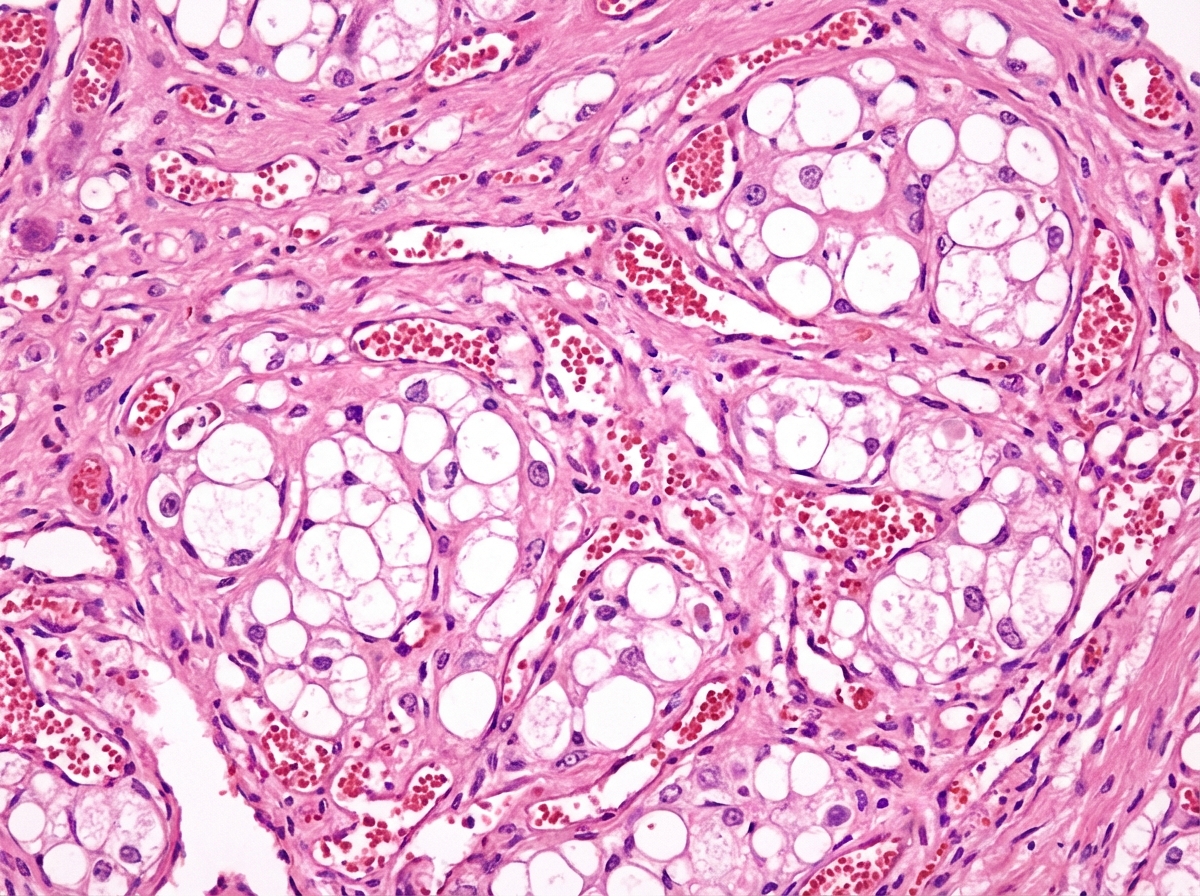
A 22-year-old woman comes to the physician because of hearing loss and unsteadiness while standing and walking for the past 2 months. She needs support from a wall to prevent herself from falling. She has not had any recent injuries and has no history of serious illness. Vital signs are within normal limits. Examination shows an unsteady gait. She sways when asked to stand upright with her feet together. She is unable to hear fingers rubbing next to her ears or repeat words whispered in her ears bilaterally. An MRI of the brain shows a 3-cm tumor in the right cerebellopontine angle and a 4.5-cm tumor in the left cerebellopontine angle. This patient is most likely to develop which of the following in the future?
A 55-year-old female presents to her primary care physician complaining of a mass in her mid-thigh. The mass has grown slowly over the past six months and is not painful. The patient’s past medical history is notable for hypertension and hyperlipidemia. She takes lisinopril and rosuvastatin. On examination, there is a firm, immobile mass on the medial aspect of the distal thigh. She has full range of motion and strength in her lower extremities and patellar reflexes are 2+ bilaterally. A biopsy of the mass reveals multiple pleomorphic smooth muscle cells with nuclear atypia. The patient subsequently initiates radiation therapy with plans to undergo surgical resection. This tumor will most strongly stain for which of the following?
A 34-year-old man comes to the physician because of a 3-week history of left testicular swelling. He has no pain. He underwent a left inguinal hernia repair as a child. He takes no medications. He appears healthy. His vital signs are within normal limits. Examination shows an enlarged, nontender left testicle. When the patient is asked to cough, there is no bulge present in the scrotum. When a light is held behind the scrotum, it does not shine through. There is no inguinal lymphadenopathy. Laboratory studies show: Hemoglobin 14.5 g/dL Leukocyte count 8,800/mm3 Platelet count 345,000/mm3 Serum Glucose 88 mg/dL Creatinine 0.8 mg/dL Total bilirubin 0.7 mg/dL Alkaline phosphatase 35 U/L AST 15 U/L ALT 14 U/L Lactate dehydrogenase 60 U/L β-Human chorionic gonadotropin 80 mIU/mL (N < 5) α-Fetoprotein 6 ng/mL (N < 10) Which of the following is the most likely diagnosis?
A 52-year-old man presents with 2 months of diarrhea, abdominal pain, and fatigue. He reports a weight loss of 4 kg (8 lb). He also says his joints have been hurting recently, as well. Past medical history is unremarkable. Review of systems is significant for problems with concentration and memory. Physical examination is unremarkable. A GI endoscopy is performed with a biopsy of the small bowel. Which of the following histologic finding would most likely be seen in this patient?
A 38-year-old woman comes to the physician for a 3-month history of bloody discharge from the right nipple. Her mother died of breast cancer at the age of 69 years. Mammography 6 months ago did not show any abnormalities. Examination of the breast shows expression of a small amount of serosanguinous fluid from the right nipple; there are no palpable breast masses or axillary lymphadenopathy. Ultrasonography of the right breast shows a single dilated duct. Which of the following is the most likely diagnosis?
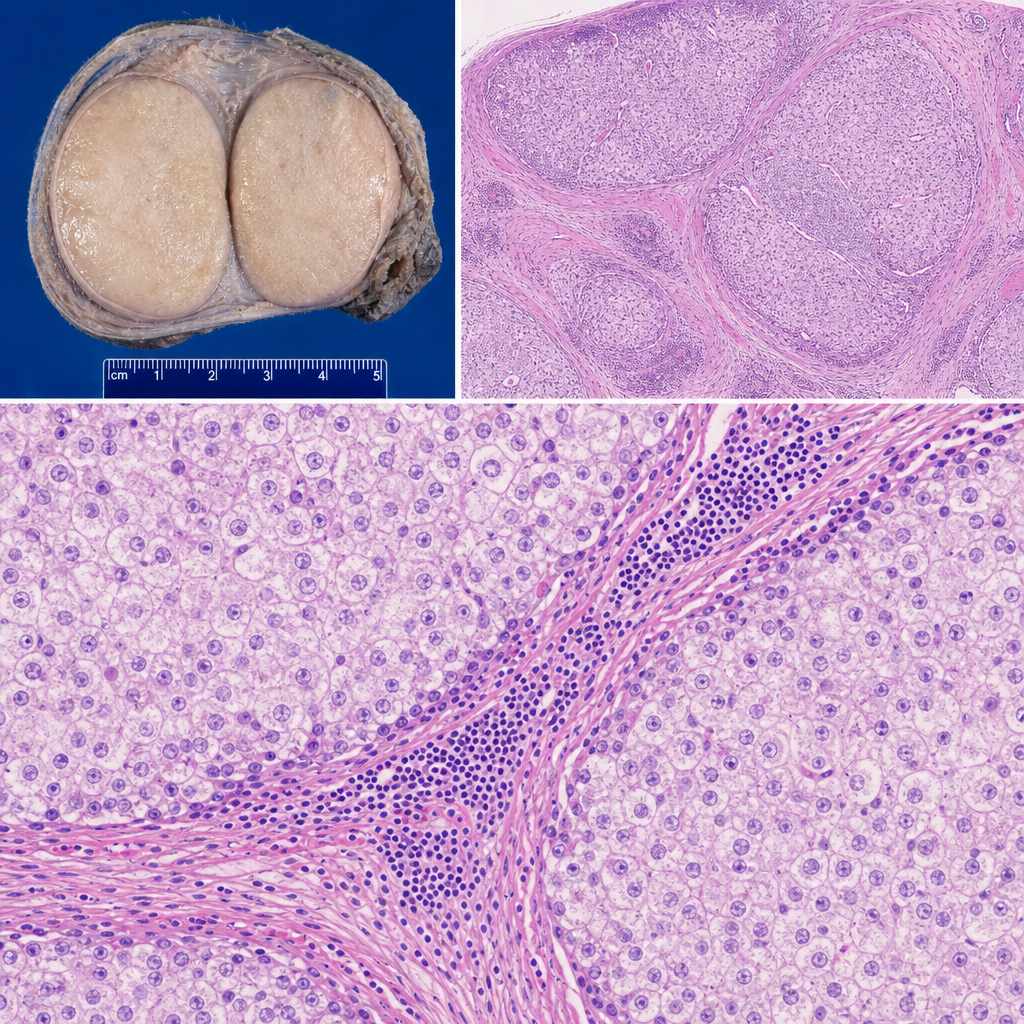
A 28-year-old man presents with a painless right testicular mass. Orchiectomy is performed. Gross examination reveals a 4 cm well-circumscribed, homogeneous, pale tan-gray mass without hemorrhage or necrosis. Histological sections show a monotonous population of large cells with clear, glycogen-rich cytoplasm and central round nuclei with prominent nucleoli, arranged in nests separated by fibrous septa infiltrated by mature lymphocytes. Which of the following best explains why the lymphocytic infiltrate is present within the fibrous septa of this tumor?
Want unlimited practice?
Get full access to all questions, explanations, and performance tracking.
Scan to download app